

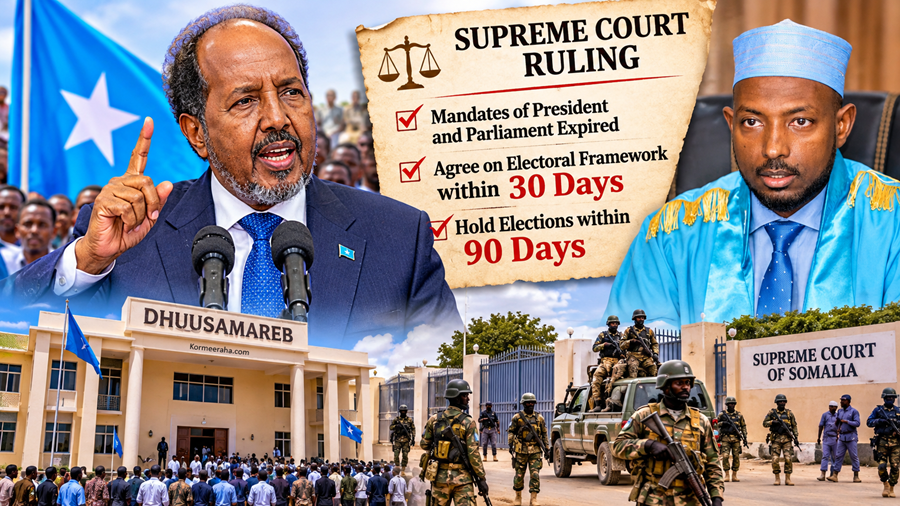
Somalia’s term-extended President, Hassan Sheikh Mohamud, appeared exhausted and defensive. He spoke on November 5, 2026, at the inauguration of Galmudug State leader Liban Ahmed Hassan “Shuluq” in Dhusamareb. This address came just hours after a Supreme Court bombshell. The Constitutional Division ruled that the mandates of the President, parliament, and federal government had officially expired.
Mohamud now grapples with an impending security collapse. His authoritarian tendencies have alienated the international community. Furthermore, his refusal to compromise on federal elections has triggered a looming AUSSOM drawdown. Consequently, President Mohamud holds a highly volatile and weakened position.
The speech unfolded amid escalating national tensions. His administration pushed to unilaterally finalize the federal constitution. They also sought to monopolize the electoral process. These maneuvers aimed to guarantee his re-election.
Key stakeholders and Federal Member States fiercely rejected these moves. The disputed 2026 constitutional amendments were approved in March. Opposition MPs were reportedly physically blocked from the parliamentary session. Their one-year term extension sparked violent clashes across the country. Ultimately, the Supreme Court’s November 5 ruling declared them unlawful.
This crisis sits against a backdrop of severe national emergencies. The security environment is rapidly deteriorating. Armed rebellions are growing in South West State and Hirshabelle. Puntland, Somaliland, and Jubaland openly defy Mogadishu. Meanwhile, a resurgent Al-Shabaab insurgency presses forward. All these forces now oppose a term-extended federal government whose legitimacy is in free fall.
Speech Summary: A Façade of Tolerance
In his address, President Mohamud framed his administration as highly tolerant. He asserted that many opposition politicians would already be in prison. This would have happened if the law were strictly enforced. Instead of carrying out arrests, he claimed the government exercises patience. Officials dispatch mediators daily to reason with opponents.
He strongly condemned what he described as armed uprisings and weapon distribution. Mohamud dismissed opposition cries of marginalization as baseless manipulation. He urged rivals to resolve grievances through the formal judiciary or traditional xeer. He argued seasoned politicians are too intelligent to claim they were deceived.
“By paralleling traditional xeer with the formal court system, Mohamud effectively demoted the national judiciary—a move critics read as a thinly veiled signal from a president already accused of threatening the highest court of the land.”
Notably, a conventional head of state would direct aggrieved politicians to the judiciary alone. Elevating xeer as a parallel track deepens this constitutional irony.
The Supreme Court Reckoning
The speech landed hours after a judicial bombshell. On November 5, 2026, a five-member Constitutional Division issued a unanimous landmark ruling. Justice Salah Sheikh Ibrahim Dhiblawe chaired the panel. The case was filed on October 11 by former President Sharif Sheikh Ahmed. The key rulings were as follows:
- Term Expiration and Caretaker Status: Amendments extending mandates cannot apply to sitting officeholders unless explicitly stated. The 2026 amendments were silent on this matter. Parliament’s and the government’s mandates expired on April 14, 2026. President Mohamud’s own term ended on May 15, 2026. Every action taken after those dates was declared unconstitutional, unlawful, null, and void. The government now survives only as a caretaker administration confined to day-to-day operations.
- Elections Ordered: The panel gave stakeholders 30 days to agree on a workable electoral framework. It directed that elections be held within 90 days. This deadline falls in early February 2027. It collides head-on with the electoral commission’s previously stated timetable. That plan set April 15, 2027, for parliament and May 15, 2027, for the presidency.
- A Split Decision on the Petition: The court dismissed the first part of the petition. Former President Sharif lacked standing under Article 86 to challenge the overall amendment process. However, it ruled decisively in his favor regarding the illegality of the term extensions.
- The Chief Justice’s Dismissal Voided: The court nullified President Mohamud’s social media announcement sacking Chief Justice Bashe Yusuf Ahmed. It also voided the installation of Ibrahim Idle Suleiman, a former presidential legal adviser. The bench stressed that a president cannot unilaterally remove a chief justice. The process requires a Supreme Judicial Council proposal and a two-thirds parliamentary vote under Articles 135 and 138. The court accused the executive of attempting to obstruct the pending constitutional case.
Within hours of the verdict, Somali security forces militarily occupied the Supreme Court complex. Dozens of military vehicles and hundreds of personnel forced the Chief Justice from the building. He and the five ruling judges fled to former President Sharif Sheikh Ahmed’s residence. They acted amid credible fears of government reprisals. The president is now threatening the judges who delivered a final ruling exercising full Constitutional Court powers.
The Legal Reality: Comply or Coup
The legal reality is stark. Unless President Mohamud formally announces a coup, he cannot simply reject a unanimous constitutional ruling. The removal and appointment of a chief justice is spelled out in both constitutions. He followed neither procedure, rendering his decision automatically illegal. By the court’s own declaration, his administration is now a caretaker government. Its mandate has expired, and a 90-day electoral clock is already running.
“Villa Somalia’s options have narrowed to two: implement the ruling, or tear up the constitutional order entirely and rule by force.”
The Critical Backlash
Critics argue that Mohamud’s rhetoric sharply contradicts his political reality. His appeal for opponents to trust the judiciary rings hollow. Stakeholders watched him sack Chief Justice Bashe Yusuf Ahmed on the eve of the ruling. He installed an alleged partisan ally in his place. Then he unleashed a campaign of threats driving the judges from their posts.
Opponents maintain that these judicial overhauls violate both constitutions. Neither grants the president unilateral power to appoint Supreme Court justices. Puntland, Jubaland, and the opposition do not recognize the 2026 charter. They continue to recognize the 2012 text as the only broad-based national agreement.
The case tested whether the Supreme Court was independent of the executive. The court’s unanimous verdict answered that question. The executive’s armed response answered it again.
“By weaponizing the threat of imprisonment while demanding adherence to a legal system he has himself gutted, critics accuse the president of gaslighting the opposition.”
The Wider Collapse
This constitutional crisis lands on a security architecture already in free fall. AUSSOM officially replaced ATMIS in January 2025. Troop levels have dwindled from over 22,000 to roughly 12,000 today. Furthermore, Washington is moving to end UN logistical support for the AU mission. This decision takes effect in 2027, compounding operational challenges.
Into this vacuum step armed rebellions in South West State and Hirshabelle. Defiance from Puntland, Somaliland, and Jubaland continues. An Al-Shabaab insurgency presses a government whose legal mandate expired months ago. Its moral authority is now openly contested in the streets, the states, and the courts.
Related
- Fractured Federation: Somalia’s Political Polarization and the 2027 Electoral Crisis (October 19, 2026)
- Somalia’s Term-Limit Crisis and Collapse of the Halane Talks (May 16, 2026)