
Somalia has ceased to be merely a state in recovery; it has become the premier maritime chessboard of the Horn of Africa. It is an arena where external powers project influence, secure strategic depth, and test the balance of power across the Red Sea and the western Indian Ocean. This competition is now omnidirectional—diplomatic, military, economic, and informational—and it has intensified at the precise historical moment Somalia most desperately required unifying, strategically disciplined leadership.
President Hassan Sheikh Mohamud has not provided it.
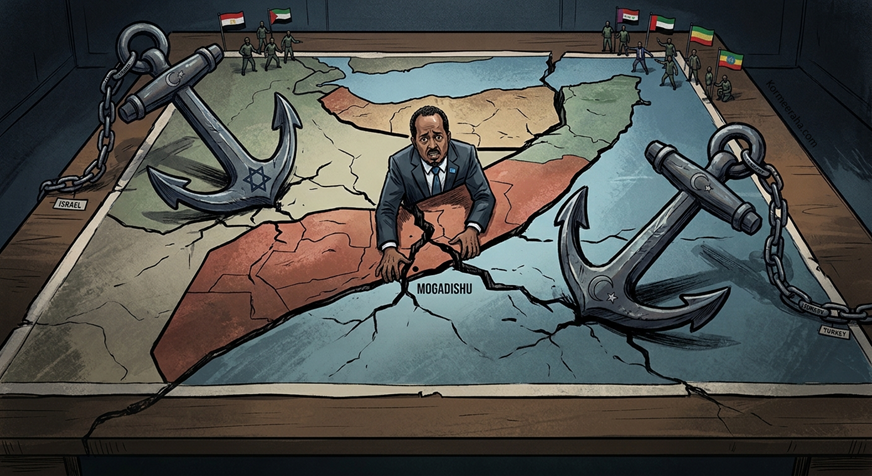
Foreign interest in Somalia is neither new nor inherently alarming. What matters is that under his presidency, Somalia has entered this great game divided. Rather than obliging external actors to engage a coherent Somali state on terms set in Mogadishu, the current leadership has allowed the country to be fractured, turning internal political disputes into invitations for foreign intervention.
“Rather than obliging external actors to engage a coherent Somali state on terms set in Mogadishu, the current leadership has allowed the country to be fractured, turning internal political disputes into invitations for foreign intervention.”
The Architecture of the Coast
The explanation begins with geography, but it is a geography of global consequence. Somalia, encompassing the territory of Somaliland, possesses mainland Africa’s longest coastline. It forms a sweeping arc along the Gulf of Aden, guarding the Bab el-Mandeb Strait and the approaches to the Red Sea, before turning south along the Indian Ocean. Together, these waters constitute one of the world’s most vital maritime arteries, linking the Suez Canal, the Arabian Peninsula, East Africa, and the sea lanes to Asia. Influence over these shores dictates the flow of global trade, energy transit, and naval mobility.
Since the escalation of Ansarallah (also called the Houthis) attacks on Red Sea shipping in late 2023, this maritime space has become heavily securitized. Ports such as Berbera and Bosaso on the Gulf of Aden, and Mogadishu and Kismayo on the Indian Ocean, are no longer viewed merely as commercial infrastructure. Port access, basing rights, and intelligence cooperation have been weaponized into instruments of statecraft.
Ankara’s Anchor, Jerusalem’s Vantage
Over the past fifteen years, Turkey has cultivated Somalia’s most substantial external partnership. From its pivotal 2011 humanitarian intervention to the sweeping defence and hydrocarbon agreements of 2024, Ankara has positioned itself as Mogadishu’s indispensable patron. For Turkey, a unified Somalia offers a military foothold, prospective energy wealth, and a central role in the Horn. For Mogadishu, Turkey provides unmatched training, equipment, and political backing.
Yet, a foreign partnership is only as durable as the state it supports. Because the federal government is fractured—locked in disputes with Puntland and Jubaland, and facing a contested domestic mandate—Turkey is not underwriting a stable Somalia. It is underwriting one side of a divided polity, a vulnerability its rivals have been quick to exploit.
Israel’s formal recognition of the Hargeisa administration in December 2025 shattered this equilibrium. Drawing fierce condemnation across the Arab and African worlds, the move granted the region what three decades of diplomacy could not: a powerful patron. For Jerusalem, the coast offers a vital vantage point opposite Yemen to monitor Houthi activity and project strategic depth, especially as Ankara-Jerusalem relations sour.
The Hargeisa administration has articulated this transactional logic with striking candour. Seeking Israeli air-defence capabilities to counter what it describes as a Turkish military build-up in Mogadishu—including F-16s and prospective drone deployments—it is no longer just seeking independence. It is defining its security architecture in direct opposition to Ankara’s federal project.
“Turkey’s Mogadishu and Israel’s Hargeisa are not merely parallel partnerships; each now supplies the justification for the other’s expansion.”
The result is a structure of geopolitical counterweights. Turkey’s Mogadishu and Israel’s Hargeisa are not merely parallel partnerships; each now supplies the justification for the other’s expansion.
The Periphery’s Calculus
It would be a mistake to reduce this contest to a binary rivalry, just as it would be naive to absolve the Federal Member States of their role in this fragmentation. Leaders in Garowe and Kismayo have long leveraged foreign patronage—particularly from the United Arab Emirates—to extract concessions from the center and weaken Mogadishu. Yet, while opportunism at the periphery is a persistent feature of Somali politics, the constitutional and moral burden of forging consensus rests squarely on the Federal Presidency. By responding to their intransigence with his own unilateralism, the President elevated a political dispute into a structural crisis.
Beyond the Federal Member States, a wider regional web is now entangled in Somali affairs. Egypt brings its own Red Sea and Nile anxieties, positioning itself as a staunch defender of Somalia’s territorial integrity. The UAE holds significant port and commercial interests along the coast, maintaining a complex, transactional relationship with both Mogadishu and Hargeisa. Ethiopia, landlocked and desperate for reliable sea access, watches every port agreement with acute sensitivity.
These actors pursue divergent objectives, but their cumulative effect is identical: they have externalized the Somali political contract. Decisions that ought to be negotiated among Somali stakeholders are increasingly dictated by calculations made in Ankara, Jerusalem, Cairo, Abu Dhabi, and Addis Ababa. This is the reality of comprehensive statecraft. It extends to port concessions, exploration rights, diplomatic recognition, and the implicit assurance to one Somali faction that a foreign patron will protect it against another.
The Mogadishu Miscalculation
It is here that the president’s strategic miscalculation becomes fatal. His failure rests on four dimensions.
First, centralization over consolidation. Rather than securing a national agreement on elections, constitutional reform, and the federal bargain, he advanced a unilateral timetable—parliamentary elections on April 15, 2027, a presidential vote on May 15, 2027. The opposition rejected it; Puntland and Jubaland refused it. A timetable without consensus is not a roadmap; it is a unilateral dictate—and an invitation for his opponents to seek leverage abroad.
“A timetable without consensus is not a roadmap; it is a unilateral dictate.”
Second, consultation dressed as negotiation. The invitation to a November 14–18 forum was issued on the government’s terms, after its principal decisions had been taken, and accompanied by the warning that “the power to decide cannot be left in the middle.” That is the language of consultation, not negotiation. The opposition’s demand for binding talks was not mere rhetoric; it identified the substantive difference between being heard and being able to shape the outcome.
Third, a foreign patron in place of a national coalition. Turkey is a formidable partner, but no external power can substitute for Puntland, Jubaland, or the opposition. By leaning on Ankara as domestic relations collapsed, the presidency allowed its critics to frame Somali sovereignty as a Turkish project—and handed Hargeisa its pretext for Israel.
Fourth, security subordinated to political rivalry. Al-Shabab remains the existential threat, and it profits directly from fragmentation. Every month consumed by mandate disputes is a month the campaign against it is divided and under-resourced. Foreign training cannot compensate for a political class at war with itself.
None of this suggests Somalia should forgo foreign partnerships. It means that partnerships must serve a Somali strategy, not stand in for one. The current presidency has inverted that order.
The Sovereignty Deficit
The immediate danger is not a conventional proxy war between Turkey and Israel on Somali soil. The more insidious danger is the gradual, quiet hollowing out of the state.
In this scenario, Mogadishu is anchored to one bloc and Hargeisa to another, while other regional actors seek patrons of their own. Ports are leased, bases are promised, recognition is traded, and each faction grows more dependent on its external backer than on a shared Somali settlement. The Red Sea and Indian Ocean sea lanes may become safer for international shipping, even as Somalia itself becomes politically more perilous for Somalis. The vacuum of a national settlement has been filled by the ledgers of foreign capitals.
“The vacuum of a national settlement has been filled by the ledgers of foreign capitals.”
Al-Shabab stands to gain from precisely this environment: a contested election, a divided political class, and a security establishment pulled between competing loyalties.
Reclaiming the Narrative
A credible alternative must begin at home. It requires four uncompromising commitments:
- A Binding Electoral Pact: The unilateral timetable must be suspended in favour of an agreement brokered not just by politicians, but with the binding arbitration of traditional elders and the Guurti, ensuring the terms cannot be torn up by the next political crisis.
- An Unmediated Dialogue with Hargeisa: However difficult, political dialogue must be pursued directly between Mogadishu and the Hargeisa administration before external powers define the terms of the relationship for both sides.
- Partnerships Without Patronage: Turkey, Egypt, the Gulf states, the US, and others must be engaged as partners in a Somali plan, not as substitutes for one. Somalia must become the client of none.
- Depoliticized Security: The fight against Al-Shabab must be insulated from Mogadishu’s political disputes, ensuring that national security does not rise and fall with the president’s political fortunes.
Hassan Sheikh Mohamud has not pursued this course. He has proceeded as though time, foreign support, and a published calendar would eventually compel his opponents to accept his terms. They have not. Instead, they have sought other audiences, other partners, and other options—and the competition across the Red Sea and the Indian Ocean is now filling the void.
Somalia need not choose between Turkey and Israel, between Mogadishu and Hargeisa, or between one foreign patron and another. It must first choose itself: a unified political settlement, negotiated among Somalis, that compels external powers to compete for Somalia’s partnership rather than for fragments of Somalia.
Until the presidency grasps that distinction, the intensifying competition across our waters will not merely be a story about foreign powers. It will be the enduring tragedy of a leadership that, at a decisive historical juncture, failed to speak for Somalia with one voice.
Related
- The Arithmetic of Decay: Why Somalia’s Discontent is a Judgment, Not a Mood (November 5, 2026)
- Somalia Needs Partners, Not Protectors: Why HSM Must Tread Carefully with the UAE (October 14, 2026)
- The New Red Sea Frontline: How the War on Iran is Redrawing Somalia’s Geopolitical Map (July 23, 2026)
- Who Owns Somalia’s Security? (July 7, 2026)
- The Diplomacy of Desperation: Somaliland’s Israel Deal (June 16, 2026)
- Turkey’s Somali Oil Gamble: Partnership or Paternalism? (April 28, 2026)