
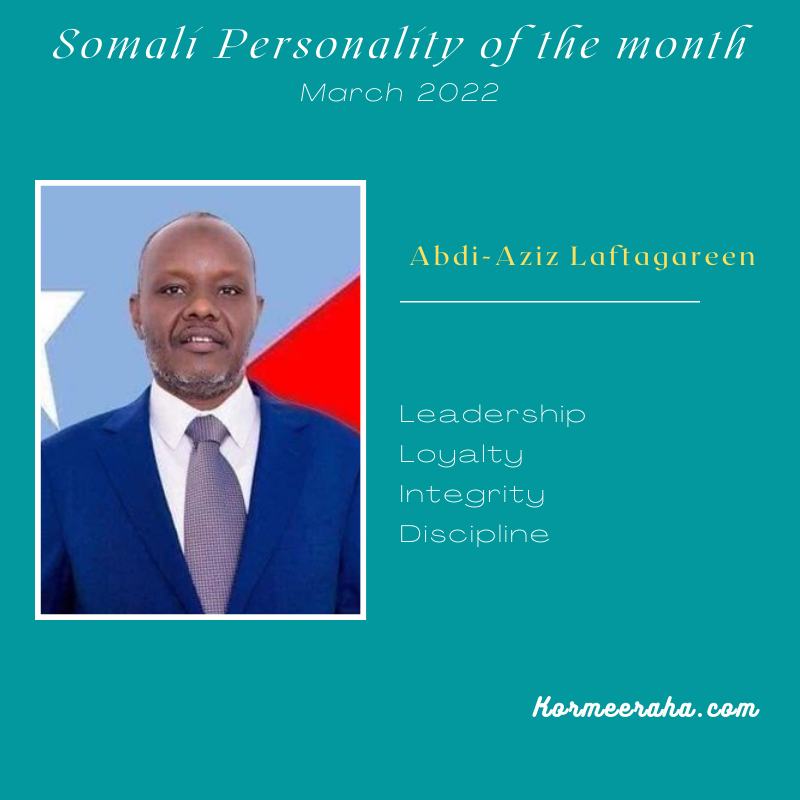
Kormeeraha Team named Abdi-Aziz Hassan Mohamed Laftagareen, Southwest State president, as March’s most outstanding Somali leader.
A Historic Electoral Milestone
Last month, Laftagareen finished Somalia’s elections on time. He was the first regional president to do so. He requested no special accommodation or delays.
Southwest’s parliamentary election proceeded without violence or quarrels. It followed electoral agreements. The region has 77 constituencies, the highest number.
Peace Amidst Regional Chaos
By contrast, Galmudug, Puntland and Hirshabelle saw bloodbaths. Jubaland and Hirshabelle still struggle to finalize elections after many missed deadlines. Puntland and Jubaland violated nearly all electoral agreements.
Laftagareen has proven himself a skilled administrator, seasoned speaker, and mediator. He brought order to his region.
The Marginalized Community Behind the Leader
Laftagareen comes from a previously marginalized community. He demonstrated that his community is more than just an arbiter in federal politics. In Mogadishu’s polarized politics, two clans perpetually pass the buck, to the Somali people’s chagrin.
This last decade has shown that turbulent Somalia needs the pacifism, nationalist fervor, and discipline of this southern community.
A History of Subjugation and Resistance
Dispossessed of their fertile land, they bowed down and suffered long humiliation. Very active in anti-colonial struggle, the diverse but cohesive Southwest populations lost power after independence.
This community inhabits six southern regions. Their dialect, agrarian culture, and inclusive nature distinguish them from other Somalis. During the colonial era, they refused Italian colonizers’ offer of an independent nation. Instead, they preferred a federation, which only materialized after the civil war.
In 1995, after the Hussein Farah Aydid militia devastated them, they rose up. For the first time, they used the same lethal means as their northern oppressors to defend property, lives, and dignity. They sincerely called their struggle “resistance.”
Forging a Path Through Compromise
In post-civil war Somalia, Laftagareen and his community are better equipped. Yet only through patient negotiations and many compromises have the Southwest people imposed their presence on federal politics.
Thus, they gave up three of their six regions, which now form Jubaland. Laftagareen himself is a Gedo native. In return, the duo alternating in federal high authorities granted them the lower house’s speakership.
Pragmatism, Not Subservience
Some believe Laftagareen is in President Farmajo’s pocket. They find it hard to grasp his assurance and pragmatism. Laftagareen supports Farmajo mainly because they share ideals of a free and strong Somalia.
Over the past two years, foreign diplomats in Mogadishu—the UN special representative and European envoys—tried to lure him with money and power to break with Farmajo. He brushed off their treacherous proposals.
Imbued with resistance and rare patriotism, Laftagareen stayed the course.
Facing Revenge and Political Crises
Yet again, Laftagareen’s leadership, unmistakable patriotism, and role as protector of the rules took aback those who discriminated against and blocked the Southwest community.
Last October, anti-Somali forces—Somaliland—frustrated by his unwavering support for Farmajo, took revenge on his community. They rounded up and expelled thousands of Las Anod and Erigabo residents originally from Southwest state.
In September, after Mohamed Hussein Roble’s coup attempt, Southwest’s president persisted in reconciling the rebellious prime minister and president. All other players had given up.
Presidential Aspirations and National Hope
His patience and tact kept Somalia together while Said Deni and Ahmad Madobe did everything to obstruct federal elections.
Somalia has avoided violence until now thanks to him. If it wants a functioning parliament in the future, it will also be thanks to him.
But Laftagareen wants more than a regional presidency or mediator role. He aspires—and deserves—to break the glass ceiling and become Somalia’s President.
If he runs, we will have a candidate from a disciplined, hard-working community armed only with patriotism. If elected, the country will leave behind the chaos, polarization, and violence that have long characterized Somalia.