
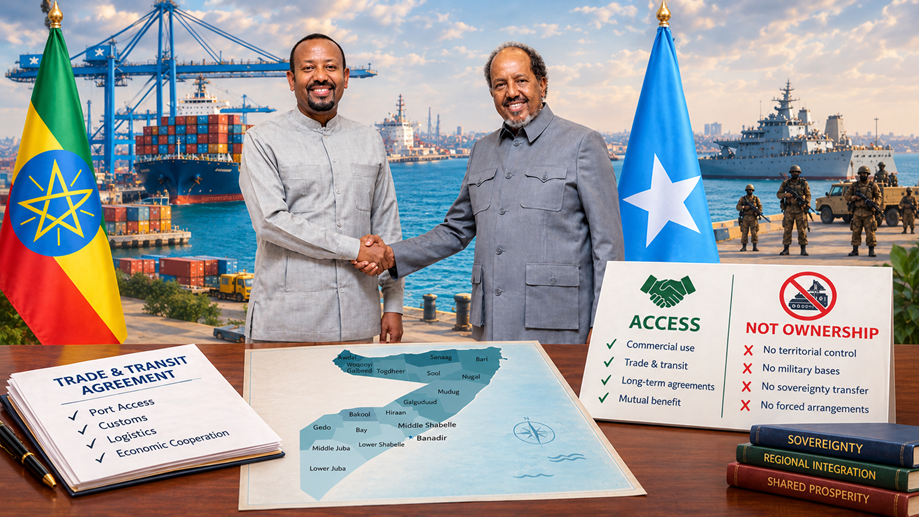
In a significant clarification of regional tensions, Somali President Hassan Sheikh Mohamud has articulated a nuanced position regarding Ethiopia’s long-standing desire for maritime access. Speaking to Al Jazeera Arabic, the President made a critical distinction that cuts through the diplomatic noise, stating unequivocally that Somalia does not oppose Ethiopia gaining commercial sea access through Somali territory. However, this openness comes with a firm caveat, as the President and Somali officials have emphasized that there is a world of difference between using a port and owning one. The current debate is not about trade; it is about sovereignty, and Mogadishu is drawing a clear line between economic cooperation and territorial control.
“Using a port is not the same as owning a port, and commercial access is not the same as military sovereignty.”
The Reality of Commercial Cooperation
Frankly, Somalia has never objected to Ethiopia, as a landlocked neighboring country, using Somali ports to import and export goods. Somalia understands the economic realities of the region and recognizes that preventing Ethiopia from accessing international trade routes would be counterproductive for both nations. What Somalia rejects is something fundamentally different: the idea that Ethiopia should obtain sovereign territory, establish its own port facilities, and station military forces on Somali soil. As the prevailing sentiment in Mogadishu suggests, there is a very simple distinction that should not require a diplomatic PhD to understand.
Mutual Benefits Without Surrendering Sovereignty
Ethiopia needs reliable maritime access, and Somalia is positioned to be a natural and mutually beneficial partner in providing it. Ethiopian businesses can import and export through Somali ports under negotiated commercial agreements, mirroring how landlocked countries around the world obtain access to neighboring states’ ports. Such arrangements offer tangible benefits for both countries by increasing trade, generating revenue for Somali port authorities, encouraging investment in infrastructure, and strengthening economic integration within the Horn of Africa. However, as Somali leadership insists, this commercial cooperation does not require Somalia to surrender its sovereignty, and economic partnership must remain distinct from political or territorial concession.
Negotiation Over Territorial Claims
If Ethiopia wants guaranteed access to a Somali port, the reasonable solution is negotiation rather than coercion or maximalist territorial claims. Somalia is open to discussing long-term leases, commercial concessions, transit agreements, customs arrangements, and dedicated cargo facilities, all of which are normal diplomatic and economic mechanisms between sovereign states. What Somalia cannot reasonably be expected to accept is a proposal that effectively transforms commercial access into territorial control, particularly if it includes a military presence. A foreign military base or armed forces stationed on Somali territory raises entirely different questions concerning national sovereignty, defense policy, territorial integrity, and regional stability, and Somalia maintains it has every right to determine who operates military facilities on its land and under what conditions.
“A commercial port agreement does not come with a free military base.”
The Principle of Access vs. Ownership
The principle emerging from Mogadishu is straightforward: Ethiopia can seek access to Somali ports, but access does not automatically create ownership, trade does not create sovereignty, and a commercial agreement does not constitute a military alliance or territorial transfer. Somalia’s position is one of pragmatic openness combined with firm boundaries, remaining ready for practical maritime cooperation while maintaining non-negotiable red lines regarding sovereignty. If Ethiopia genuinely wants to solve its maritime-access problem, there is no need for complicated formulas; it simply needs to sit down with Somalia, negotiate in good faith, agree on commercially viable terms, and build a relationship based on mutual benefit and respect for territorial integrity.
Final Warning: The Door Is Open, But the House Is Not for Sale
Ultimately, Ethiopia is not being asked to stop trading; it is simply being asked to distinguish between using someone else’s door and claiming ownership of the house. Apparently, even in twenty-first-century diplomacy, someone still needs to explain that access does not mean ownership. Somalia’s message to Addis Ababa and the wider international community is clear: the door to trade is open, but the keys to sovereignty remain firmly in Somali hands.
“Ethiopia is not being asked to stop trading. It is simply being asked to distinguish between using someone else’s door and claiming ownership of the house.”