

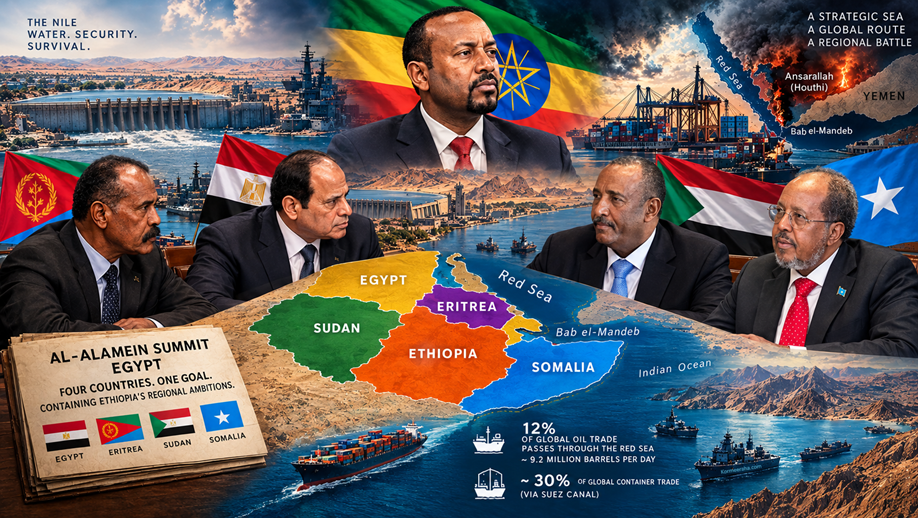
On October 4, 2026, the leaders of Egypt, Sudan, Eritrea, and Somalia convened in Al-Alamein, Egypt, for a quadrilateral summit officially hosted and funded by President Abdel Fattah El-Sisi. The gathering was explicitly designed to coordinate on regional security, Red Sea navigation, and Nile water rights. Crucially, Ethiopia was deliberately excluded from the assembly. Rather than a general regional forum, the summit was a targeted diplomatic mechanism engineered to forge a united front against Addis Ababa’s recent geopolitical maneuvers, as all four participating nations find themselves locked in severe disputes with Ethiopia.
The Catalyst of Expansionism
The fundamental glue binding this quartet is a shared perception of Prime Minister Abiy Ahmed’s Ethiopia as a common threat to their sovereignty, security, and livelihoods. The catalyst for this regional alignment was Abiy’s aggressive push for Red Sea access. In January 2023, Ethiopia signed an ill-fated Memorandum of Understanding (MoU) with the breakaway region of Somaliland, offering formal recognition and shares in Ethiopian Airlines in exchange for naval access. While the African Union blocked the move by strictly enforcing the inviolability of colonial-inherited borders, the thousands of Ethiopian troops remaining in Somalia keep Mogadishu on edge.
Simultaneously, Abiy’s maritime ambitions triggered deep alarm in Eritrea. Having occupied Eritrea for close to 40 years and exclusively utilized its ports of Massawa and Assab, Ethiopia’s historical footprint remains a raw nerve. With Assab lying just 60 kilometers from the border, Eritrea has mobilized military personnel and issued stark warnings against Abiy’s expansionism. This deterioration culminated recently in the closure of Ethiopia’s embassy in Asmara and mutual diplomatic expulsions.
“The fundamental glue binding this quartet is a shared perception of Prime Minister Abiy Ahmed’s Ethiopia as a common threat to their sovereignty, security, and livelihoods.”
The Global Geopolitics of the Red Sea
This regional friction is supercharged by broader global geopolitical shifts. The ongoing “Iran War” and the Ansarallah-led (Houthi) offensive along the Yemeni coast have turned the Red Sea into a critical global chokepoint. With the Strait of Hormuz closed and the Bab el-Mandeb threatened by the recent blitzkrieg-style Ansarallah takeover, the maritime route—carrying 12% of global oil trade and roughly 30% of global container shipping—is under severe threat. Littoral states are now forced to take security into their own hands to protect the waters crucial to their livelihoods.
This strategic necessity prompted the United States to lift sanctions on Eritrea, hoping Asmara will help keep the Red Sea open for business and eventually align with the anti-Iran campaign. Ironically, the role of “regional gendarme” was once expected of Ethiopia. Addis Ababa has been actively trying to resurrect its navy with Western, notably French, assistance. However, the Al-Alamein Summit makes it clear that coastal states will not allow a landlocked, aggressive neighbor to dictate terms in their maritime backyard.
“The Al-Alamein Summit makes it clear that coastal states will not allow a landlocked, aggressive neighbor to dictate terms in their maritime backyard.”
Egypt’s Existential Fight and Horn of Africa Maneuvering
At the heart of Egypt’s strategy is an existential fight over the Nile. Ethiopia’s unilateral filling and operation of the Grand Ethiopian Renaissance Dam (GERD) poses a severe risk to downstream nations, particularly Egypt, which relies on the river for the vast majority of its freshwater. Abiy’s refusal to abide by international water conventions or accept binding mediation has pushed Cairo to take drastic countermeasures.
Egypt’s Horn of Africa strategy is now explicitly designed to halt the GERD’s full operationalization by applying peripheral pressure. To this end, Cairo has maintained a robust physical presence in Somalia via the AUSSOM forces, placing boots close to Ethiopian borders. Furthermore, Egyptian intelligence actively backed President Hassan Sheikh Mohamud in the last Somali elections, successfully ousting the previous president, Mohamed Abdullahi Farmajo, who had denied Egypt military equipment and security assistance out of fear of antagonizing his cordial ally, Abiy.
Sudan’s Shift and the Proxy War Complex
Sudan’s inclusion in the summit marks a dramatic geopolitical shift. Historically somewhat receptive to the GERD, Khartoum’s calculus changed entirely following the outbreak of a devastating civil war between General Abdel Fattah al-Burhan (head of the Sudanese Armed Forces) and the UAE-backed Hamdan Dagalo “Hemedti” (leader of the Rapid Support Forces, or RSF). Sudan now views Ethiopia as an active sponsor of its internal fragmentation.
Addis Ababa has allegedly become a key node in a complex supply network funneling arms to the RSF—a logistical web involving transit through Somalia, Libya, Yemen, and Chad, with backing from the UAE and indirect US complicity. Furthermore, Ethiopian troops have crossed the border, engaging in direct clashes with Sudanese forces over the disputed Al-Fashaga region. This external aggression is mirrored internally, as Ethiopia’s military openly accuses Egypt, Sudan, and Eritrea of arming a Tigrayan-led rebellion to destabilize the country—allegations the trio denies, framing the conflict as a consequence of Addis Ababa’s own hostile policies.
“History shows that almost every modern Ethiopian leader has embarked on a war of expansion abroad, coupled with a brutal war against their own people at home. Abiy Ahmed appears determined to perpetuate this tragic cycle.”
Diplomatic Fallout and the Tragedy of Abiy Ahmed
Because the fundamental objective of the Al-Alamein gathering was to draw geopolitical “red lines” around Ethiopia’s ambitions, inviting Addis Ababa would have entirely defeated the purpose of consolidating this new four-way alignment. Unsurprisingly, Ethiopia’s Ministry of Foreign Affairs sharply criticized the event as an attempt at “encirclement,” arguing that exclusionary frameworks cannot solve the region’s realities. Yet, following the summit, a defiant Abiy doubled down on his asserted “rights” to the Nile and his Red Sea ambitions, cementing his status as the neighborhood bully.
The trajectory of Abiy Ahmed stands as a profound geopolitical tragedy. Once a Nobel Peace Prize laureate heralded as a beacon of hope for his border peace initiatives, the change he is forcing upon the region risks perpetuating a dark historical cycle. History shows that almost every modern Ethiopian leader has embarked on a war of expansion abroad, coupled with a brutal war against their own people at home. By alienating his neighbors and threatening the vital interests of Egypt, Sudan, Eritrea, and Somalia, Abiy Ahmed appears determined to ensure that Ethiopia remains trapped in this tragic, cyclical legacy.