
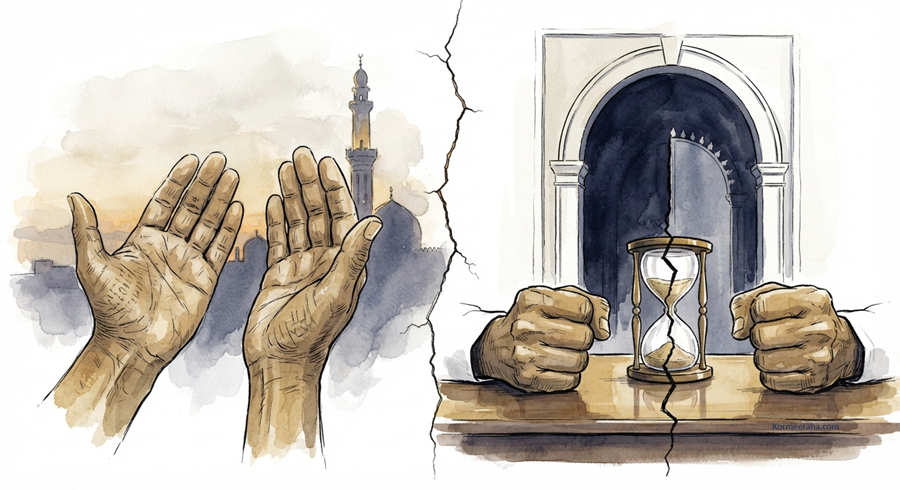
Somalia is a praying nation. In the mosques of Mogadishu and Beledweyne, in the homes of Baidoa and Garowe, and across the diaspora from Calgary to Nairobi, Somalis raise their hands and ask God for the same two things: a country that belongs to all Somalis again, and leaders who serve it instead of holding it hostage.
Today that prayer has a name. It is a prayer against a presidency without a mandate.
The Law Has Spoken
On November 5, the Supreme Court spoke plainly. The mandates of Parliament ended on April 14, 2026, and the President’s ended on May 15, 2026. Decisions taken after those dates have no legal force. Political leaders must agree on an electoral framework within thirty days and hold elections within ninety. That was the law, and it was the nation’s prayer answered on paper.
“That was the law, and it was the nation’s prayer answered on paper.”
What has the President done with it? The night before the ruling, he dismissed the Chief Justice who was about to deliver it. The Court declared that dismissal null and void. United Nations experts condemned it as interference with the judiciary and called for the Chief Justice to be reinstated. The government’s answer was to swear in a replacement and have its Attorney General reject the ruling outright.
He then invited the opposition to talks at Villa Somalia and refused the one thing that could make those talks real: a guarantor. “Our request for a guarantor from the international community for whatever is agreed was rejected,” said Mohamed Mahmoud Dirie, spokesman for the Somali Future Council. The forum planned for November 14 to 18 never opened, and no new date has been set. The December 5 deadline is approaching, and nothing has been built to meet it.
A State Run Like a Family Business
The crisis over the mandate did not begin in May. It grew out of a way of governing that treats the state as a family estate.
Start with the record. In Transparency International’s 2025 Corruption Perceptions Index, Somalia scored 9 out of 100, tied with South Sudan for last place in the world. Somalia’s own Auditor General found that 59 percent of audited federal agencies broke procurement rules, producing more than $18.5 million in irregular spending. Meanwhile the government owes nearly $53 million in unpaid salaries to civil servants, soldiers and members of Parliament. A government that cannot pay the soldiers facing Al-Shabaab has no excuse for money that leaks away through unlawful contracts.
The Architecture of Nepotism
Then look at who stands closest to power. In 2023 the President named his daughter, Jihan, as his senior adviser on foreign affairs. His son-in-law, Adam Roble, was made Director General of the Somali Development and Reconstruction Bank. Published reports say one of his sons commands the presidential guard and that other relatives hold posts in diplomacy and protocol. When Somalia’s ambassador to Saudi Arabia resigned in 2023, he blamed interference by the President’s inner circle, led by a cousin. And when citizens objected, the President replied: “My daughter, son, brother, and nephew did not lose their rights as citizens when I became President.”
No one says they did. The question is why so many of the most sensitive posts in the Somali state, in foreign policy, finance and the President’s own security, keep landing in one household. A nation of millions of qualified sons and daughters is being told, in effect, that the surest path to public office runs through the President’s family.
The Land Question
Then there is the land. Three former presidents, Sharif Sheikh Ahmed, Abdikasim Salad Hassan and Mohamed Abdullahi Farmaajo, declared publicly that the government’s sales of public land in Mogadishu broke the rules. The land had not been declared surplus, the sales did not go through the National Contracts Agency, and the proceeds did not reach the state treasury. Ninety-seven members of Parliament accused federal leaders of auctioning public land for personal gain, including the grounds of the Somali National University, where generations of Somalis studied. Families who had lived on that land for decades were evicted.
The government says it is only recovering and modernizing state assets. If that is true, the remedy is simple: publish the contracts, the buyers, the prices and the bank deposits. Until it does, Somalis have every right to ask who is growing rich while the most vulnerable are pushed onto the street.
Even independent analysts who doubt some specific claims agree that both of Hassan Sheikh Mohamud’s administrations have carried a reputation for nepotism and graft. This is not a new story. It is the same story, told for a second time.
“The surest path to public office runs through the President’s family.”
So let the prayers be matched with predictions. These are not wishes. They are a plain reading of what is already happening.
Prediction One: Division Cannot Unite
A president who rules without a mandate cannot unite a country he has divided, and a presidency run for one family cannot speak for every family. He has governed by divide and rule, setting clan against clan and region against region, and the results are in front of us. In Beledweyne, Macawisley fighters, who once held the front line against Al-Shabaab, moved onto the airport runway to stop a plane carrying federal troops. Djiboutian peacekeepers, guests who came to protect us, were killed in the clash, and the plane turned back. This is what happens when a government has no legitimacy to negotiate and no trust left to calm a crisis: its own reinforcements cannot land at its own airports.
Prediction Two: The Vacuum Feeds Al-Shabaab
While Villa Somalia fights the opposition, the courts and Hiiraan, Al-Shabaab is reported to have taken Coomaad, near Matabaan, and is tightening its grip on the countryside. Men who once held trenches against the militants have left them because of a political quarrel. Soldiers who go unpaid while public land is sold do not fight with conviction. A president who spends his energy holding on to his chair cannot defend his country. Every month he stays past his mandate is a month the enemy advances.
Prediction Three: The Talks Will Not Save Him
He calls it dialogue. But the opposition has said it will not attend a meeting at Villa Somalia without international mediation, and his refusal to accept a guarantor has confirmed their fear that no agreement would be honored. An offer of international facilitation alone, with the presidency still setting the venue, the agenda and the outcome, is not mediation. A consultation staged to approve a 2027 timetable that has already been announced is not a negotiation. It is theatre, and everyone knows it.
Prediction Four: The Door Is Still Open
The fourth prediction is the one the prayers point to. If he respects the ruling, limits himself to caretaker duties, opens the books on public land and public contracts, and lets Somalis agree on a framework and hold elections within the time the Court set, the country can still be pulled back from the edge.
But stepping aside alone will not be enough.
The Case for Accountability
Since 1991, Somalia has made a habit of letting its leaders walk away. Presidents leave Villa Somalia, the files close behind them, and the next administration inherits both the empty treasury and the lesson that nothing will happen. That is how one administration’s abuses become the next one’s blueprint. If Hassan Sheikh Mohamud leaves office without answering for what was done under his authority, Somalia will not have ended a bad presidency. It will have trained the next one.
“Somalia will not have ended a bad presidency. It will have trained the next one.”
The case for prosecution does not rest on anger. It rests on the law and on the record.
The Constitution itself names the offence. Article 92 allows the removal of a president accused of “gross violation of the Constitution or the laws” of the Republic. Holding power after the Supreme Court declared his mandate expired, dismissing the Chief Justice in a way the Court ruled unconstitutional, and rejecting the Court’s ruling outright are not mere political mistakes. They are exactly the kind of conduct that clause was written for.
The Record Demands Investigation
The record on public money demands investigation. Unlawful procurement documented by the Auditor General, public land sold outside legal procedure with proceeds that never reached the treasury, and family members placed in charge of the nation’s foreign policy, finance and security are matters for investigators and courts, not only for columnists. Every contract, land sale and appointment should be examined, and anyone who broke the law, whatever their name, should be charged.
He also dismantled the very body built to do this work. Somalia’s Independent Anti-Corruption Commission, created by law in 2019, was disbanded by presidential decree in 2022, the first year of his second term, and it has never been reconstituted. A leader who removes the watchdog cannot complain when the nation demands an investigation.
Immunity Is Not a Pardon
Immunity is not a pardon. Whatever protection a president enjoys while in office ends when his lawful term ends, and his ended in May. Nor should the seat for life that the Constitution grants former presidents in Parliament ever become a shield against prosecution.
Africa has already shown that this is possible. In Mauritania, former President Mohamed Ould Abdel Aziz was convicted of illicit enrichment and money laundering, his illegally acquired assets were confiscated, and the country’s Supreme Court upheld a fifteen-year sentence. A former head of state was held to account, and the nation was stronger for it.
The path for Somalia is clear:
- Restore the Independent Anti-Corruption Commission with real independence and its own prosecutors.
- Appoint an independent prosecutor, approved by a newly elected Parliament, to investigate the land sales, procurement and appointments of this administration.
- Freeze and trace public assets and land-sale proceeds, with international partners helping to recover any money moved abroad.
- Give the accused a fair trial before an independent court, with every right the law allows.
That last point matters. Justice is not revenge. A trial staged to settle scores would only repeat the abuse it claims to punish. What Somalia needs is the opposite of what it has suffered: evidence in place of rumour, courts in place of decrees, and a verdict that every Somali, whatever their clan, can accept as fair.
The Choice
The prayer, then, is for justice, not revenge. It is for a legitimate government, chosen by Somalis, that can face Al-Shabaab, settle Hiiraan and speak for the whole nation rather than for one camp or one household. It is for a Somalia where the ballot replaces the bullet, where public office is earned on merit, where the nation’s land belongs to the nation, where no leader is above the law, where federal and regional leaders work as partners instead of rivals, where our young people build the country instead of fleeing it, and where the world sees in us not a crisis but a nation that has finally kept faith with itself.
Prayers are not passive, and predictions are not fate. They are warnings. Somalia has prayed, and Somalia has predicted. What happens next is partly his choice: he can leave with the law, or be made to answer to it. But the clock he is running down, like the land he is selling and the offices he is handing out, belongs to the nation, not to him. When his time is up, the account must be settled, so that no Somali president ever again believes the country is his to keep.
May God protect Somalia, unite her people, grant justice to the wronged and give her leaders the humility to hear them. Ameen.
Related
- The Dual Collapse: When Constitutional Crisis Meets Security Freefall in Somalia (November 10, 2026)
- Why Hassan Sheikh’s November Dialogue is Too Little, Too Late (October 31, 2026)
- The Politics of Dispossession: Hassan Sheikh’s Predatory Legacy (September 6, 2026)