

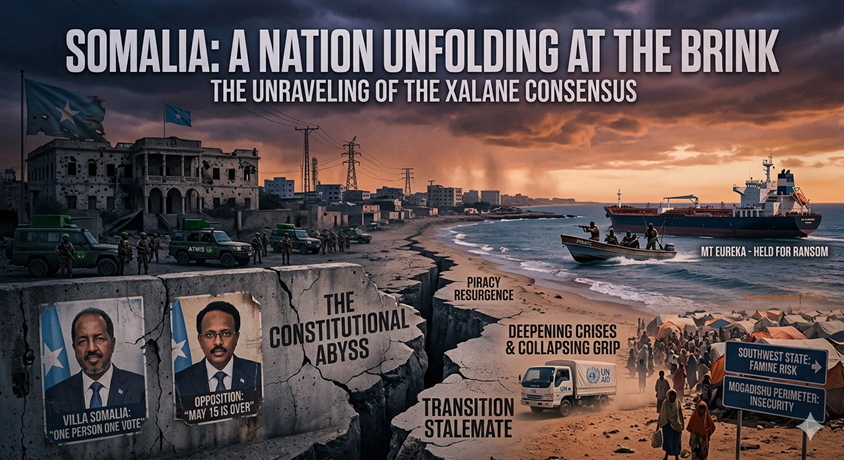
For the third time in a decade, Somalia stands at a perilous political crossroads. On May 15, 2026, President Hassan Sheikh Mohamud’s four-year mandate officially expired—with no framework in place for federal elections. Instead of a transition, the country has fractured into rival camps, each accusing the other of tearing up the rule of law. And after the dramatic failure of emergency peace talks held at Mogadishu’s Halane compound, the question haunting every Somali is no longer when elections will happen, but whether the country can avoid sliding back into civil war.
At the heart of the deadlock is a furious dispute over the constitution, presidential power, and the very meaning of democratic legitimacy.
The Constitutional Flashpoint
The current crisis did not emerge from nowhere. In March 2026, the federal parliament approved sweeping amendments to Somalia’s Provisional Constitution, transforming the country’s governance into a full presidential system. Crucially, the changes introduced a direct “one person, one vote” electoral framework—replacing the traditional 4.5 clan-based power-sharing model that has long defined Somali politics.
President Hassan Sheikh has seized on these amendments to claim a legal one-year extension, arguing that his term should now run until May 2027 to allow time to properly prepare for direct democratic elections.
But a powerful coalition of opposition figures and federal member states rejects this outright. They call the constitutional changes an illegal power grab. In their view, the president’s legitimate term expired on May 15—nothing more, nothing less.
Halane: The Talks That Failed
Fearing a constitutional vacuum and possible armed escalation, the international community rushed to organize emergency talks at the Halane compound in Mogadishu. The goal was simple: broker a consensus between the federal government, the opposition alliance, and regional leaders before the deadline passed.
The result was a total collapse.
Two irreconcilable positions emerged. First, the opposition demanded the creation of an inclusive transitional governing framework for the post-May 15 period, arguing that no country can be led by a president whose legal term has already ended. The government flatly rejected this. Second, on the voting system, the government insists on pressing ahead with the new “one person, one vote” model, while the opposition warns that security conditions and logistical preparations make direct elections impossible at this time—and that any such move without broad political consensus would be a recipe for chaos.
Regional Rebellion: Puntland, Jubaland, and Farmaajo
Perhaps the most dangerous development is the unified backlash from Somalia’s heavyweight political players and two of its most powerful federal states.
Former President Mohamed Abdullahi Farmaajo, together with other prominent leaders such as Sheikh Sharif Sheikh Ahmed, issued a blistering joint statement declaring that they no longer recognize Hassan Sheikh Mohamud as the legitimate president. Citing Article 91 of the original provisional constitution, they argue that “no one can unilaterally alter the four-year term limit.” The bloc has explicitly labeled him a “former president” who is leading the nation into a constitutional void.
Meanwhile, Puntland’s President Said Abdullahi Deni—a key opposition figure who boycotted the Halane talks—accused Villa Somalia of engaging in desperate “land grabs” to fund the controversial constitutional changes. Puntland has suspended all cooperation with the federal government, insisting that only the 2012 Provisional Constitution retains legal authority.
In Jubaland, the situation has already turned violent. President Ahmed Madobe severed relations with Mogadishu over the contested electoral laws, accusing the federal government of manipulating the framework to centralize power. Jubaland proceeded to hold its own independent, state-level indirect elections—a move the federal government rejects. Localized armed skirmishes between federal forces and regional troops have already been reported.
UN and International Community Reactions
The collapse of the talks has drawn sharp focus from international observers who fear an escalating domestic crisis. The United Nations Transitional Assistance Mission in Somalia (UNTMIS) issued a formal statement expressing deep regret over the failure of the talks to resolve the underlying constitutional and transition disputes. Striking a tone of immediate urgency, the UN mission declared:
“As Somalia enters a period of transition, UNTMIS hopes that, during this phase, the Federal Government of Somalia will prioritize engaging all stakeholders to build consensus around an electoral model that is practical and unifying.”
While UNTMIS welcomed the stated commitments from both sides to continue pursuing a constructive path forward, it called for maximum restraint.
This sentiment was mirrored by European Union Ambassador Francesca Di Mauro on her X account. Di Mauro urged Somali leadership to build consensus on elections, emphasizing that the decisions made in the coming days will shape the country’s long-term stability. She called the current state of gridlock and political fragmentation a “shame,” pressing leaders to find an acceptable compromise for national unity.
No Deal, Two Paths
So what was actually agreed upon at Halane? In short, an agreement to disagree.
The federal government has now officially declared that the country has entered a “Transitional Period” moving toward a taxpayer-based democratic system, with President Hassan Sheikh announcing the formal enactment of the new constitution.
The opposition bloc, in turn, accuses the president of destroying the final opportunity for a negotiated compromise. They have signaled that they may establish a “parallel political structure”—including appointing their own lawmakers—to directly challenge Villa Somalia’s authority.
Security Implications, Deepening Crises, and a Collapsing Grip
The collapse of the Halane talks has pushed Somalia into a highly volatile state of instability, with opposition factions warning that the political impasse could rapidly devolve into armed confrontation. This governance vacuum coincides with a severe fracturing of the federal order, most notably in Southwest State. Political infighting there has paralyzed local administration just as the region faces a catastrophic humanitarian crisis: the United Nations has warned of an imminent risk of famine in the Burhakaba district, driven by severe drought and skyrocketing fuel prices.
Simultaneously, the federal government’s grip has collapsed along the coastline, marked by an aggressive resurgence of Somali piracy. Exploiting the domestic political chaos and the distraction of international naval forces, pirate networks have launched bold operations off the coast of Puntland, successfully hijacking multiple commercial vessels. Coupled with Al-Shabaab intensifying its bombardment around the perimeter of Mogadishu, this multi-layered breakdown on land and at sea plunges the nation into a profound existential crisis. The only certainty, for now, is that the clock has run out—and no one has agreed on how to set it again.
