

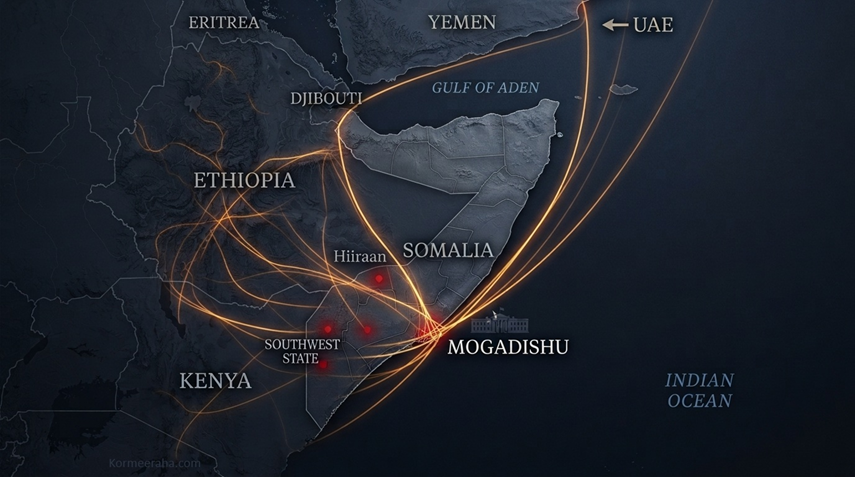
The diplomatic rupture between Somalia and the United Arab Emirates (UAE) in early 2026 has evolved from a severe sovereignty breach—involving the smuggling of a Yemeni separatist leader to Abu Dhabi—into a full-spectrum geopolitical campaign by Abu Dhabi to isolate and unseat President Hassan Sheikh Mohamud.
Leveraging its vast financial resources, intelligence networks, and regional alliances, the UAE has systematically empowered sub-national actors, opposition figures, and neighboring states to render the Federal Government of Somalia (FGS) ungovernable. This strategy has successfully catalyzed a convergence of military, political, and constitutional crises that now threaten the survival of the current administration.
“The diplomatic rupture between Somalia and the United Arab Emirates (UAE) in early 2026 has evolved from a severe sovereignty breach into a full-spectrum geopolitical campaign to isolate and unseat President Hassan Sheikh Mohamud.”
The Catalyst: The Early 2026 Fallout
The breakdown in relations was primarily triggered by a brazen violation of Somali sovereignty that simultaneously sparked a diplomatic fallout with Saudi Arabia. The immediate catalyst was the UAE’s unilateral facilitation of a prominent Yemeni separatist leader’s escape through Somali territory, utilizing Somali ports and airspace to reach Abu Dhabi without any consultation with the Federal Government.
This act not only severely undermined Mogadishu’s authority but also angered Riyadh, which viewed the UAE’s manoeuvre as a destabilizing overreach that complicated the broader Yemeni peace architecture. Under significant diplomatic pressure from Saudi Arabia to assert its sovereignty, and facing intense domestic backlash, President Hassan Sheikh’s administration was compelled to take a firm stand. This geopolitical realignment was compounded in January 2026 when Mogadishu unilaterally annulled defence, security, and port agreements with the UAE. The culmination of this deepening rift occurred in November 2026 when Somalia officially expelled the UAE ambassador, accusing Abu Dhabi of launching an “open invasion” by backing armed groups outside the national command structure.
The UAE’s Multi-Front Strategy to Unseat the President
Empowering Sub-National Power Centres
The UAE has bypassed Mogadishu to directly fund, arm, and politically legitimize regional leaders who oppose the FGS.
In the Southwest State, the UAE has provided tacit and material backing to former President Abdiaziz Hassan Laftagareen. This support enabled his forces to rapidly capture strategic districts like Buurhakaba and Awdiinle in late 2026. This advance was facilitated after Ethiopian AUSSOM troops deliberately vacated the area to allow his progress. Beyond the Southwest, the UAE maintains independent security and economic agreements with Somaliland, Puntland, and Jubaland. By ensuring these regions have the financial autonomy to resist Mogadishu’s centralizing efforts, Abu Dhabi is effectively fracturing the federation and preventing the FGS from projecting unified authority across the country.
“Rather than engaging in direct confrontation, the UAE has executed a sophisticated, indirect strategy designed to hollow out the Federal Government of Somalia from the inside and the periphery.”
Exploiting the Security Vacuum in AUSSOM
The UAE is also actively exploiting the severe security vacuum created by the financial struggles of the African Union Support and Stabilization Mission in Somalia (AUSSOM). Following the withdrawal of crucial US funding and Uganda’s subsequent decision to pull its troops, the mission has faced imminent operational collapse. In this void, the UAE has strategically positioned itself to fill the gap, offering alternative funding and logistical support to specific regional forces or peacekeeping contingents. This tactic deliberately fractures the unified AU command, allowing the UAE to cultivate loyalist security pockets that operate independently of the Somali National Army (SNA), thereby further diluting Mogadishu’s monopoly on the use of force.
Fuelling Localized Insurgencies and Clan Militias
In addition to manipulating the formal peacekeeping structure, the UAE’s network has actively fuelled localized insurgencies and clan militias to keep the federal government off balance. This is most evident in the Hiiraan region, where the UAE has supported armed movements and clan mobilizations. The recent uprising of Hawadle clan militias, which resulted in direct and deadly clashes with Djiboutian AUSSOM peacekeepers at Beledweyne’s airport, is a direct manifestation of this strategy. By keeping Hiiraan in a perpetual state of rebellion, the UAE ensures the SNA is distracted, overstretched, and unable to project power toward Mogadishu or the Southwest, effectively paralyzing the federal government’s security apparatus.
Orchestrating the Political Opposition
To complement its military and security manoeuvres, Abu Dhabi has aligned with specific Somali political and intelligence figures who have broken ranks with the current administration to paralyze the capital and regional governance. A central figure in this opposition is Abdullahi Sanbaloolshe, the former NISA director and former Minister of Information. Having broken ties with Hassan Sheikh, Sanbaloolshe leverages his profound understanding of Somalia’s security architecture to mobilize clan-based resistance and facilitate cross-border coordination, notably via Ethiopia, to challenge federal authority. Furthermore, the UAE has provided financial and political backing to Mogadishu-based opposition alliances, such as the Mustaqbal Council, and various regional strongmen. These groups are actively boycotting governance structures and stalling electoral reforms, working in tandem with external backers to render the FGS politically illegitimate and administratively paralyzed.
Geopolitical Encirclement via Ethiopia and Kenya
Finally, the UAE has leveraged its strong economic and strategic ties with Addis Ababa and Nairobi to ensure Mogadishu is completely isolated on the international stage. Ethiopia, deeply angered by Hassan Sheikh’s alignment with Egypt over the Nile and the Red Sea, has withdrawn its protective buffer and shifted its posture against the Somali president. By facilitating the movement of opposition figures like Sanbaloolshe and allowing Laftagareen’s forces to manoeuvre freely, Ethiopia has signalled that it no longer views Hassan Sheikh’s survival as a strategic interest. Meanwhile, Kenya has been brought firmly into Abu Dhabi’s orbit, bolstered by massive UAE financial injections, including a $1.5 billion budget loan. This economic leverage has ensured that Nairobi aligns its regional posture with UAE interests, effectively tightening the diplomatic and geopolitical noose around Mogadishu from all sides.
The Constitutional Crisis as the Final Accelerant
The UAE’s multifaceted strategy reached its zenith when Somalia’s Supreme Court ruled in November 5 that President Hassan Sheikh’s one-year term extension was unlawful, declaring his tenure legally void. This ruling provided the UAE and its allied opposition factions with the ultimate legal and political pretext to declare the administration entirely illegitimate. The court’s decision triggered mass protests, a total boycott of governance structures by the opposition, and a complete breakdown of state authority, transforming a geopolitical dispute into an existential constitutional crisis.
Conclusion: The Futility of Confrontation and the Only Safe Way Out
The convergence of military rebellion in the Southwest, clan mobilization in Hiiraan, political paralysis in Mogadishu, and the active hostility of neighboring states represents a perfectly coordinated, multi-dimensional siege on the Federal Government. This is not a temporary political setback; it is a systemic collapse engineered by a coalition with vastly superior financial, intelligence, and geopolitical resources.
“The safe way out for him is to abandon his bid to remain president by any means.”
The security situation would get worse unless Hassan Sheikh realizes it is futile to continue his confrontation with the UAE and its allies in and around Somalia and thus plunge the country in further turmoil. Attempting to cling to power through coercive state measures will only deepen clan fractures, empower Al-Shabaab to exploit the security vacuum, and accelerate the disintegration of the state. Recognizing the reality on the ground, stepping aside, and facilitating a negotiated, inclusive, and peaceful political transition is the sole remaining path to spare the nation from further bloodshed.
Related
- The Lame Duck’s Roar: How Hassan Sheikh’s Late Stand Against the UAE Masks a Sovereign Crisis (November 19, 2026)
- The Dual Collapse: When Constitutional Crisis Meets Security Freefall in Somalia (November 10, 2026)
- The Shub Assassination Plot: Sovereignty, Suspicion, and Spoiled Evidence (September 30, 2026)
- Inside Somalia’s Rift with the UAE (January 18, 2026)