
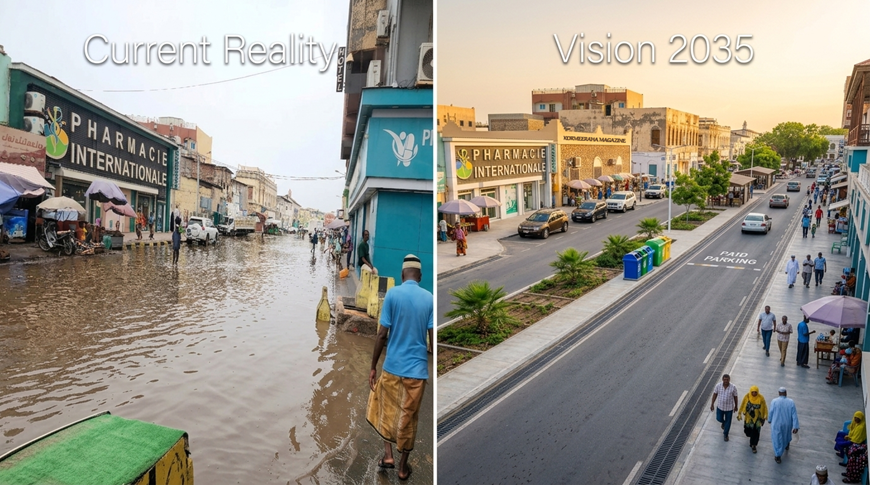
Djibouti City, the capital of a small nation with outsized ambitions, is far more than a mere administrative centre. It is the face of the country. It offers the first impression to investors, diplomats, and citizens alike. Yet, for several years, the city has projected the image of a tired and disorganized capital. It appears far removed from the dynamism demanded by its strategic regional role.
The modernization of Djibouti City is not a political option; it is a national emergency. It determines the ultimate success of Vision Djibouti 2035. This strategic blueprint aspires to make the country a hub of stability and sustainable growth. That vision speaks eloquently of sustainability, good governance, and inclusive cities. Yet, more than a decade after its adoption, the capital still struggles to embody these principles in practice.
“The modernization of Djibouti City is not a political option; it is a national emergency.”
The Predictable Crisis: Infrastructure, Health, and Economic Toll
Every rainy season, Djibouti City transforms into a disaster zone. Flooded roads, isolated neighbourhoods, and paralyzed businesses are not the result of an unavoidable climate curse. They stem from chronic drainage deficits. Pipelines are insufficient or non-existent. A modern capital cannot suffer annually from predictable rains. While climate change amplifies risks, weak urban planning and neglected maintenance exacerbate the damage.
Flooding is merely the visible symptom of a deeper pathology: the absence of long-term, data-driven municipal policy. A master plan for urban resilience is urgently needed. This must include mapping flood zones, rehabilitating stormwater networks, and enforcing municipal accountability.
“Flooding is merely the visible symptom of a deeper pathology: the absence of long-term, data-driven municipal policy.”
Beyond logistical paralysis, stagnant rainwater breeds malaria and dengue-carrying mosquitoes. As these waters evaporate, contaminated mud turns into toxic dust. Residents inhale this dust, spreading respiratory illnesses. Furthermore, water degrades road networks. This creates potholes that inflict heavy mechanical and financial burdens on citizens. For ordinary residents, the rainy season means wading through urban swamps to reach work or school. This daily ordeal inflicts a severe economic toll through vehicle breakdowns and strained public budgets. It underscores the urgent need for a comprehensive drainage plan meeting the population’s real needs.
Spatial Anarchy and the Deficit of Urban Dignity
Beyond the floods, the city suffers from pervasive spatial anarchy. Vehicles park in chaotic disregard for order. Sidewalks are hijacked as impromptu parking lots. Public spaces are privatized by establishments operating without a municipal licence. The pedestrian citizen has been erased, and local businesses suffer daily.
These public spaces are collective assets. Their mismanagement represents a massive loss of potential municipal revenue. Implementing paid, regulated parking and enforcing public domain occupancy fees are essential fiscal tools to finance public services.
Similarly, waste management remains largely artisanal. The Office de Voirie de Djibouti (OVD) makes notable efforts. However, a lack of clear logistics, selective sorting, and environmental strategy means garbage heaps still blight certain districts. This is an affront to urban dignity and a deterrent to foreign investment. The system must be rethought. We must establish regular collection routes, introduce selective sorting, and launch civic education campaigns. Urban ecology must become a pillar of municipal policy, not an empty slogan. This fulfils the clean, organized vision of Vision Djibouti 2035.
The Aid Paradox and the Imperative for Technocratic Leadership
Perhaps the most frustrating paradox is that Djibouti is not starved of resources. The country benefits from continuous international financial support. Notably, France and the European Union explicitly earmark funds for urban infrastructure and waste management. Yet, the ground-level impact remains disproportionately low. Institutions like ONEAD, OVD, and ADR have failed to utilize these funds with the required efficiency. Instead of cleaner streets, international assistance is diluted by administrative inertia. This disconnect underscores a critical need for modernized governance and performance-based management.
This brings us to the crux of the issue: leadership. The role of the mayor can no longer be treated as a political reward. It requires technical expertise and administrative rigor. The African cities that have successfully navigated urban transformation are led by professional managers and urban planners. Think of Kigali, Addis Ababa, Port Louis, and Accra. Their success stems from method and technocratic competence. Djibouti must pivot from political appointees to professional urban managers to realize Vision 2035.
“The role of the mayor can no longer be treated as a political reward.”
Decentralization, Civic Renewal, and Global Integration
Modernizing the city requires a fundamental shift in civic behaviour. The municipality must reclaim its identity as a transparent, efficient public service institution. Decentralization must move from a buzzword to a reality. This requires granting the municipality true autonomy and its own robust budget. A modern capital listens to its citizens and is accountable to the people.
The transformation of Djibouti City is a collective duty. We cannot claim modernity if our capital remains congested and flooded. Djibouti possesses an educated youth, local expertise, and an unmatched strategic geographic position. To clean and modernize the city is to honour the dignity of the Djiboutian people. It rebuilds the social contract through an exemplary living environment.
Finally, a city cannot modernize in isolation. Djibouti City must actively pursue city-to-city cooperation. It should establish sister-city partnerships with global hubs like Kigali, Dakar, Lyon, Shanghai, and Montreal. This decentralized diplomacy will facilitate the transfer of practical expertise. It will accelerate the professional growth of municipal staff and integrate Djibouti into global sustainable development networks.
A Roadmap for Urban Renaissance: Pillars of Reform
A comprehensive roadmap is imperative to provide Djibouti City with a modern, sustainable management framework. This genuine modernization must rest on clear, measurable priorities.
First, governance and local finance must be reformed. The municipality must embrace digital tools for tax and permit payments to eliminate bottlenecks. A dedicated “Town House” will provide a true institutional nerve centre. Second, spatial order must be restored. The rehabilitation of main roads and sidewalks is urgent. A dedicated municipal control unit must roll back the illegal privatization of public land. Furthermore, a master plan for stormwater drainage must end the annual flooding cycle.
Third, ecological dignity must be prioritized. The OVD requires restructuring with district-specific collection schedules and upgraded equipment to align with global environmental standards. Fourth, local economic development must be stimulated. The municipality can incubate small enterprises for parking, waste, and green space management, creating jobs and building civic pride.
Finally, a Municipal Monitoring Committee, chaired by the mayor, must publish quarterly performance reports tracking cleanliness, road quality, and citizen satisfaction. This transparency will rebuild public trust and ensure accountability.
“To clean and modernize the city is to honour the dignity of the Djiboutian people.”
Conclusion: Rebuilding the Social Contract
Together, these measures form the backbone of a practical roadmap. They will create a cleaner, more organized, and economically vibrant Djibouti City. Ultimately, this fulfils the spirit of Vision Djibouti 2035 and gives citizens a capital they can proudly call their own.
Related
- The Strategic Mirage: Why Djibouti’s “Stability” Is the Horn’s Most Dangerous Illusion (April 9, 2026)
- The Squeezed State: Djibouti Caught in the Crossfire of the Horn (October 15, 2026)