
Facing existential threats from aggressive immigration raids and hostile political rhetoric, the Somali-American community didn’t just vote in the 2026 US midterm elections—they reshaped the political landscape. Here is what their historic 10-seat victory means for the diaspora, the Horn of Africa, and the future of immigrant rights.
By securing these crucial legislative seats at the federal and state levels, the community achieved a watershed moment during a highly volatile election cycle marked by intense, anti-immigrant campaigns. Far from being mere individual triumphs, these wins represent a collective milestone that is fundamentally altering the country’s political architecture. As the dust settles, it is crucial to examine the grassroots mobilization that made this possible and the profound transnational impact it will have on Somalia and the global diaspora.
The Electoral Triumph: A New Era of Representation
The success of Somali-American candidates in 2026 serves as a definitive testament to their emergence as an indispensable political force. By securing representation at both the federal and state levels, the community has gained the leverage needed to influence legislation affecting their daily lives, protect local budgets, and direct community development projects. More importantly, these consecutive victories served as a direct, democratic rebuttal to the anti-immigrant rhetoric that dominated the election cycle, proving that American voters deeply trust the integration and contributions of the Somali community.
“These consecutive victories served as a direct, democratic rebuttal to the anti-immigrant rhetoric that dominated the election cycle, proving that American voters deeply trust the integration and contributions of the Somali community.”
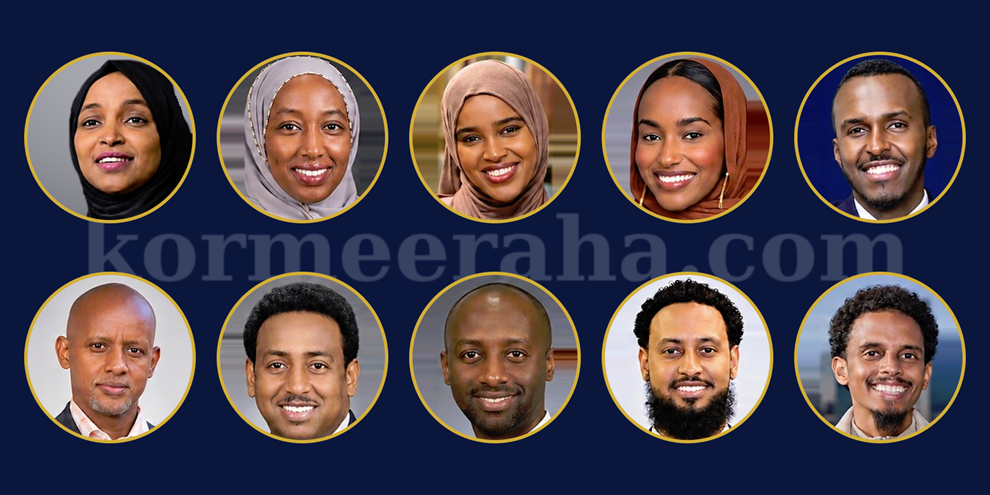
The electoral map reveals a strategic and widespread consolidation of Somali-American political power. At the federal level, Ilhan Omar secured her fifth term in the U.S. House of Representatives, solidifying her grip on Minnesota’s 5th Congressional District with a commanding majority. At the state legislative level, Minnesota—the demographic heart of the diaspora—saw six successful candidates. Omar Fateh and Zaynab Mohamed retained their seats in the State Senate, while Mohamud Noor, Samakab Hussein, and Anquam Mahamoud held their ground in the State House of Representatives. Crucially, Abdi Daisane made history by flipping a previously Republican-held seat to win the Minnesota House of Representatives District 14A (St. Cloud).
This momentum extended beyond Minnesota. In Ohio, Munira Yasin Abdullahi and Ismail Mohamed successfully defended their seats in the State House, while in Oregon, Kayse Jama secured his re-election to the State Senate. These individual wins were amplified by a broader national shift, as the Democratic Party regained control of the U.S. House of Representatives. This coalition victory provides Somali-American lawmakers and their allies with the institutional power necessary to resist harsh national immigration and refugee agendas.
The Catalyst: What Mobilized the Community?
The unprecedented voter turnout and mobilization displayed by the Somali-American community was not born in a vacuum; it was a direct response to urgent, existential threats. The primary catalyst was “Operation Metro Surge,” a massive and aggressive immigration enforcement campaign launched by ICE in areas like Minnesota, home to nearly 80,000 Somalis. The operation resulted in the detention of thousands of individuals, including several U.S. citizens.
“This created an atmosphere of intense fear, disrupting local businesses and school attendance, and ultimately compelling the community to view the ballot box as their most vital tool for self-defence.”
This mobilization was further fuelled by pervasive hate speech and bigotry, particularly rhetoric directly targeting individuals of Somali origin and personal attacks against Representative Ilhan Omar. Such hostility galvanized the community’s sense of civic duty. The tipping point for many occurred just three weeks before the election, on October 12, when federal security forces (DHS) conducted a highly publicized and unexpected raid on Ilhan Omar’s home in Washington, D.C. Widely perceived by the community as an act of political intimidation, the raid sparked widespread outrage and drove a landslide re-election vote in her favour.
In response to these compounding threats, the community proactively organized to protect its own. Fear of ICE targeting led hundreds of residents to form grassroots rapid-response networks—organized, trained groups dedicated to documenting and preventing abuses against immigrants. This localized self-defence seamlessly transformed into a massive, highly coordinated get-out-the-vote campaign to support candidates who championed human rights.
Checking the MAGA Agenda: Federal and State Leverage
The political victories achieved in 2026 provide significant power to mitigate the pressures of the Trump administration and its MAGA allies, operating effectively on a dual-track strategy. At the federal level, with Democrats now holding the majority in the U.S. House of Representatives, Representative Omar and her colleagues possess vital constitutional tools to curb aggressive executive overreach.
“Through the ‘power of the purse,’ Congress can deny or defund budgets allocated to ICE and large-scale deportation operations, effectively halting initiatives like Operation Metro Surge.”
Furthermore, congressional committees can now initiate formal oversight investigations into abuses by federal security agencies, ensuring accountability for actions like the October 12 raid.
At the state level, legislators in Minnesota, Ohio, and Oregon are uniquely positioned to build localized fortresses for their constituents. They possess the authority to enact or strengthen sanctuary policies, legally prohibiting local police and state resources from being used to assist federal deportation operations. Additionally, they can direct state funding to support Somali-owned businesses, community centers, and schools that have been economically or socially impacted by immigration raids. While it is true that the executive branch retains the power to issue unilateral orders regarding refugees and border enforcement, a hostile Congress and fortified state laws serve as a formidable check on that authority.
Transnational Impact: Somalia and the Global Diaspora
The political ascendancy of Somali-Americans extends far beyond U.S. borders, exerting both direct and indirect influence on Somalia and the global diaspora. In the realm of foreign policy, federal legislators—particularly through their work on committees like the House Foreign Affairs Committee—are uniquely positioned to shape U.S. strategy in the Horn of Africa. They are actively advocating for U.S. aid to Somalia to be prioritized for democracy, institution-building, and humanitarian assistance, rather than an over-reliance on military and drone interventions. Beyond policy, cities like Minneapolis (affectionately known as “Little Mogadishu”) and Columbus remain vital economic engines, housing remittance companies and academic institutions that directly fuel Somalia’s domestic economy and tech sectors.
Socially, the success of these 10 candidates serves as a powerful psychological anchor for Somali communities across Canada, the UK, and Northern Europe.
“It stands as undeniable proof that immigrants can reach the highest echelons of Western politics without compromising their cultural or religious identities.”
This success has also fostered robust global diaspora networking, encouraging international collaboration among Somali legislators worldwide—from Canada to Scandinavia—thereby creating a unified front to defend immigrant rights globally.
Finally, this newfound legislative leverage plays a critical role in defending global immigration frameworks. The influence of Somali-American lawmakers acts as a vital barrier against the enactment of restrictive laws that would harm Somalis worldwide seeking family reunification or travel. By holding legislative power, they are uniquely equipped to counter discriminatory efforts, such as denaturalization campaigns, protecting the broader refugee community from systemic vulnerability.
Conclusion
The 2026 midterm elections have firmly established Somali-Americans as a community fully woven into the democratic fabric of the United States, opening vast new leadership corridors for the youth and the next generation. While these 10 legislative seats will not entirely erase prejudice or dismantle the MAGA agenda overnight, they provide the Somali community with an indispensable legal and political shield.
“The deeper their roots and influence grow within the United States, the more the voice of Somalis everywhere—both at home in the Horn of Africa and across the global diaspora—will command a seat at the table of global decision-making.”
Ultimately, the power of the Somali-American community represents a profound form of transnational power. As they continue to secure their place in American governance, they ensure that the global Somali voice will never again be marginalized.
Related
- The Confidence to Win: How Somalis Became a Political Force in the West (October 13, 2026)
- Deconstructing Trump’s “Garbage” Remarks and Their Strategic Resonance (December 10, 2025)