

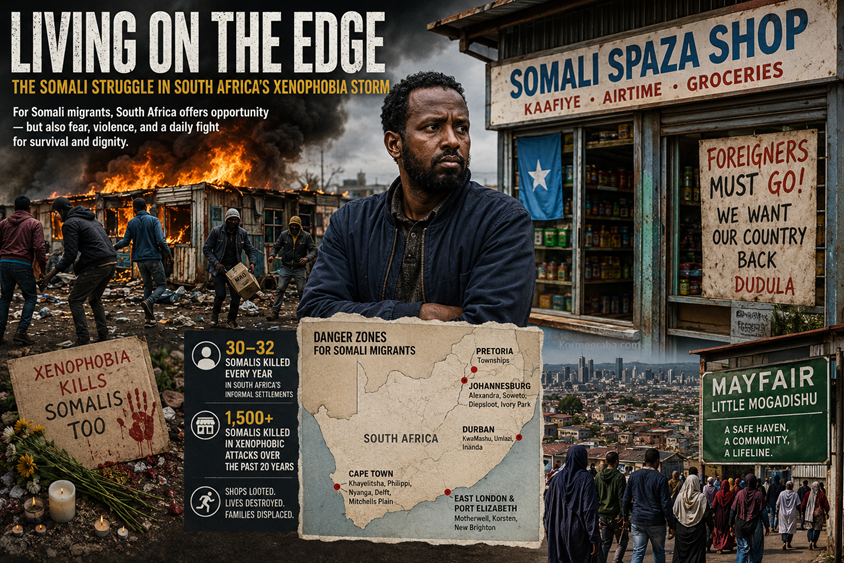
For decades, Mayfair—a bustling suburb just west of Johannesburg’s central business district—has been affectionately dubbed “Little Mogadishu.” To walk its streets is to experience a vibrant slice of East Africa transplanted to the foot of the continent. The air is thick with the aroma of freshly brewed spiced tea and traditional Somali laxoox flatbreads. Brightly painted signs advertise wholesale textiles, electronics, and global remittance agencies.
For thousands of young Somali men fleeing the scars of civil strife and the terror of Al-Shabab back home, this neighborhood represents a sanctuary, a testament to an extraordinary entrepreneurial spirit, and the gateway to a better life.
But outside the protective cocoon of Mayfair and Cape Town’s Bellville district lies a terrifying reality. In the impoverished, under-policed townships where Somali merchants operate the lifeblood of the local retail economy, a deeply entrenched crisis is boiling over.
Today, the Somali dream in South Africa is increasingly being written in blood.
The Boiling Pot: Unemployment, Populism, and Xenophobia
South Africa is currently navigating a perfect storm of economic hardship and social unrest. With a staggering national unemployment rate hovering around 33%, a deep-seated frustration has gripped the country’s youth. Amidst highly charged political climates and local election cycles, foreign shopkeepers have become the ultimate scapegoat for structural government failures.
Anti-foreigner sentiment—locally termed xenophobia—is no longer just sporadic tribal anger; it has become institutionalized through highly organized, militant vigilante movements.
Groups like Operation Dudula and the March and March movement systematically march through communities. They force foreign-owned shops to shut their doors—most of which belong to fellow Africans—all under the banner of “taking back local jobs.” But their campaign doesn’t stop at economic intimidation. These self-appointed citizen syndicates have veered into outright humanitarian violations, blocking other Africans from accessing public hospitals and schools, denying them some of the most basic rights.
The Legal Myth vs. The Taxpaying Reality
Vigilante groups and populist politicians frequently weaponize the narrative that township commerce is overrun by illegal, untaxed syndicates draining South Africa’s resources. However, community data completely shatters this myth: community experts and leaders point out that an overwhelming majority of Somali immigrants—by some estimates close to 97% to 98%—hold valid legal status in South Africa.
Far from operating in the shadows of the informal economy, these entrepreneurs navigate the rigorous paperwork of work, study, and recognized refugee asylum permits.
The Economic Footprint
Rather than a drain on the public purse, the Somali community forms a crucial pillar of the local commercial ecosystem. As documented contributors to the South African revenue base, they pay value-added tax (VAT) on billions of rands of bulk wholesale goods every year, essentially fueling the local supply chains and pouring vital capital directly back into the national treasury.
Despite being legitimate, law-abiding taxpayers, these merchants are denied the basic state protections their tax Rands should guarantee.
Living as a “Soft Target”
To understand why the Somali diaspora bears the brunt of this fury, one must understand how they do business. Unlike other immigrant groups who find employment in corporate sectors or secluded industries, Somalis are aggressively entrepreneurial retail traders.
To bypass expensive commercial rents, they set up tiny convenience stores—known locally as Spaza shops—deep within vulnerable, high-crime townships like Soweto, Alexandra, and Khayelitsha. Operating out of reinforced metal shipping containers or modified front rooms of rented township houses, these merchants live and sleep where they work.
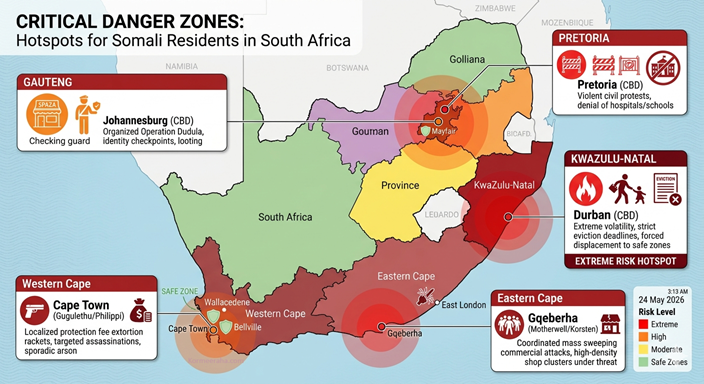
| The Hardest-Hit Conflict Zones | The Local Reality on the Ground |
| Durban (KwaZulu-Natal) | The current epicenter of volatility. Xenophobic groups issued a hard deadline for June 30 for all foreigners to leave, forcing displaced women and children into makeshift church sanctuaries. |
| Johannesburg (Gauteng) | The commercial heartland where organized mobs set up illegal checkpoints in the streets to inspect residents’ IDs and systematically loot Somali storefronts. |
| Pretoria (Tshwane) | The administrative capital has seen bloody protests, with vigilante groups barricading public service buildings against foreign entry. |
| Cape Town & East London | Plagued by sporadic, highly targeted hits on small township grocers and violent turf wars involving local transit syndicates. |
By bringing goods into impoverished neighborhoods at wholesale bulk quantities and undercutting local competitors’ prices, Somalis have revolutionized the township market. But their efficiency has bred fatal jealousy. Because they are isolated inside under-policed areas, local gang see them as “soft targets”—easily squeezed, easily broken.
The Bullet or the Levy: A History of Extortion
The violence confronting Somali merchants is a lethal cocktail of political xenophobia and raw, organized criminality. In recent years, a predatory underworld economy has exploded: the protection fee racket.
Criminal gangs routinely visit Somali Spaza shops, demanding exorbitant monthly cash payments under the threat of death. If a merchant pays, they survive until the next gang arrives. If they refuse or attempt to involve the police, the consequences are immediate and fatal.
“In South Africa, you walk into your shop in the morning, and you honestly do not know if you will walk out alive in the evening. We are hunted for the crime of working hard.”
— An anonymous Somali trader in Philippi, Cape Town
The body count tells a devastating story. Somali community leaders estimate that more than 1,000 Somalis have been murdered in South Africa over a ten-year stretch, with studies indicating that roughly 500 foreign merchants lose their lives to violence annually.
The tragedy strikes in rapid, heartbreaking succession. Just last year, two young men—Nur Mohamed Mahdi (Faroole) and Shol Mohamed Adde—were gunned down inside their shops in Cape Town within 48 hours of each other for refusing extortion demands. Weeks earlier, two teenagers, ages 18 and 20, were shot dead at point-blank range in Wallacedene for the exact same reason.
A Grim Global Comparison: Wealth vs. Survival
The sheer brutality of life in South Africa begs a haunting question: Is this the worst place on earth to be a Somali migrant?
The answer is complex. When weighed against other modern migration crises, South Africa represents a unique, tragic paradox. It offers unprecedented economic mobility, but demands the ultimate psychological price.
- The Horrors of Libya: On the Mediterranean route, Somalis endure unimaginable human rights abuses—modern-day slave markets, brutal torture camps, and mass drownings at sea.
- The Gridlock of Dadaab: In the massive refugee camps of Kenya and Ethiopia, hundreds of thousands live in safety, but are stripped of their freedom of movement, denied the right to work, and left entirely dependent on dwindling international aid.
- The Crossfire in Yemen: Thousands of Somalis remain stranded in the Gulf region, trapped in an active, grinding civil war. Surrounded by conflict, they survive without any form of international protection, basic healthcare, or stable employment opportunities, caught directly in the crossfire of someone else’s war.
South Africa stands entirely apart. Here, legal and taxpaying Somalis enjoy absolute freedom of movement, open markets, and a highly advanced economy. They can build empires, buy property, and send life-saving remittances back to East Africa. Yet, it remains the only place on earth where a documented migrant can achieve magnificent financial success in the morning, only to be murdered in broad daylight on a routine walk down the street.
The Diplomatic Deafness
As the body bags continue to return to Mogadishu, anger within the diaspora is boiling over—not just at South African authorities, but at their own government.
The Federal Government of Somalia’s response has been slow, predictable, and largely performative. When crisis strikes, the Ministry of Foreign Affairs issues boilerplate press statements condemning the violence. Somali diplomats frequently attempt to play their ultimate historical card: reminding South Africa’s ruling African National Congress (ANC) of the vital financial and political backing Somalia provided during their historic anti-Apartheid liberation struggle.
But in the corridors of power in Pretoria, historical gratitude has a short shelf life when balanced against angry local voters.
The Somali Embassy in Pretoria issues frantic safety alerts, warning citizens to bolt their doors and abandon their livelihood during riots. Beyond these warnings, however, there is an absolute vacuum of tangible support. There are no state-funded relocation packages, no financial compensation for law-abiding taxpayers whose life savings are reduced to ash overnight, and no official repatriation programs for those desperately wanting to come home.
The Resilient Horizon
Despite the terror, the extortion, and the quiet funerals, the trucks from the wholesale markets continue to arrive in the townships every single morning. Young Somali men, fueled by an unbreakable work ethic and the responsibility of supporting families thousands of miles away, open their metal shutters to face another uncertain day.
They know the risks. They know that the very counter they serve across could be the place where their journey ends. But until peace and economic viability return to the Horn of Africa, the Somali diaspora will continue to pay the perilous price of admission to South Africa’s economy—living by the blade, and surviving by the shop.