
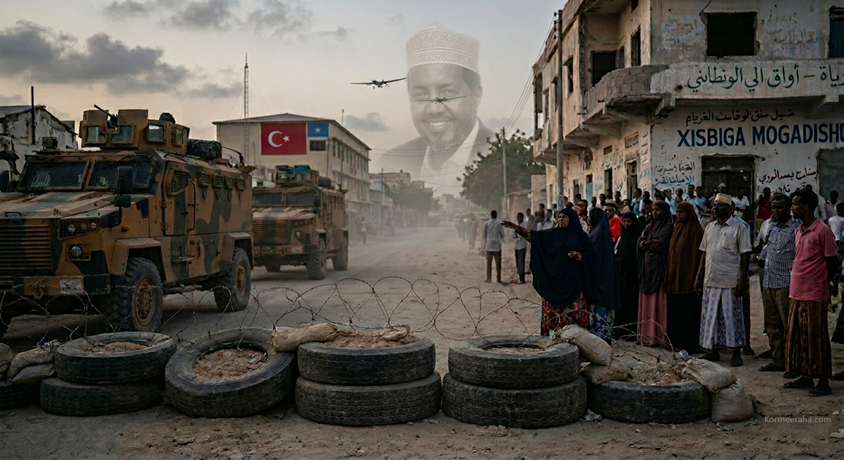
The explosive resurgence of violence in Mogadishu between government forces and opposition militias has once again cast a harsh, unforgiving spotlight on Somalia’s fragile political landscape. But as gunfire echoes through the capital, the tremors are being felt acutely thousands of miles away in Ankara. Turkiye, enticed by the promise of lucrative resource deals and strategic influence, now finds itself deeply entangled in a Somali quagmire of its own making.
The Architecture of a Crisis
At the heart of the current crisis lies a blatant, systemic power grab. Outgoing President Hassan Sheikh—whose mandate technically expired on May 15—has orchestrated a controversial constitutional maneuver. With the explicit complicity of the Speaker of Parliament, his administration has unilaterally extended its grip on power for another year, masking the move under the noble but presently unrealistic guise of preparing for universal suffrage elections.
The opposition has rightly refused to play along. They are demanding an immediate return to the indirect election model—a flawed system, certainly, but one that has provided a fragile framework for consensus among Somalia’s fractured factions for over a decade. Even President Hassan Sheikh owes his own election to this very mechanism.
The golden rule of democratic transition is this: any fundamental constitutional amendment, particularly one extending executive and legislative terms, must only take effect after the election of a new administration. To do so mid-term is not governance—it is a bloodless coup.
Funded by Ankara, Deployed Against Somalis
The domestic backlash against the president is fueled by rampant allegations of corruption, specifically surrounding the opaque awarding of Somali oil contracts to Turkiye. High-profile critics, such as MP Abdillahi Abib, have openly lambasted Turkish President Recep Tayyip Erdoğan and Turkish officials for exploiting the country’s resources.
More disturbing, however, is how Turkish patronage is manifesting on the streets of Mogadishu. The very military hardware—armored vehicles, drones, and elite units trained and equipped by Turkiye to fight terrorism—is now being weaponized by the federal government against its political opponents.
This dangerous overreach is part of a troubling pattern:
- The Southwest Campaign: Federal forces previously invaded Southwest State, actively backing militias to overthrow President Abdi-Aziz Laftagareen after his fallout with Hassan Sheikh, leaving the region in political chaos.
- The Threat to Galmudug: President Hassan Sheikh is currently leveraging the same threat against Galmudug State, aiming to depose President Abdi-Karie Qoorqoor if he does not yield to a hand-picked federal successor.
- The Siege of Mogadishu: The capital now bears the brunt of a newly emboldened, omnipotent presidency—one financed, armed, and sustained by Turkish interests.
Panic in Ankara: Late-Stage Diplomacy
Realizing that a total collapse of the current regime would vaporize their uncontested and highly lucrative oil concessions, the Turkish government has suddenly shifted into damage-control mode. Panic has sparked a flurry of late-stage diplomacy, with Ankara dispatching high-level delegations to Mogadishu to force mediation between the federal government and the opposition.
- A delegation including the deputy head of Turkish intelligence and other officials met with former President Sharif Sheikh Ahmed to pitch Ankara’s framework for dialogue and de-escalation.
- A separate senior diplomatic delegation engaged federal government leadership, seeking a survival strategy for the regime that would preserve Turkish contracts.
The Naivety of Turkish Foreign Policy
Turkiye’s fundamental mistake is an acute lack of geopolitical nuance. Having arrived late to the Somali political theater, Ankara is playing chess with checkers rules.
While established actors like the West, Ethiopia, and the United Arab Emirates carefully distribute their leverage across all factions, Turkiye has committed the cardinal sin of geopolitical gambling: putting all its eggs in one basket. Traditional stakeholders understand that in Somalia, alliances are transactional, support is strictly conditional, and no leader is permanent. Experienced foreign powers refrain from over-investing in a single regime or tying long-term strategic concessions to an uncertain future.
Turkiye, conversely, has blinded itself by backing a single horse, misjudging the deep undercurrents of Somali clan dynamics and political volatility.
A Betrayed Nation
It remains highly doubtful whether Turkiye’s heavy-handed methods can inject order into Somalia’s chronic instability. What is certain is the tragedy of the Somali people. Once again, a corrupt ruling class has chosen foreign patronage and personal enrichment over national stability. By succumbing to external influence and selling off national assets to the highest bidder, Somalia’s leaders have betrayed their citizens—leaving ordinary Somalis to pay the price in a predictable, devastating cycle of violence.