
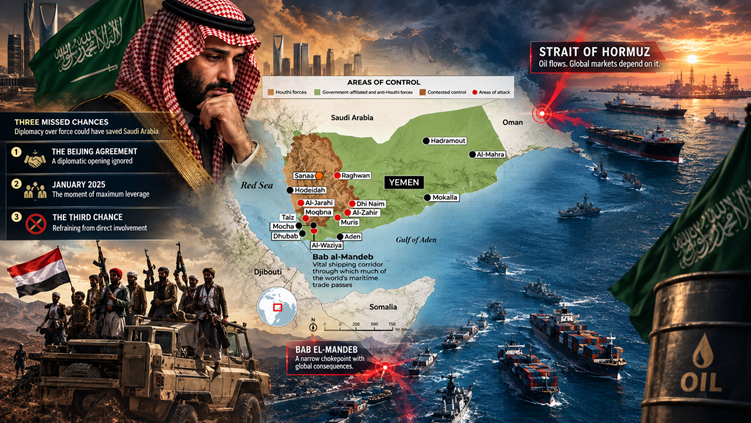
Saudi Arabia stands at a strategic crossroads of its own making. A kingdom that once sought to reshape the Middle East through military intervention and economic largesse now finds itself squeezed between two hostile chokepoints — the Strait of Hormuz to its east and the Bab el-Mandeb to its south — while the Ansarallah, a Houthi-led coalition of northern tribes, consolidates control over one of the world’s most critical maritime corridors. Riyadh had three clear chances to negotiate an exit from the Yemen war. It took none.
The Beijing Agreement: A Diplomatic Opening Ignored
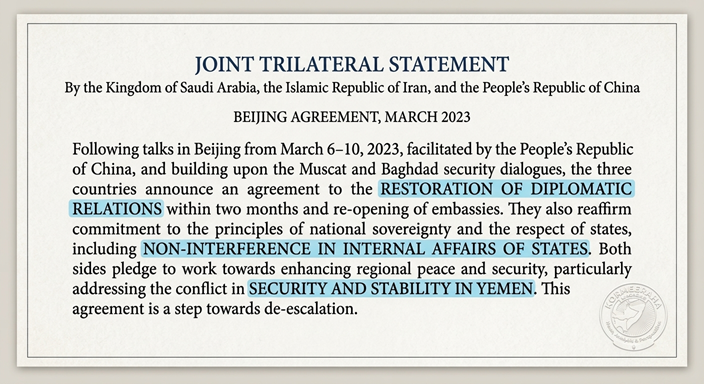
In March 2023, China brokered a landmark agreement between Saudi Arabia and Iran to restore diplomatic relations after seven years of rupture. The deal was widely hailed as a demonstration that West Asian rivalries could be de-escalated through patient diplomacy. Analysts noted that Iranian-Saudi normalization offered real hope for a negotiated solution to the Yemen conflict.
The logic was straightforward: if Riyadh could stabilize its relationship with Tehran, the principal external backer of Ansarallah, the pathway to a Yemen settlement would become clearer. China, Saudi Arabia, and Iran even jointly urged a UN-backed Yemen peace deal in December 2025, reaffirming support for a comprehensive political solution.
“Iranian-Saudi normalization offered real hope for a negotiated solution to the Yemen conflict.”
Yet Saudi Arabia failed to capitalize on the momentum. Instead of leveraging the Beijing Agreement to push for sustained negotiations with Ansarallah, Riyadh let the opening narrow. By September 2026, a planned high-level meeting with Iran on regional maritime security and Yemen was postponed — a decision that exposed fresh strains in the reconciliation and the fragility of the Saudi-Iranian thaw when tested by military developments.
The failure was not Iran’s alone. Ansarallah accused Saudi Arabia of procrastinating on peace efforts and delaying a roadmap. A Yemeni leader alleged that Riyadh retreated from key terms, notably salary disbursements and the lifting of the siege on ports and airports. The diplomatic opening created by China’s mediation was never truly seized.
January 2026: The Moment of Maximum Leverage
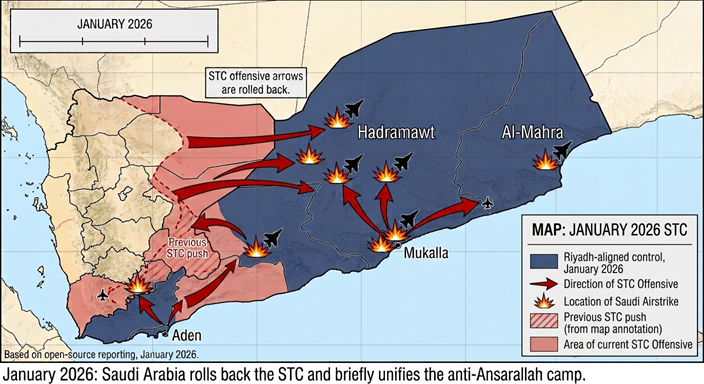
A second opportunity arose in late December 2025 and January 2026. The UAE-backed Southern Transitional Council launched a lightning offensive into Hadramawt and Al-Mahra, threatening to fracture the anti-Ansarallah coalition. Saudi Arabia responded decisively: it carried out airstrikes on STC positions near Mukalla, deployed forces, and regained control of Hadramawt and Aden with direct air support.
This was a moment of maximum leverage. For the first time in years, Riyadh had unified the anti-Ansarallah factions outside Ansarallah-held territory under its own authority. The STC was rolled back to Aden, its leader Aidarous al-Zubaidi was expelled from the Presidential Leadership Council on charges of high treason, and the Riyadh-aligned government met on January 7 to consolidate power.
Saudi Arabia had, in effect, cleared the board of its most disruptive internal rival. It could have used this unified front as a credible negotiating partner to bring Ansarallah to the table. Ansarallah had signaled openness; secret talks had been revived in hopes of continuing the ceasefire and establishing a negotiating track.
Instead of building on that momentum, Riyadh reverted to a purely military posture. The chance closed. In a rapid operation that began in early September 2026, Ansarallah forces seized Yemen’s entire western coast and several strategic Red Sea islands, including the port city of Mokha, the island of Perim (Mayyun) in the Bab el-Mandeb Strait, and the Greater and Lesser Hanish islands. Government forces offered little resistance, and Riyadh’s position deteriorated rapidly.
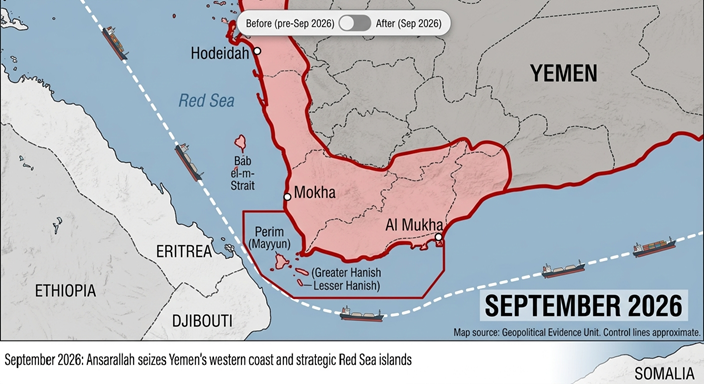
The Third Chance: Refraining from Direct Involvement
The third missed opportunity was structural and longer-term: the failure to stay out of direct military involvement in Yemen’s civil war. Saudi Arabia’s original intervention in 2015 was itself a costly miscalculation. The campaign contributed to the deaths of hundreds of thousands of Yemenis from violence, hunger, and disease, and it did not achieve its political goals. It damaged the kingdom’s reputation and drained its finances.
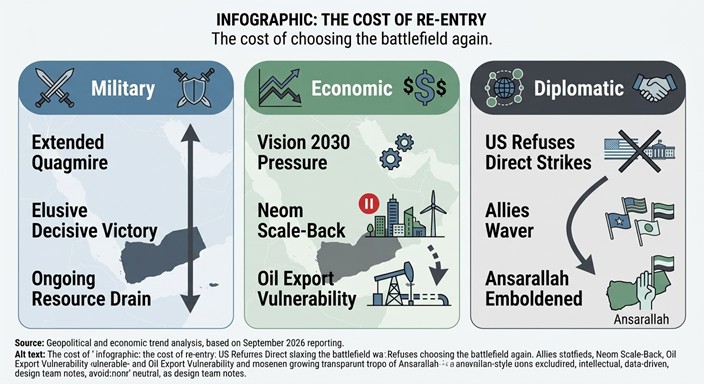
By 2022, a UN-brokered truce had drastically reduced large-scale fighting. The lesson was clear: military intervention had failed; only negotiation could produce a durable outcome. Yet when Ansarallah began attacking Red Sea shipping in response to the Gaza war and escalated strikes on Saudi territory, Riyadh again chose military response over diplomacy. Saudi Arabia scaled back its flagship Neom megacity project and shuffled Vision 2030 priorities away from large-scale tourism spending as the conflict mounted.
“Saudi Arabia will not find anyone to rescue it from the Yemen crisis.”
— Joe Kent, former U.S. Counter-Terrorism Center director
Former U.S. Counter-Terrorism Center director Joe Kent noted that Saudi Arabia will not find anyone to rescue it from the Yemen crisis. He argued that negotiation with Ansarallah is the most pragmatic solution, pointing out that the United States has refused direct intervention and that no outside power — Egypt, the U.S., or now Saudi Arabia — has succeeded in subduing the northern tribes.
Riyadh did seek American military support. Crown Prince Mohammed bin Salman reportedly called President Trump twice requesting direct U.S. strikes on Ansarallah. Washington refused, agreeing only to increase intelligence and targeting support. Saudi Arabia was left to fight its own war — one it had been warned against re-entering.
The Cost of Missed Diplomacy
Saudi Arabia’s predicament is now one of strategic and economic squeeze. Its oil exports are vulnerable and its Vision 2030 transformation is at risk. Its allies are wavering. And Ansarallah has emerged emboldened, with intact command-and-control, a demonstrated ability to disrupt global shipping, and a growing capacity to dictate terms in any future negotiation.
The three missed opportunities — the Beijing Agreement, the January 2026 unification of anti-Ansarallah forces, and the chance to refrain from re-entering the civil war — form a pattern of diplomatic hesitation and military overreach. Each time Riyadh chose the battlefield over the negotiating table, it lost leverage and deepened its isolation.
Former U.S. officials now suggest that the only viable path forward is a direct agreement with Ansarallah — the very option Saudi Arabia has avoided for years. The price of that agreement will be higher now than it would have been in 2023 or January 2026. As the war grinds on, the continued conflict costs Saudi Arabia, Yemen, and the broader regional balance. Riyadh can still choose diplomacy. Its options, however, are narrower than ever.