

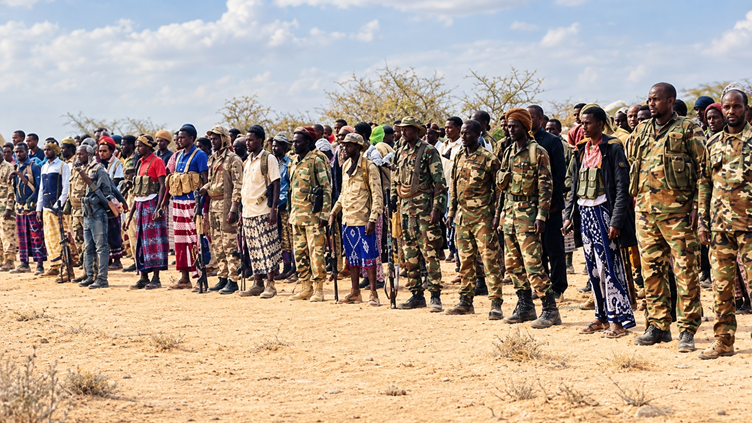
Since October 1, Ahlu-Sunna-Wa-Jama’a (ASWJ), an extremist politico-religious militia that had been disbanded early last year, has taken over Guri-El and surrounding areas in Galmudug. ASWJ leaders had arrived in the region a month earlier, apparently to attend a religious gathering after a year and a half in exile abroad. Galmudug state forces, supported by federal security forces, are now fighting the militia for the fourth consecutive day in Guri-El. Reports indicate up to 120 casualties, with additional wounded treated in nearby towns.
In light of these events, people are wondering whether it is worth shedding blood instead of finding more peaceful ways out of the crisis. ASWJ has been in Somalia’s political landscape for over two decades and has presented itself as an anti-Al-Shabab force—or has it? Some see the group as another “terrorist group” seeking to divide the nation. The following sections revisit ASWJ and compare it with Al-Shabab.
The Problem with the “Terrorist” Label
First, calling ASWJ a terrorist organization is distracting because such a designation will not resolve the issue at hand. On the Somali political spectrum, allegiance is based more on clan affiliation than on ideology or a particular cause. Few people agree on who qualifies for the label anyway. Every country has its own idea of what a terrorist group is. It could be a group with an extreme worldview, a violent group, any rebel group, or simply a religious group like the Muslim Brotherhood with no connection to violence or extremism.
In the Somali context, one could designate as a terrorist group any rebel militia that wages war against the legitimate government, indiscriminately kills civilians, feeds young people an extremist ideology to commit violence, and claims to be a total system. Sadly, history is replete with groups and individuals who ended up trading their fatigues for a costume and earning the respect of those who once called them terrorists. In Somalia, one can point to President Ahmed Madobe of Jubaland and President Musa Bihi of Somaliland as examples of such transformation.
Shared Traits, Different Paths
ASWJ and Al-Shabab share important features. Both have an extreme religious ideology that seeks to triumph over all other doctrines. They have structures, diehard militants, armed militias, and control over territories and businesses. Both want to govern Somalia, and both occupy opposing extremes.
Their difference lies in their modus operandi and their history. ASWJ emerged from a defensive Sufi reaction to violent Salafist attacks on Somali religious traditions. Al-Shabab emerged from the Islamic Courts Union and evolved into a guerrilla movement after foreign intervention. One is built around clan ties, local grievances, and a personality cult. The other presents itself as an internationalist, decentralized shadow structure. Yet both use radicalized youth and armed force to impose parallel systems of law and advance political agendas. Understanding these similarities and differences is essential to assessing the current crisis in Galmudug.
From Sufi Reaction to Armed Movement
Sufism was part of the Somali cultural fabric and was tolerant. Modern education and Salafist ideology from Saudi Arabia made it moribund until 1991. President Mohamed Siad Barre preferred traditional Sufi clerics to the dogmatic Muslim Brotherhood and Wahhabis, whom he violently repressed.
After the civil war and the collapse of the state, some Somali fighters returned from Afghanistan after the Soviet defeat. They sought to obliterate the remaining Sufism in Somalia and began destroying revered mausoleums. ASWJ was born as a reaction. Initially, it sought to protect an ancestral way of life—whether we like that way of life or not.
General Mohamed Farah Aydid, from the region where ASWJ operated, did not see the group as a threat to his authoritarian rule. After September 11, 2001, and the invasion of Afghanistan, Americans were alerted that fleeing Al-Qaeda leaders were using Somali lawlessness to set up bases. They were told ASWJ was the sworn enemy of groups linked to Al-Qaeda. With the rise of the Islamic Courts, the Americans did not hesitate to train, equip, and fund the group. After Ethiopia invaded Somalia, ASWJ continued to collaborate with the Ethiopian army and even served as auxiliary troops.
ASWJ: Structure, Demands, and Leadership
ASWJ took Sufism to a more ideological and dogmatic level unknown to Somalis until then. It established its own state within the state, similar to the Lebanese Hezbollah and has its own army and politicians. It agrees to collaborate with the Somali government as long as it is part of decision-making. If it is not satisfied with the political arrangement, it does not hesitate to turn violently against the state to obtain better terms. Until now, it has been difficult to accommodate its list of demands, which are sometimes at odds with how a modern state functions.
Like all groups that claim to be Sufi, ASWJ cultivates a personality cult around a spiritual leader, Moalim Mohamud; respect for his family, whose son Abdisamad Moalim Mohamud is also revered and will eventually succeed him; and a political leader, Sheikh Mohamed Shakir Ali.
Al-Shabab: From ICU to Al-Qaeda Franchise
Al-Shabab was initially part of the Islamic Courts Union (ICU). Once its plans for an Islamic state were frustrated by American intervention and the Ethiopian invasion, it resorted to guerrilla tactics against the occupiers. With its leaders either killed, jailed, expelled, or now part of the government, its ideology hardened. Its all-out war against Ethiopian occupation morphed into a struggle against any individual suspected of being close to the government of collaborators.
With its allegiance to Al-Qaeda, Al-Shabab became estranged from the local religious culture and showed no care for human life. It also developed a sophisticated shadow state system operating from the shadows and kills those who stand in its way. Al-Shabab’s ideology is similar to that of armed groups indoctrinated by Wahhabism. It presents itself as an internationalist group and therefore does not consider affiliation to a nation or clan. For Al-Shabab, there is no border and no difference between ethnic groups. As part of the Al-Qaeda network, it enlists foreign fighters in its ranks in Somalia.
Why ASWJ Remains Dangerous
ASWJ is just as lethal and no less dangerous for the future of an established, viable government. Its mix of clan affiliation, religion, politics, and the weaponization of its followers makes it very dangerous. Some ASWJ leaders have toughened their voices and made comments worthy of groups such as Al-Qaeda and Daesh. Sheikh Shakir, the group’s political wing chief, encouraged his militants fighting government security forces to die as martyrs defending their religion. This came after other clerics of the same movement in Mogadishu cited fatwas on October 22 qualifying the operations in Galmudug as a war against the principles of religion.
Second, ASWJ’s deceitful flexibility—laying down its weapons when it sees fit or has no other options, then resorting to violence at the first turn—makes it untrustworthy. To make matters worse, the current ASWJ is no longer the ragtag militia protecting its way of life against an imported violent ideology. It has grown into a formidable mercenary army ready to sell its services to the highest bidder and shed its own people’s blood. ASWJ, trained and armed by the Ethiopian TPLF and funded by the American CIA, has carried out more attacks against Somalia’s security forces than against Al-Shabab fighters. It has also been implicated in abuses against civilians suspected of supporting or sympathizing with Al-Shabab. Its reappearance in September came at a time when Somalia was awaiting the ICJ’s verdict on Kenya’s maritime claim, and when elements within Somalia—such as Puntland, which previously defended ASWJ—resent Ahmed Karie Qoor-Qoor, the Galmudug president, for supporting the outgoing Somali president.
Conclusion
All in all, both organizations use ideologically radicalized youth and armed militias to conserve their territory, levy taxes, and advance their own political agendas. They come from two opposite extremes. Whether it is a clan-based organization revolving around a personality cult or a decentralized internationalist shadow structure, the end game is the same, and their method of forcing Somalis to comply with a parallel set of laws is the same.
As long as we clearly identify as not working for the government and mind our own business, we could survive in either group’s territory. However, from the government’s perspective, their ideologies, militias, and antigovernment activities are deadly and must be defeated at all costs. After many years without a properly functioning government capable of protecting its citizens, it is hard to understand government security operations that can result in preventable deaths and displacements. But have we asked ourselves: what is the alternative if negotiation with ideologically violent and uncompromising groups is not possible?