

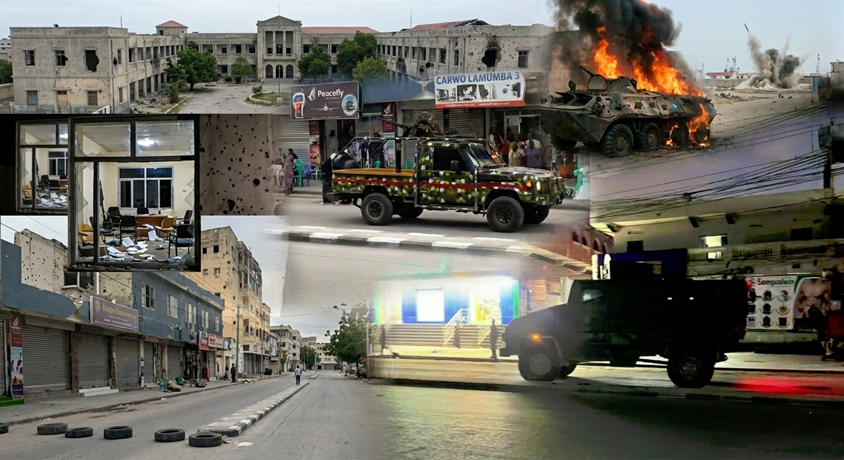
Mogadishu – Somalia’s capital woke up under a de facto lockdown this morning after hours of intense overnight fighting. Heavy clashes, involving a range of weaponry, erupted across several key districts, pushing Mogadishu to the edge of political collapse. The violence stems from a deepening dispute over an electoral process widely condemned as unconstitutional, alongside accusations that President Hassan Sheikh Mohamud is clinging to power by force. Casualties have been reported, property has been destroyed, and residents once again fear forced displacement.
The Root Cause: A Term Extension Rejected by Opposition
The government’s term officially ended in May, but Parliament voted to extend it by one year. The opposition—including former Prime Minister Hassan Ali Khaire and former President Sharif Sheikh Ahmed—has described the extension as illegal and called for mass protests. This political gridlock ignited the worst street battles the capital has seen in years.
Assault on Former Prime Minister Escalates Tensions
The crisis took a sharply more dangerous turn yesterday when government forces reportedly attacked former Prime Minister Hassan Ali Khaire while he was meeting with prominent members of his clan. The targeting of a leading opposition figure and presidential hopeful has sent shockwaves through the political landscape. Opposition leaders view the incident as a deliberate attempt by the sitting administration to neutralize or intimidate its rivals. Khaire’s guards and allied militias later clashed with government troops near his residence.
Overnight Battlegrounds and Initial Casualties
Following the attack on Khaire, fierce fighting broke out overnight in the Abdi’aziz district—specifically the Mirinayo neighborhood—as well as in Howlwadag. According to residents and social media footage, government forces clashed with armed groups loyal to former President Sharif Sheikh Ahmed and other opposition figures.
Key confirmed damage and casualties include:
- Burned Armored Vehicles: Two government-owned armored personnel carriers (APCs) were set on fire.
- Stray Mortars: Several mortar shells landed near the Port of Mogadishu and other parts of the capital.
- Civilian Injuries and Deaths: Local health journalists and eyewitnesses have reported deaths and injuries among both civilians and combatants. Some of the wounded died from blood loss because ambulances could not reach conflict zones due to gunfire and roadblocks.
- Property Damage: Artillery and heavy gunfire hit buildings near the residences of Khaire and Sheikh Ahmed, as well as in other neighborhood where opposition guards were present.
Opposition Protests Crushed Before They Begin
The opposition coalition had planned a large peaceful demonstration today to protest delayed elections, the assault on their leaders, and what they see as an illegitimate term extension for the president. But those plans faced an immediate government crackdown.
Security forces deployed heavily around designated protest squares and blocked major roads leading to strategic locations, effectively strangling any public mobilization. The preemptive suppression turned last night’s armed confrontation into a broader political and civil standoff, paralyzing movement across the capital throughout the day.
Presidency Digs In as Opposition Fights Back
Unconfirmed reports suggest that President Hassan Sheikh Mohamud ordered military commanders to press forward with operations against opposition forces—both to degrade their military capabilities and to halt planned protests. However, government troops met stiff resistance. Opposition fighters deployed heavy weapons and technicals (battle vehicles), signaling that they remain entrenched in Mogadishu and are willing to defend their political ground against any state offensive.
Displacement and Paralysis
Hundreds of families living in Howlwadag and Abdi’aziz districts have fled their homes seeking safer areas. Today, Mogadishu resembles a ghost town. Major roads remain closed, bringing all movement to a halt. Shops and businesses have shuttered, delivering a severe economic blow to residents already struggling under harsh living conditions.
International Concern and Pressure
The fighting has drawn sharp concern from the international community. The United Nations and the U.S. Embassy in Mogadishu called for an immediate halt to the violence and warned both sides that their actions endanger the country’s future. The African Union also issued appeals to resolve the electoral disputes peacefully.
Ceasefire and Current Situation
As night fell, no formal agreement had been reached to end the fighting. However, the situation in conflict areas—including Dabka Intersection and around Howlwadag district—has reached a working ceasefire, with government forces intervening between the opposing sides. Security forces continue to conduct operations in the affected areas of the Banadir region.
Casualty Figures: Still Unknown
To date, no complete official figure has been released for the actual casualties resulting from the fighting. The intensity of the clashes and the difficulty of independently accessing the conflict zones have prevented a full tally. The true human cost will likely only be known when the city fully calms down.
What Comes Next?
Local security and political analysts warn that this week’s events—the term extension, the attack on a former president or prime minister, the overnight firefights, and the displacement of hundreds of families—are ominous signs of how volatile the crisis has become. Using military force against opposition leaders and suppressing peaceful demonstrations, experts say, risks dragging the country back into full-scale civil conflict.
The path to stability is now dangerously narrow. Only an immediate halt to the violence, space for citizens to express grievances peacefully, and a return to inclusive dialogue over the country’s electoral future. Without it, Mogadishu risks sliding back into the darkest hours of the 1990s.
