
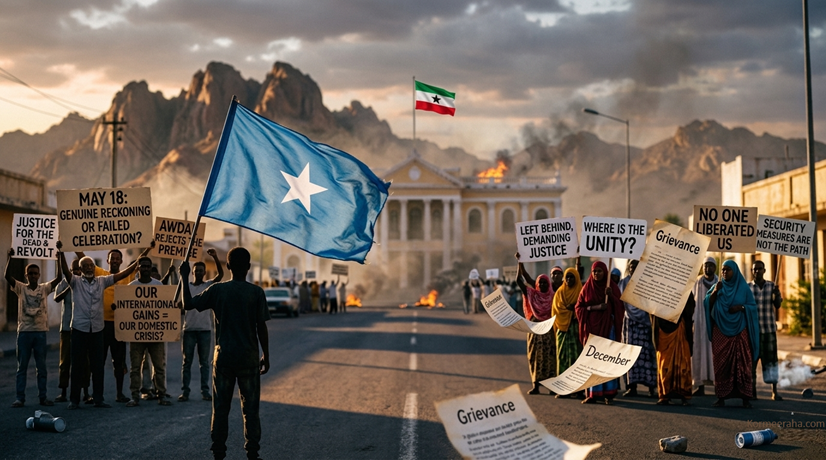
In Borama, youth burn flags to protest the May 18 celebration while elders warn of “Mogadishu propaganda.” Between Israel’s recognition and December’s dead protesters, a region’s broken promise threatens to unravel Somaliland’s 35-year project.
The Generation War
Awdal is at war with itself—but the battlefield is generational. On one side stand the youth protesters who took to Borama’s streets on May 17, tearing down Somaliland’s flag and setting it ablaze while waving Somalia’s blue banner. On the other side are the elders and traditional politicians who insist the May 18 celebration must proceed, warning young people they have fallen victim to what they call “Mogadishu propaganda.”
This isn’t merely a dispute over ceremony. It is a fundamental clash over identity, memory, and justice.
The youth’s rejection comes with fresh blood on their hands—the memory of fellow Borama protesters killed in December remains raw. Demands for an independent investigation into the lethal force used against unarmed civilians continue unanswered. For young Awdalites, celebrating Somaliland’s independence while their comrades’ killers walk free is unthinkable.
The Irony of Representation
Here lies Somaliland’s bitter paradox: the Foreign Minister spearheading this year’s May 18 celebration is himself from Awdal. Abdirahman Daahir Adan (Bakaal) has declared the 2026 commemoration uniquely significant, citing Israel’s recent recognition of Somaliland as a secessionist state.
But his hometown doesn’t celebrate. Instead, authorities have tightened security, fearing national pride events will merge with local grievances. The minister’s diplomatic triumph has become his region’s nightmare.
35 Years of Marginalization
Beneath the flag-burning and generational disputes lies a deeper accounting that stretches back three and a half decades. Awdalites describe a prolonged pattern of systematic exclusion that has defined their experience within Somaliland. Development funding, they argue, consistently bypasses their region, leaving infrastructure projects and economic opportunities concentrated elsewhere. At the same time, residents face heavy taxation without meaningful representation in the decision-making bodies that determine how those revenues are spent.
Political activity in Awdal is met with intensive surveillance, creating an atmosphere of suspicion that stifles dissent and discourages civic engagement. This underrepresentation in Somaliland’s power structures extends to government appointments, parliamentary seats, and security sector leadership. For a region that never enthusiastically embraced Somaliland’s unilateral declaration of independence in 1991, the promise of inclusion has rung hollow. The cumulative effect of these grievances has transformed quiet resentment into open resistance.
The Geography of Betrayal
Awdal’s predicament is also geographic. Trapped between Djibouti and provinces inhabited by what many describe as the most extreme separatist factions in Somalia, the region has become a contested buffer zone between Djibouti and Somaliland. This strategic location has made Awdal a focal point for competing regional interests, yet its residents have made their political choice clear: they want to be part of a unified Somali state governed from Mogadishu.
This unionist identity puts them at direct odds with Hargeisa’s separatist project—and makes them targets. Rather than being treated as equal partners in Somaliland’s state-building endeavor, Awdalites increasingly feel like subjects of a government they never chose.
The Xeer Ciise Flashpoint
Last fall brought the crisis to a boiling point. When an event celebrating a book called “Xeer Ciise”—which claims Awdal as part of the Issa clan’s traditional territory—was planned, locals refused to accept it. The Issa clan spans Djibouti and Ethiopia, and this cultural claim was widely perceived in Awdal as a form of territorial encroachment disguised as heritage preservation.
Somaliland’s decision to support the move transformed a cultural dispute into a political confrontation. The result was armed conflict, with dozens of Awdal youth killed and over a hundred more imprisoned. The violence revealed whose side Hargeisa was on—and it wasn’t Awdal’s. For many residents, this was not an isolated incident but the latest chapter in a long history of marginalization enforced by state power.
Israel Recognition: A Double-Edged Sword
Israel’s recognition of Somaliland should have been Hargeisa’s diplomatic triumph. Instead, it has added another layer of sensitivity to an already explosive situation. For the central government, international validation strengthens their case for statehood and opens doors to new partnerships. For Awdal youth, however, it deepens the separation from Somalia they never wanted and tightens the grip of a state they do not recognize.
The timing could not be more fraught. As Somaliland celebrates its growing diplomatic footprint, Awdal residents see their own aspirations for unity with Somalia being further marginalized. The foreign minister’s hometown celebration of Israeli recognition has become, for many young Awdalites, a symbol of everything they oppose.
The Unhealed Wound
Beneath any surface calm, the political and emotional fractures exposed by the December crisis remain far from healed. Elders, activists, and community leaders continue calling for accountability. Funerals have ended, but demands for justice persist. Civil society groups have repeatedly urged the establishment of an independent commission to investigate the use of lethal force against unarmed civilians, arguing that only transparency can begin to restore trust.
The warning is explicit: without an independent investigation into the killing of unarmed civilians, Awdal’s political future will be shaped by these wounds for years to come. Impunity, they argue, only fuels the next cycle of protest and repression.
What This Means for Somaliland
Awdal’s crisis exposes the fundamental contradiction at the heart of Somaliland’s project. Can a state built on the principle of self-determination deny that same right to its own regions? Can international recognition compensate for growing domestic illegitimacy? And how long can Hargeisa govern a unionist region primarily through coercion rather than consent?
As May 18 celebrations proceed under tightened security, with a Foreign Minister from Awdal celebrating Israel’s recognition while his kinsmen burn flags in protest, Somaliland faces its most serious internal challenge since 1991. The question isn’t whether Awdal will remain quiet. It is whether Somaliland can survive the answer when it finally speaks.
THE BOTTOM LINE: May 18 was meant to showcase Somaliland’s unity and diplomatic progress. Instead, it has exposed a region in open revolt, a generation demanding justice for the dead, and a state whose international gains may be deepening its domestic crisis. Awdal isn’t just protesting a celebration—it is rejecting the entire premise of Somaliland’s existence. The path forward requires more than security measures or diplomatic milestones; it demands a genuine reckoning with the grievances of those who feel left behind by the very project meant to liberate them.