

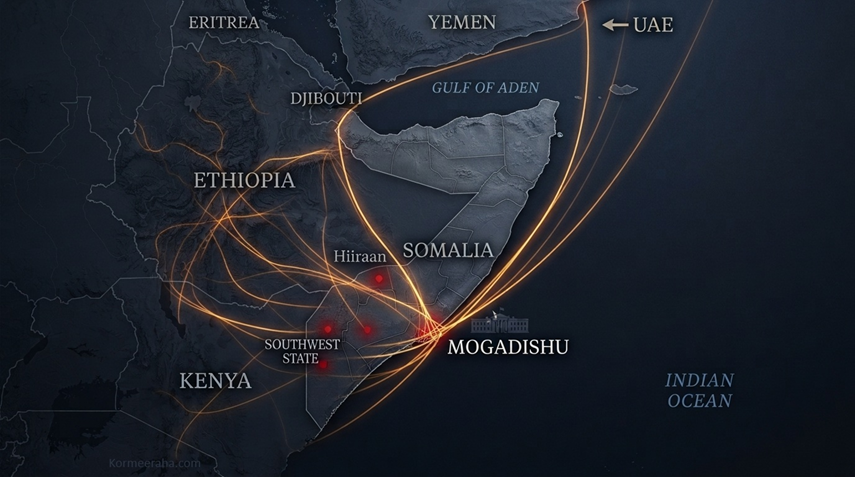
The diplomatic rupture between Somalia and the United Arab Emirates in January 2026 has escalated dramatically. What began as a dispute over sovereignty has evolved into a full-spectrum campaign to isolate and unseat President Hassan Sheikh Mohamud.
Leveraging vast financial resources and regional alliances, the UAE has systematically empowered sub-national actors and opposition figures. This strategy aims to render the Federal Government of Somalia (FGS) ungovernable. It has catalyzed a convergence of military, political, and constitutional crises.
“The diplomatic rupture between Somalia and the United Arab Emirates (UAE) in early 2026 has evolved from a severe sovereignty breach into a full-spectrum geopolitical campaign to isolate and unseat President Hassan Sheikh Mohamud.”
The Catalyst: The Early 2026 Fallout
The breakdown in relations was triggered by a brazen violation of Somali sovereignty. This simultaneously sparked a diplomatic fallout with Saudi Arabia. The immediate catalyst was the UAE’s unilateral facilitation of a Yemeni separatist leader’s escape. Abu Dhabi utilized Somali ports and airspace to smuggle the figure out of the country without consulting the Federal Government.
This act severely undermined Mogadishu’s authority. It also angered Riyadh, which viewed the manoeuvre as a destabilizing overreach. Under significant diplomatic pressure from Saudi Arabia, President Hassan Sheikh’s administration was compelled to take a firm stand. This geopolitical realignment was compounded in January 2026. Mogadishu unilaterally annulled defence, security, and port agreements with the UAE. This deepening rift culminated in November 2026 when Somalia expelled the UAE ambassador. Mogadishu accused Abu Dhabi of launching an “open invasion” by backing armed groups outside the national command structure.
Empowering Sub-National Power Centres
The UAE has bypassed Mogadishu to directly fund and arm regional leaders. The main active military flashpoint is currently in the Southwest State. There, former President Abdiaziz Hassan Laftagareen is wrestling for his political comeback. The UAE has provided tacit and material backing to his forces. This support enabled them to rapidly capture strategic districts like Buurhakaba in late 2026. This advance was facilitated after Ethiopian AUSSOM troops deliberately vacated the area.
Beyond the Southwest, Puntland and Jubaland have previously defeated federal forces. The UAE maintains independent security and economic agreements with these states, as well as Somaliland. By ensuring these regions have the financial autonomy to resist Mogadishu’s centralizing efforts, Abu Dhabi effectively fractures the federation.
“Rather than engaging in direct confrontation, the UAE has executed a sophisticated, indirect strategy designed to hollow out the Federal Government of Somalia from the inside and the periphery.”
Exploiting the AUSSOM Security Vacuum
The UAE is also actively exploiting the severe security vacuum created by the financial struggles of the African Union Support and Stabilization Mission in Somalia (AUSSOM). Following the withdrawal of crucial US funding and Uganda’s subsequent decision to pull its troops, the mission has faced imminent operational collapse.
In this void, the UAE has strategically positioned itself to fill the gap, offering alternative funding and logistical support to specific regional forces or peacekeeping contingents. This tactic deliberately fractures the unified AU command, allowing the UAE to cultivate loyalist security pockets that operate independently of the Somali National Army (SNA), thereby further diluting Mogadishu’s monopoly on the use of force.
Fuelling Localized Insurgencies and Clan Militias
Abu Dhabi has aligned with intelligence figures who have broken ranks with the current administration to paralyze the capital and regional governance. A central figure in this opposition is Abdullahi Sanbaloolshe, the former NISA director and former Minister of Information. Having broken ties with Hassan Sheikh, Sanbaloolshe leverages his profound understanding of Somalia’s security architecture to mobilize clan-based resistance in Hiiraan and facilitate cross-border coordination, notably via Ethiopia, to challenge federal authority.
A significant armed resistance, from within the Hawiye clan itself, is now being organized by Sanbaloolshe. This former intelligence chief hails from the Hiiraan region and is mobilizing his sub-clan, the Hawadle. This burgeoning flashpoint is driven by long-standing disputes over the presidency of Hirshabelle, a position consistently held by a member of the Abgaal sub-clan—the very same sub-clan to which President Hassan Sheikh belongs.
Armed clashes took place on Thursday, November 19, 2026, at Ugaas Khalif Airport in the city of Beledweyne, involving a local militia from the Hawadle clan (Macawiisley/Dulmi Diid) and Djiboutian forces serving as part of the African Union mission, AUSSOM. Djibouti is the only neighboring country that supports Hassan Sheikh Mohamud’s tenure. On November 23, the Djiboutian president’s son-in-law, Sadaq Omar Mohamed—known as “Sadaq Joon”—was appointed Somalia’s Minister of Defence.
By keeping Hiiraan in a perpetual state of rebellion, the UAE ensures the SNA is distracted and overstretched. The army becomes unable to project power toward Mogadishu or the Southwest. This effectively paralyses the federal government’s security apparatus.
Orchestrating the Political Opposition
Abu Dhabi has also aligned with specific Somali political figures to complement its military manoeuvres. However, the main Mustaqbal leaders remain confined in Mogadishu. Federal forces recently attacked their militias near Villa Somalia, rendering them militarily harmless. Despite this, the UAE continues to provide political backing to Mogadishu-based opposition alliances. This external support gives sub-national leaders and opposition figures greater room to pursue their priorities. It allows them to resist federal moves on constitutional changes more effectively.
Furthermore, the UAE has provided financial and political backing to Mogadishu-based opposition alliances, such as the Mustaqbal Council, and various regional strongmen. These groups are actively boycotting governance structures and stalling electoral reforms, working in tandem with external backers to render the FGS politically illegitimate and administratively paralyzed.
Hosting Political Consultations in Abu Dhabi
Somali opposition figures and regional leaders have reportedly been hosted in Abu Dhabi for political consultations. These meetings occurred amid escalating tensions over elections, federalism, and the diplomatic rift. Reported participants include former President Sharif Sheikh Ahmed, Puntland President Said Abdullah Deni, and Jubaland President Ahmed Madobe. No joint statement has officially outlined the outcome of those meetings. Reports point to informal consultations occurring around September and October.
Media outlets reported that Deni and Madobe travelled from Nairobi to Abu Dhabi. They held discussions with senior Emirati officials regarding Somalia’s constitutional disputes. In late October, Sanbaloolshe stated he held discussions in the UAE. He named Deni, Madobe, and Somaliland’s Abdirahman Irro in talks about forming an opposition alliance. Neither the UAE government nor the main opposition coalition has released an official communiqué confirming a formal summit.
President Mohamud and his now ousted Defence Minister Ahmed Moallim Fiqi have accused the UAE of supporting domestic rivals. They accuse Abu Dhabi of undermining sovereignty by backing forces outside federal control. Conversely, several regional administrations have pushed back against Mogadishu. They have maintained strong ties with Abu Dhabi. These include Puntland, Jubaland, and the Southwest State. Despite these heavy accusations, the UAE has consistently denied interfering in Somalia’s internal affairs.
Geopolitical Encirclement via Ethiopia and Kenya
The UAE has leveraged its strong economic ties with Addis Ababa and Nairobi. This ensures Mogadishu is completely isolated on the international stage. Ethiopia is deeply angered by Hassan Sheikh’s alignment with Egypt over the Nile. Addis Ababa has withdrawn its protective buffer and shifted its posture against the Somali president.
Ethiopia is actively facilitating the movement of opposition figures. This cross-border coordination allows figures like Sanbaloolshe to challenge federal authority directly from Ethiopian territory. It is also allowing Laftagareen’s forces to manoeuvre freely. This signals that Addis Ababa no longer views Hassan Sheikh’s survival as a strategic interest. A September 4 assassination attempt on General Mahad Abdirahman Aden reveals more of this complex puzzle. Known as “Shub,” the former Custodial Corps commander was a staunch Laftagareen supporter. He was reportedly coordinating directly with Ethiopian and Kenyan actors regarding this movement.
Meanwhile, Kenya has been brought firmly into Abu Dhabi’s orbit. This is bolstered by massive UAE financial injections, including a $1.5 billion budget loan. This economic leverage ensures Nairobi aligns its regional posture with UAE interests. It effectively tightens the diplomatic noose around Mogadishu from all sides.
The Constitutional Crisis as the Final Accelerant
The UAE’s multifaceted strategy reached its zenith when Somalia’s Supreme Court ruled in November 5. The court declared President Hassan Sheikh’s one-year term extension unlawful and his tenure legally void. This ruling provided the UAE and its allied opposition factions with the ultimate legal pretext to declare the administration illegitimate.
The court’s decision triggered mass protests across the capital and a total boycott of governance structures. Opposition figures, freshly empowered by their consultations in Abu Dhabi, leveraged this ruling to halt all parliamentary proceedings. This caused a complete breakdown of state authority and paralyzed the federal budget process. Ultimately, this transformed a geopolitical dispute into an existential constitutional crisis. The legal void has left the country without a universally recognized executive authority. This institutional paralysis perfectly serves Abu Dhabi’s goal of rendering the federal government entirely ungovernable.
Conclusion: The Futility of Confrontation
The convergence of military rebellion in the Southwest, clan mobilization in Hiiraan, political paralysis in Mogadishu, and the active hostility of neighboring states represents a perfectly coordinated, multi-dimensional siege on the Federal Government. This is not a temporary political setback; it is a systemic collapse engineered by a coalition with vastly superior financial, intelligence, and geopolitical resources.
“The safe way out for him is to abandon his bid to remain president by any means.”
The security situation would get worse unless Hassan Sheikh realizes it is futile to continue his confrontation with the UAE and its allies in and around Somalia and thus plunge the country in further turmoil. Attempting to cling to power through coercive state measures will only deepen clan fractures, empower Al-Shabaab to exploit the security vacuum, and accelerate the disintegration of the state. Recognizing the reality on the ground, stepping aside, and facilitating a negotiated, inclusive, and peaceful political transition is the sole remaining path to spare the nation from further bloodshed.
Related
- The Lame Duck’s Roar: How Hassan Sheikh’s Late Stand Against the UAE Masks a Sovereign Crisis (November 19, 2026)
- The Dual Collapse: When Constitutional Crisis Meets Security Freefall in Somalia (November 10, 2026)
- Between Two Anchors: Somalia’s Coast, Foreign Patrons, and the Failure of National Leadership (November 8, 2026)
- The Shub Assassination Plot: Sovereignty, Suspicion, and Spoiled Evidence (September 30, 2026)
- Inside Somalia’s Rift with the UAE (January 18, 2026)