

Western nations are urging Somalia to annul a direct election law that was unanimously passed by Parliament and signed by President Mohamed Abdullahi Farmajo on April 12.
The People’s Representatives, Somalia’s Lower House, took a significant constitutional step on April 12 to resolve the federal election deadlock, passing a law that repeals the controversial September 17 agreement on indirect elections.
Public Response to Electoral Reform
The legislation, which would enable universal suffrage for direct election of members of parliament and the president for the first time since 1969, was welcomed by many Somalis frustrated with clan dominance, vote-buying in previous elections, and regions’ ability to block the electoral process.
Although passed by an absolute majority of MPs, the law has drawn opposition from individuals perceived to benefit from the previous indirect electoral system, with some threatening civil unrest.
International Community Divided
The legislation has divided the international community between those respecting Somalia’s sovereign right to determine its electoral process and those advocating for continued international oversight.
While some UN Security Council members support Somalis managing their internal affairs within established frameworks, American and European countries have emerged as primary opponents, reportedly concerned about alignment with their own interests.
Western Diplomatic Pressure
Following the law’s passage—which also extends the administration’s current term—officials from Western nations issued critical statements challenging Somalia’s federal institutions and warning of consequences if the new law remains in place.
After months of urging Somali leaders to hold elections “immediately,” while simultaneously shielding Puntland and Jubaland leaders who were blocking elections, the US, EU, and UK have shifted focus to target the Somali parliament and president over the new election bill.
US Secretary of State Antony Blinken tweeted: “The decision to extend the Federal Government’s term undermines further the country’s peace and security. We call on Somalia’s Federal Government and Federal Member States to return to talks and agree to a way forward.”
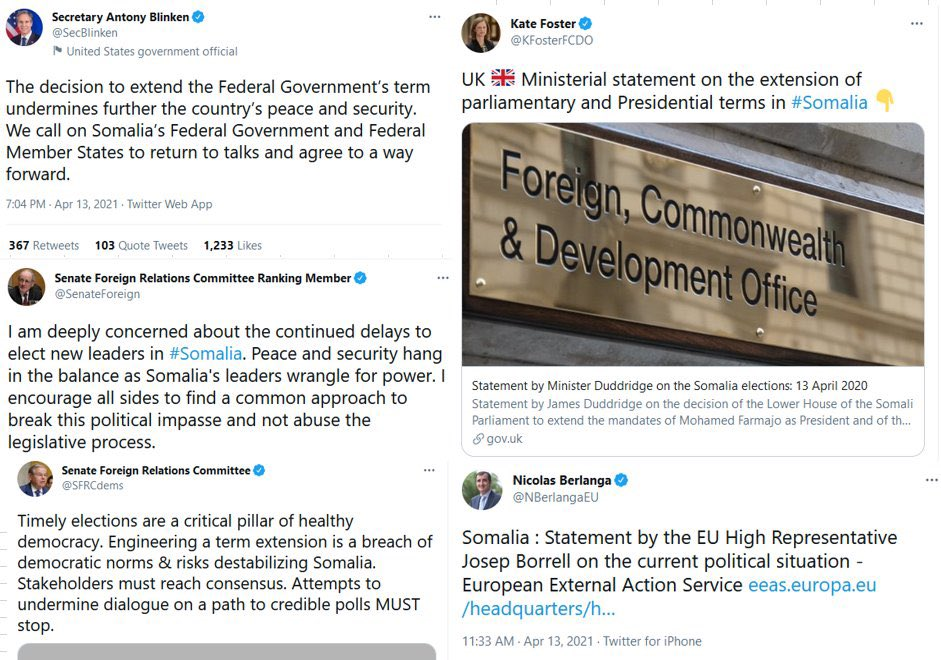
A strongly worded tweet from the US Senate Foreign Relations Committee addressed to the Somali President and Parliament stated: “Engineering a term extension is a breach of democratic norms & risks destabilizing Somalia. Stakeholders must reach consensus. Attempts to undermine dialogue on a path to credible polls MUST stop.”
Accusations of Undermining Stability
Critics argue these statements support agitators by branding state institutions as illegal while projecting instability unless the parliament and government change course.
Some observers suggest this Western approach aligns with foreign policies toward African, Asian, and Latin American nations that have historically contributed to unrest and displacement.
Somalia’s Defence of Sovereignty
The Somali administration, aware of potential repercussions, has demanded respect for its sovereignty while attempting diplomatic engagement with these donor nations who are also UN Security Council members.
The Somali Foreign Ministry issued a communique affirming the government’s commitment to addressing elections and security issues while pursuing free, fair, and direct elections as demanded by citizens.
Official Response from Mogadishu
The statement read: “The Federal Government of Somalia is deeply dismayed to see public statements made by some of its international partners and long-time friends that misconstrue the laws passed by government institutions to uphold the democratic rights of the people to choose their leadership, and instead paint them as unlawful term extensions.
“While we appreciate the concerns of our friends and international partners for Somalia’s stability and security, it is regrettable to witness champions of democratic principles falling short of supporting the aspirations of the Somali people to exercise their democratic rights.
“Inflammatory statements laden with threats, which undermine the political independence and sovereign rights of national institutions, will only serve to embolden terrorist organizations and anti-peace elements in Somalia.”
The Oil Factor
This renewed international interest in Somalia coincides with recent oil discoveries. American, British, Norwegian, French, and Italian oil companies have reportedly signed contracts with previous Somali government members without parliamentary approval—individuals now leading opposition to the direct election law.