
As orderly queues formed in Addis Ababa, millions across Tigray, Amhara, and Oromia were excluded from voting—underscoring the deep fractures beneath Ethiopia’s democratic veneer.
Long before dawn broke over Addis Ababa on June 1, queues of voters had already formed outside polling stations across the Ethiopian capital. Many arrived eager to cast ballots in what government officials hailed as another step forward in the country’s democratic journey. “This election allows the people to exercise their right to choose without any external pressure,” one voter said afterward. “It is important for determining the social and economic destiny of our country.”
Yet beyond the orderly scenes of the capital, a very different reality unfolded. Entire regions consumed by conflict were excluded from voting. Opposition parties complained of severe restrictions. Independent observers questioned whether the election could genuinely be considered competitive at all.
The contrast could hardly be starker: ballots in the capital, bullets in the regions.
With Prime Minister Abiy Ahmed’s Prosperity Party widely expected to secure a comfortable parliamentary majority, few believe the outcome will alter the country’s political leadership. Instead, attention has turned to what a renewed mandate might mean for a nation where millions remain voiceless—and where the prime minister’s ambitions increasingly reach beyond Ethiopia’s borders, toward the Red Sea and regional dominance.
An Election With a Foregone Conclusion
Ethiopians were voting to elect 547 members of the House of Peoples’ Representatives, who will subsequently choose the prime minister. Despite the country’s population of roughly 130 million, only around 50 million people were registered to vote.
The election took place against a backdrop of continuing instability. No voting occurred in the Tigray region, while polling was limited in parts of Amhara and Oromia where insurgencies and security challenges persist. As a result, millions of Ethiopians were unable to participate in the country’s most important political exercise.
Prime Minister Abiy nonetheless presented the election as evidence that democratic governance remains possible. After casting his ballot, he accused opponents and foreign adversaries of attempting to undermine public confidence through propaganda and destabilisation efforts.
Critics, however, argue the outcome was effectively predetermined—with opposition parties restricted, marginalised, or unable to campaign freely due to conflict and government controls. For many observers, the vote appeared less about choosing a government than about reinforcing the political authority of one that already dominates the national landscape.
A Nation Divided Between Progress and Conflict
Reliable nationwide polling remains scarce, but many analysts describe a growing divide between urban and rural perceptions of the government.
In Addis Ababa, supporters point to new roads, modern buildings, and ambitious infrastructure projects as evidence of progress under Abiy’s leadership. The capital has undergone a dramatic transformation, becoming a symbol of the government’s modernisation agenda.
Outside the major cities, however, the picture is considerably more complex. Large areas of rural Ethiopia continue to grapple with food insecurity, displacement, economic hardship, and the consequences of prolonged conflict. For many communities in Tigray, Amhara, Oromia, and other affected regions, development projects in the capital have not translated into improved security or living conditions.
This contrast highlights one of Ethiopia’s most pressing challenges: balancing modernisation with unresolved political grievances and regional tensions.
Tigray’s Exclusion and Regional Implications
Particular controversy surrounds the continued exclusion of Tigray from national elections. For the second consecutive election cycle, the region did not participate, leaving millions of citizens without representation. Critics argue this raises fundamental questions about the election’s legitimacy.
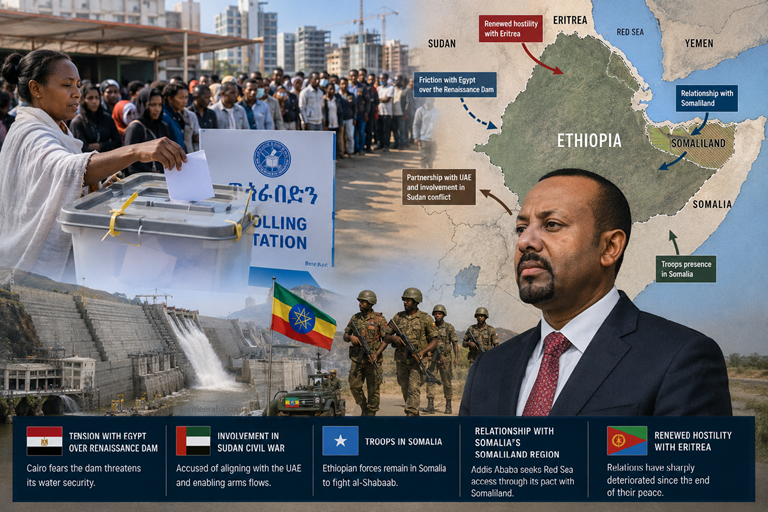
Beyond domestic politics, the election carries significant consequences for the wider Horn of Africa. One of the most sensitive issues is Ethiopia’s pursuit of direct access to the Red Sea. Since losing its coastline following Eritrea’s independence in 1993, Ethiopia has depended heavily on neighbouring Djibouti for maritime trade. Abiy has repeatedly argued that securing sovereign access is a strategic necessity for long-term development.
These ambitions have generated controversy, particularly following Ethiopia’s 2024 agreement with Somaliland. Critics warn that a renewed mandate could embolden the government to pursue these objectives more aggressively, potentially increasing tensions with Somalia, Eritrea, and other regional actors.
The Grand Ethiopian Renaissance Dam (GERD) remains another enduring source of tension. While Ethiopia views the massive hydroelectric project as essential for development and energy security, Egypt continues to regard it as a potential threat to its water supply. Years of negotiations have failed to produce a comprehensive agreement.
Relations with Eritrea have also soured dramatically. The 2018 peace agreement that earned Abiy the Nobel Peace Prize has largely evaporated amid disagreements over the aftermath of the Tigray War, regional security arrangements, and Ethiopia’s Red Sea push. Fears of a potential confrontation between the former allies have become a recurring concern among diplomats and security analysts.
A Debate About Power, Democracy, and the Future
These regional tensions intersect with a broader debate about Ethiopia’s direction. Supporters argue the country is pursuing an ambitious strategy of state-building, economic modernisation, and national renewal—emerging as a genuine regional power.
Critics offer a different interpretation. They argue that economic development cannot compensate for restrictions on political freedoms, the exclusion of opposition voices, and the unresolved grievances that continue to fuel conflict in several regions. They question whether an election that excludes millions of citizens can provide the legitimacy required to unite a deeply divided nation.
The debate ultimately reflects a larger question confronting many African states: Can stability and development be achieved without broad political inclusion, or are democratic freedoms an essential component of long-term national cohesion?
What is certain is that the election has given Abiy Ahmed a renewed mandate at a moment when Ethiopia faces profound challenges. The insurgencies in Amhara and Oromia remain unresolved. Tigray’s political future is uncertain. Relations with Egypt, Somalia, Eritrea, and Sudan remain fragile. Millions of Ethiopians continue to grapple with the economic and humanitarian consequences of years of conflict.
For supporters, the election represents continuity and an opportunity to advance Ethiopia’s transformation into a stronger, more influential state. For critics, it symbolises a political system that has yet to reconcile development ambitions with democratic inclusion.
Either way, this election may ultimately be remembered less for the votes cast in Addis Ababa than for the decisions made afterward. Those decisions could shape not only Ethiopia’s future but also the balance of power across the Horn of Africa and the wider Red Sea region for years to come.