
Officially recognized as Somalia’s 7th federal member state, the Northeast State (SSC-Khatumo) has achieved a historic legal milestone. But can paper recognition survive the harsh realities of economic isolation, constitutional disputes, and internal fractures?
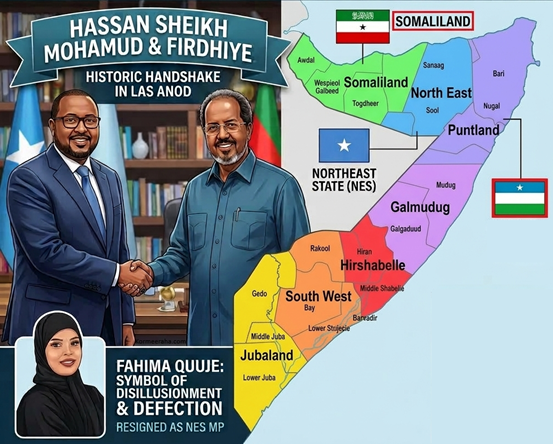
In July 2023, a historic uprising erupted in Las Anod. Youth, women, and elders united to resist Somaliland forces, declaring their desire for self-determination. Three years later, that raw, grassroots energy has been formalized into statehood. As of late 2025 and early 2026, the Northeast State (NES), also known as SSC-Khatumo, has crossed a monumental threshold: it is now officially recognized domestically and internationally as the 7th federal member state of the Federal Republic of Somalia.
Crucially, the NES constitution is explicitly structured to encompass the historic regions of Sool, Sanaag, and Cayn. By uniting these three distinct regions, the administration theoretically satisfies the constitutional mandate of forming a state from “two or more regions.” Yet, as we navigate the latter half of 2026, the central question has shifted. It is no longer “Will they be recognized?” but rather, “Can this newly minted state survive the immense political, economic, and constitutional pressures pulling it from all sides?”
💡 QUICK FACTS: The 7th State Milestone
- August 2025: The Ministry of Interior officially announced NES as the 7th member state, approving its name, flag, and constitution.
- January 2026: President Hassan Sheikh Mohamud made a historic visit to Las Anod, declaring NES a “full member state.”
- Federal Registry: The Ministry of Planning has formally added NES to the official list alongside Puntland, Jubaland, Galmudug, South West, Hirshabelle, and Somaliland.
The Presidential Flip-Flop: Balancing Clan Power and Electoral Survival
President Hassan Sheikh Mohamud’s oscillating stance toward the Northeast State (NES) is a high-stakes balancing act to navigate Somalia’s complex clan politics and secure his electoral survival.
Historically, he leaned toward Somaliland via the “Irir Samale” alliance to counter a feared Darod coalition takeover. This bias required keeping Somaliland’s Mogadishu representatives—crucial for his re-election bid—on side, putting any move to diminish Hargeisa’s territorial claims on hold, despite its recent recognition by Israel.
Last month, President Hassan Sheikh Mohamud stated clearly: “Hirshabelle was the last federal member state to be established in the country.” This brief statement sent tremors throughout Somali politics, especially among the people of Sool, Sanaag, and Cayn (SSC).
Yet, NES disrupts the delicate federal balance of two Darod-led and two Hawiye-led states. The formation of the NES constitutes an anomaly in Somali political life: unlike the other regional states, it is led by a clan that did not take part in the collapse of Somali central authority in 1991. This unique historical legitimacy creates a third Darod-aligned entity that initially threatened the equilibrium.
However, electoral necessity forced a pivot. With Puntland and Jubaland firmly aligned with the opposition, Hassan Sheikh turned to Las Anod. He leverages Puntland’s hostility toward an SSC region outside its control to garner grassroots support in Laascaanood. By positioning himself as the protector of SSC interests against encroachment, he secures a vital political base, using NES to fracture the opposition’s Darod stronghold and secure his second term.
The Constitutional Controversy of the “7th State”
While federal institutions now record NES as a fully-fledged regional state, this status remains controversial. The primary debate centers on numbering and Somaliland’s paradoxical status.
Some analysts argue NES should be considered the 6th functional regional state. This rests on the premise that Somaliland, despite declaring independence, remains deeply entangled in Somali politics. Elected MPs representing Somaliland’s regions in the Mogadishu-based federal parliament continue to actively advocate for their constituencies’ interests, contradicting claims of total detachment. How Somaliland views itself externally has no bearing on reality: it remains part of Somalia’s political tapestry of centrifugal forces. Treating it as a “vacant slot” is a legal fiction; the active federal system operates with five functioning member states, making NES the 6th functional state (or the 7th, if counting Somaliland’s nominal, albeit inactive, registry status).
Furthermore, while uniting Sool, Sanaag, and Cayn satisfies the “two or more regions” rule on paper, legal traditionalists cite the Galgudud precedent. Formed in 2014 through controversial political gymnastics, Galmudug comprises only one full region and part of Mudug, falling short of the strict constitutional allowance. Because the system halted at Hirshabelle to avoid repeating Galgudud’s friction, advancing NES without a nationwide constitutional referendum is viewed as setting a precarious precedent.
Nevertheless, despite political debates and opposition from neighboring administrations, current legal frameworks and Villa Somalia’s official recognition define the Northeastern State as a full-fledged regional state within Somalia’s federal system as of 2026.
The Illusion of Recognition vs. The Reality of Isolation
Despite the historic ink on official documents, the ground reality in Las Anod tells a story of profound economic and political isolation. The city remains geographically trapped between two hostile neighbors: Somaliland and Puntland.
Las Anod lacks a seaport, making its trade entirely dependent on Bosaso (Puntland) and Berbera (Somaliland). Both administrations have weaponized this dependency, actively pressuring merchants who supply the Northeast State. Recently, disputes over taxation and the qat/khat trade have intensified, with Puntland implementing bans on vehicle license plates originating from the Northeast State. Furthermore, while the NES administration exercises practical control over eastern Sool, the broader Sanaag and Cayn regions remain heavily contested or actively governed by Puntland and Somaliland forces.
This disconnect between high-level political recognition and grassroots reality has bred deep disillusionment, perfectly symbolized by the recent defection of Fahima Yusuf Ahmed (Fahima Quuje). In July 2026, Fahima—a prominent parliamentarian and one of the most visible faces of the 2023 youth uprising—resigned and relocated to Hargeisa.
In her resignation letter, she stated bluntly: “I do not see anyone genuinely working for the common good of the Somali nation. My people face ten unresolved dangers.” Fahima’s defection is not merely a personal matter; it is a sign that some politicians feel Villa Somalia is using the region merely as a political card, with no real commitments, financial budget, or official international recognition.
“The Northeastern Region is a full member state of the federal government, granted the same rights and responsibilities as other regional administrations in the country.”
— President Hassan Sheikh Mohamud, during his historic visit to Las Anod, January 2026.
Sanaag – The Epicenter of Overlapping Claims
Nowhere is the fragility of this new statehood more apparent than in the Sanaag region, which has become the most fiercely contested territory in Somalia. Three distinct administrations lay claim to it, each with historical and legal arguments.
The Northeast State claims Sanaag (particularly the east and center, inhabited by the Warsangeli and Dhulbahante clans), having allocated 38 parliamentary seats to the Maakhir constituency in its new constitution. Somaliland maintains that all of Sanaag falls within the 1960 British Protectorate boundaries, continuing to administer Erigavo and the western districts. Meanwhile, Puntland insists that eastern Sanaag—including the Maakhir areas of Badhan, Dhahar, and Las Qoray—has been an integral part of its territory since 1998.
This creates a stark contrast between the map and reality regarding Las Qoray. The official map of the Northeast State includes the historic city, designating it in the administration’s 2025 constitution as the second city or the commercial and maritime capital of the Northeast State. However, the ground reality is that Puntland largely controls Las Qoray and eastern Sanaag. Its forces and tax system operate there, and Puntland does not acknowledge Las Qoray being removed from its map.
President Firdhiye’s “Soft Power” Tightrope
Navigating this minefield requires immense political dexterity, which President Abdikadir Aw-Ali “Firdhiye” attempts to exercise through a “soft power” strategy. Rather than provoking military confrontations, his administration focuses on peaceful expansion, clan dialogue, and addressing Maakhir’s historical grievances.
A notable success of this strategy occurred in August 2026, when President Firdhiye successfully integrated Brigadier General Ali Ahmed Ismail “Ashkato”—a senior former Somaliland officer operating in Sanaag—into the NES security apparatus. Furthermore, to prevent the Warsangeli clan from feeling marginalized by the Dhulbahante-dominated capital of Las Anod, Firdhiye has decentralized governance, delegating significant regional decisions to his vice president and Maakhir’s traditional elders.
However, this cautious approach has its critics. The defection of prominent figures like Fahima Quuje highlights a growing sentiment among some Maakhir politicians that the administration is failing to deliver concrete security and economic investment, leaving them vulnerable to the enticing overtures of Hargeisa.
CONCLUSION: The Ultimate Test of Statehood
The Northeast State is a historic anomaly born from blood, courage, and an unyielding desire for freedom. It has achieved the seemingly impossible: transitioning from a grassroots liberation movement into a constitutionally recognized federal member state. Now the 7th star on Somalia’s map, it stands as a testament to the constitutional union of Sool, Sanaag, and Cayn.
But statehood is not merely a title; it is a daily practice of governance. Breaking the region’s economic isolation will not be achieved through military confrontation with Puntland or Somaliland. The only sustainable path forward is Economic Diplomacy: leveraging its new federal status to secure direct budgetary support from Mogadishu, negotiating transparent trade corridors, and genuinely investing in the development of Sanaag to solidify the Maakhir alliance.
President Firdhiye and his government now face their ultimate test. They have won the legal and political battle for recognition. Now, they must win the practical battle of governance. Will they succeed in turning the 2023 dream of freedom into a functioning, prosperous reality in 2026?
Time is short, and history is watching.