
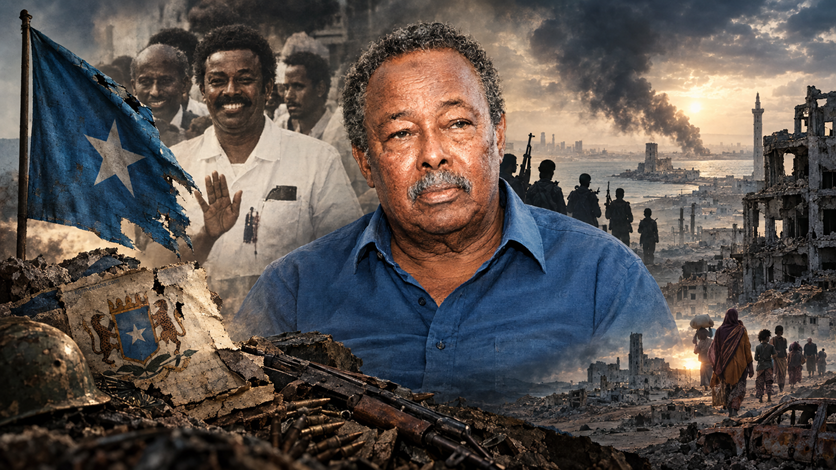
Ali Mahdi Mohamed, the first interim president of Somalia following the collapse of the Siad Barre regime and the country’s fourth president since independence, has died in a Nairobi hospital from complications related to COVID-19.
While remembered by supporters for his steadfast belief in Somali unity and for holding the torch of nationhood during the country’s most turbulent years, his legacy is inextricably bound to the devastating controversies, power struggles, and scandals that defined the early Somali Civil War.
Early Life and the Push for Democracy
Born in 1938 in the village of Addow-uul in the Middle Shabelle region, Ali Mahdi attended school in Mogadishu before traveling to Cairo, Egypt, in 1959 to continue his education. He returned to Somalia and was elected to the Somali Parliament in 1969, becoming its youngest member.
Following the 1969 military revolution, he returned to the Ministry of Health, eventually rising to the position of Director General. In 1977, he resigned from the government to enter the private sector, becoming one of Somalia’s most prominent and successful businessmen over the next decade. In the 1980s, alongside other Somali scholars, he co-founded the “Manifesto” group. The organization made history by sending a letter to then-President Mohamed Siad Barre, boldly calling for democratic reforms and political change in Somalia.
A Disputed Ascension and the Collapse of the State
Following the collapse of Barre’s government in early 1991, Ali Mahdi’s transition to power was immediate and highly contested. Just two days after the dictator fled the capital, a small group of Hawiye clan elders and politicians hastily named Ali Mahdi—the head of the United Somali Congress (USC)—as interim president.
This rapid appointment lacked broad consensus. Major rebel factions, notably the Somali National Movement (SNM), rejected the choice. The hasty coronation deeply angered rival commanders, fracturing the rebel alliance and sparking an immediate, bloody civil war among former allies.
Compounding the political fracture was a catastrophic military decision. During this period, Ali Mahdi’s Prime Minister, Omar Arteh Qalib, ordered the remnants of the Somali National Army (SNA) to surrender to various rebel groups—including the SNM, USC, SSDF, and SPM—who were invading from Ethiopia. Because Ali Mahdi was simultaneously leading the USC, the lines between state and faction blurred. The surrendering army handed over bases, heavy equipment, and vast territories to the militias.
This power vacuum and territorial fragmentation directly set the stage for the SNM to declare the secession of the northwest as “Somaliland.” With no official, unified National Army left to enforce peace, Ali Mahdi’s interim government was left powerless to control the descending chaos.
The War for Mogadishu and The 1992 Famine
The absence of a national army devolved into a brutal turf war between Ali Mahdi and General Mohamed Farrah Aidid, transforming Mogadishu into a devastated battleground. This physical destruction laid the groundwork for an even deadlier crisis: the catastrophic 1992 famine that killed 300,000 Somalis. While Aidid is often viewed as the primary antagonist to international intervention, historical records show Ali Mahdi’s strategies directly engineered this human-induced disaster.
The famine was not a natural drought. The war split Mogadishu along a militarized “Green Line,” blocking food relief. Furthermore, Ali Mahdi’s forces routinely shelled the vital Mogadishu Port and airstrips, ensuring millions of tons of World Food Programme aid rotted offshore while the interior starved.
To weaken Aidid, Ali Mahdi’s militia engaged in scorched-earth tactics in southern Somalia’s fertile inter-riverine areas. His forces burned crops and slaughtered livestock, devastating agricultural communities, particularly the Rahanweyn clan in Baidoa, the famine’s epicenter. Under his oversight, food became Mogadishu’s most valuable currency. His militias systematically looted relief convoys and forced NGOs to pay exorbitant “protection fees.” This stolen aid was sold on the black market to purchase weaponry, funding his military campaign at the expense of dying civilians.
Unlike Aidid, Ali Mahdi actively pleaded for external military intervention in early 1992. Historians note he intentionally used the famine’s horrific optics to his political advantage. By participating in the total breakdown of food distribution, his administration forced the UN Security Council to pass Resolution 794, authorizing 30,000 U.S.-led troops to break the warlord-enforced blockades by military
Property Cleansing, Looting, and the Warlord Economy
Beyond Mogadishu’s physical destruction, Ali Mahdi’s administration was deeply entangled in the violent, war-driven “property cleansing” and looting that devastated the capital after the 1991 regime collapse.
Human Rights Watch notes that when the United Somali Congress (USC) took Mogadishu, the city split between Ali Mahdi’s Abgal sub-clan in the north and General Aidid’s Habr Gidir sub-clan in the south. Their conflict was heavily driven by competition to commercially exploit looted property. Militias loyal to Ali Mahdi seized state assets, vehicles, and real estate abandoned by the fleeing dictatorship.
As transitional president in North Mogadishu, Ali Mahdi was widely criticized for enabling the systematic ethnic cleansing of Darood clan civilians. Tens of thousands were violently expelled, and their private homes and land were illegally occupied by Hawiye militias, then distributed as spoils of war or commercialized by political elites under his watch.
Furthermore, Ali Mahdi was already a wealthy entrepreneur who had built his empire managing the Barre regime’s commercial ties to Italian businesses. Critics argue that the foundation of Mogadishu’s warlord economy—where land titles and state resources were used as private collateral for arms and trade—was sustained by the business networks Ali Mahdi and his inner circle maintained. While he later presented himself as a “man of peace,” historians note his faction actively benefited from the violent redistribution of public and private assets that permanently altered Mogadishu’s property landscape.
The “Eco-Mafia” and Toxic Waste Scandal
This domestic exploitation of assets mirrored a darker international scandal. One of the most persistent controversies surrounding Ali Mahdi involves allegations that his administration facilitated an illegal “eco-mafia” scheme. In 1992, the United Nations Environment Programme (UNEP) exposed a secret, 20-year contract signed between European waste brokers and Nur Elmy Osman, an aide and self-proclaimed Health Minister in Ali Mahdi’s government.
The deal allowed Swiss and Italian firms, such as Achair Partners and Progresso, to export up to 500,000 tons of toxic industrial and hospital waste to Somalia annually. In exchange, Ali Mahdi’s faction was promised $80 million. While disposing of toxic waste in Europe cost between $250 and $1,000 per ton at the time, these firms exploited the war-torn nation’s lack of a central government, paying a mere $2.50 to $8 per ton.
Investigations by Italian authorities and journalists revealed that the Calabrian ‘Ndrangheta mafia controlled much of this trafficking, using front companies to move hazardous materials to developing countries. According to confessions from mafia turncoats, some agreements operated as a direct “guns-for-waste” barter. The mafia allegedly transported barrels of radioactive waste—containing cesium, strontium, and uranium oxide—aboard disguised fishing vessels to areas controlled by Ali Mahdi. In return, his militia received shipments of heavy weaponry, including Kalashnikovs and ammunition, to fuel the war against General Aidid.
The depth of this conspiracy was thrust into the international spotlight following the 1994 assassination of Italian journalist Ilaria Alpi and her cameraman in Mogadishu. Alpi was actively investigating this exact illegal waste-to-weapons pipeline connecting the Italian mafia, state enterprises, and Somali warlords. While Ali Mahdi vehemently denied personal knowledge of the contracts—claiming Osman lacked the authority to sign them—a subsequent Italian Parliamentary investigation confirmed many of the core trafficking allegations.
The “White Gun” Ultimatum and Later Years
Ali Mahdi officially held the presidency from January 26, 1991, to January 3, 1997, maintaining a nominal grip on the title until 2000, when he finally handed over power to Abdiqasim Salad Hassan at the Arta conference in Djibouti.
For two decades, he largely remained on the political sidelines. However, in August 2020, Ali Mahdi broke his retirement to mount a fierce public stand against incumbent President Mohamed Abdullahi Farmajo. Serving as a prominent elder and leader of the Mudulood clan (a major sub-clan of the larger Hawiye family), he used the platform of a three-day clan conference in Mogadishu to issue a stark ultimatum regarding a looming constitutional crisis.
Accusing Farmajo of systematically undermining the 2020–2021 electoral process to orchestrate an unlawful term extension, Ali Mahdi delivered a highly publicized threat. Emphasizing that the government’s mandate was strictly capped at four years, the former president famously declared that while he was no longer an active politician, his “white gun is still cocked and ready to fire.”
A Complex Legacy
Ali Mahdi’s life spanned the entirety of Somalia’s post-independence era. He was a key figure in Somali politics who continually advocated for a unified state. Yet, his tenure remains a deeply complex and heavily scrutinized chapter in Somali history. He is remembered by some for his vision of nationhood, but his legacy is forever overshadowed by the disputed seizure of power, the destruction of the capital, the violent ethnic cleansing and property expropriation of Mogadishu, the surrender of the national army, and the toxic shadows of international mafia dealings.