

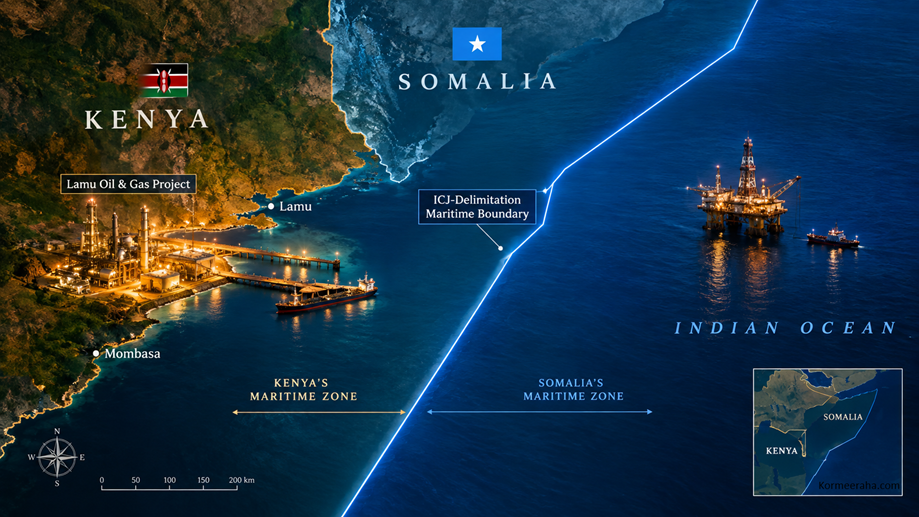
As Nairobi pushes forward with a $16 billion mega-refinery in Lamu, the intersection of massive energy projects and disputed Indian Ocean waters demands strict adherence to international law.
Kenya is moving forward with ambitious plans to establish a major oil refinery in the coastal city of Lamu. With a planned capacity of 700,000 barrels per day and an estimated investment of roughly $16 billion, the project is designed to strengthen Kenya’s energy security and supply petroleum products across East Africa and beyond.
However, whenever major energy projects intersect with disputed maritime areas, questions of sovereignty and international law cannot simply be pushed into the background.
The Shadow of the Maritime Dispute
Somalia and Kenya have a long-standing dispute over their maritime boundary in the Indian Ocean. In 2021, the International Court of Justice (ICJ) determined the maritime boundary between the two countries after Somalia brought the case before the Court. The dispute involved overlapping claims over territorial waters, exclusive economic zones, and continental-shelf rights.
Somalia had previously argued that Kenya had authorized oil exploration activities in an area Somalia considered part of its maritime domain. In submissions to the Court, Somalia alleged that exploration and drilling activities had taken place without its consent.
This history makes any discussion of offshore petroleum resources particularly sensitive. If the crude oil intended to feed Kenya’s growing petroleum-processing ambitions were ever sourced from offshore areas that Somalia regards as belonging to its maritime jurisdiction, a critical question arises: What legal and diplomatic framework governs that resource?
The Tension Between Ambition and Sovereignty
Kenya has every right to pursue economic development within its internationally recognized territory and maritime jurisdiction. A refinery in Lamu has the potential to create jobs, attract investment, improve regional fuel security, and strengthen Kenya’s industrial capacity. Reports indicate the project is expected to serve markets across East Africa and potentially beyond.
But economic development cannot erase questions of sovereignty. If resources originate in a disputed or legally sensitive maritime area, the relevant states need transparent arrangements based on international law. Resource development should not become an excuse for one country to act as though maritime boundaries are merely lines that can be redrawn whenever valuable hydrocarbons are discovered.
It is a cynical reality of global geopolitics that maritime maps often appear remarkably flexible when someone is holding an oil barrel. Yet, under international law, boundaries are not supposed to change according to the price of crude.
The Path Toward Transparency
The better approach is straightforward: transparency, legal certainty, consultation, and respect for established maritime boundaries. Any petroleum development involving potentially disputed resources should be supported by clear documentation showing where the resources originate and which jurisdiction legally governs them.
Somalia should therefore remain attentive to developments in Kenya’s energy sector while using diplomatic and legal mechanisms to protect its maritime interests. Kenya and Somalia are neighbors. They share economic interests, security concerns, and a long coastline facing the same strategic waters. Their future relationship should not be defined by competition over offshore resources.
There is nothing wrong with Kenya pursuing ambitious energy development. But oil does not erase sovereignty, and economic opportunity does not make international law optional. If both countries respect that principle, cooperation remains possible. If not, the oil barrel may become yet another source of regional tension.
Related
- How Kenya’s Claim To Somalia’s Sea Could Backfire (March 17, 2021)
This piece analyzes Kenya’s strategic positioning and the potential diplomatic and legal repercussions of its claims over the disputed maritime zone, especially following reports of Kenya’s initial hesitation to participate in the ICJ hearings. - Kenya Withdraws From The ICJ Maritime Case (March 14, 2021)
A timely report covering Kenya’s surprising decision to withdraw from the maritime dispute proceedings ahead of the scheduled hearings at the International Court of Justice, and what that meant for the legal process. - ICJ Begins Hearing The Maritime Dispute (2021)
This article provides on-the-ground context and analysis as the Hague-based International Court of Justice officially commenced the hearings on the maritime boundary delimitation between the two nations. - Somalia’s Reliance On The ICJ Decision Won’t Stop Kenya (October 14, 2021)
Published shortly after the ICJ ruling, this analysis warns that a legal victory on paper does not automatically translate to enforcement on the water, highlighting concerns about Kenya’s continued naval and economic activities in the region. - ICJ Decision: A Victory At Great Cost (October 19, 2021)
A post-ruling breakdown of the October 2021 ICJ judgment. It examines how the Court endorsed the equidistance/median line method favored by Somalia, while also discussing the broader diplomatic and economic costs of the prolonged dispute.