
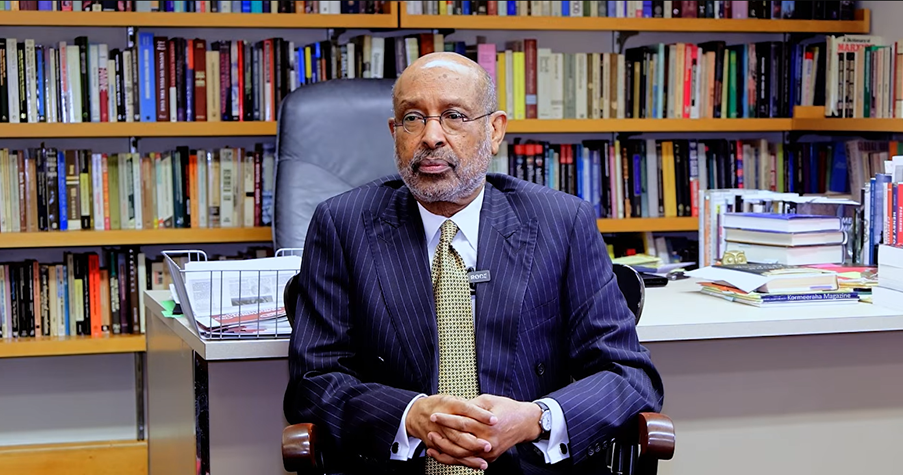
Professor Ahmed Ismail Samatar recently delivered what many observers described as a remarkably candid and well-reasoned assessment of the political fallout following Abdirahman Mohamed Abdullahi “Irro”’s recent visit to the United States. Moving beyond the surface-level optics of the trip, Samatar’s reflections examined the unrealistic expectations surrounding it, the reality of what unfolded, and the broader implications for Somaliland’s political trajectory.
Assessment of the US Diplomatic Trip
Samatar argued that Irro’s visit, heavily promoted domestically as a diplomatic breakthrough, ultimately yielded no meaningful results. In his view, the journey confirmed what many Somalilanders and foreign analysts have long suspected about the administration’s diplomatic capabilities. He pointed to a glaring absence of strategic planning, noting that the delegation arrived without a clear framework or well-defined objectives, leaving them ill-equipped to capitalize on the visit’s momentum.
Furthermore, the trip exposed a concerning inability to articulate core policy positions on the international stage. Irro reportedly faltered during interviews, struggling to present coherent arguments on essential state-building matters when pressed by foreign counterparts. Ultimately, this lack of preparation culminated in a failure to advance the primary goal of the trip, as the delegation did not deliver a unified, persuasive case for Somaliland’s international recognition.
“Somaliland’s political class has spent decades promoting the narrative of secession without building the institutional foundations required to achieve it.”
Samatar noted that the political class has spent decades promoting the narrative of secession without building the institutional foundations required to achieve it, exposing this structural weakness in full daylight.
Critique of Foreign Policy Alignments
Beyond the US visit, Samatar criticized Somaliland’s growing tendency to seek symbolic support from Israel and Taiwan. He argued that moves such as establishing an embassy in Jerusalem undermine the aspirations of the Palestinian people and have generated more international controversy than tangible benefit for Somaliland’s core diplomatic goals.
This criticism has been echoed by prominent cultural figures, including several respected poets from the Isaaq clan, who have publicly expressed disapproval of Irro’s perceived closeness to Israeli Prime Minister Benjamin Netanyahu. These poetic rebukes reflect a deeper cultural and moral unease: the belief that Somaliland’s diplomatic gestures should not inadvertently legitimize leaders associated with severe human rights violations.
“Somaliland’s diplomacy remains reactive, improvised, and shaped by narrow clan-based calculations rather than a coherent, long-term national strategy.”
To Samatar, these alignments reveal a core structural problem. Somaliland’s diplomacy remains reactive, improvised, and shaped by narrow clan-based calculations rather than a coherent, long-term national strategy that prioritizes broad international consensus.
Structural Stagnation in Governance
Samatar concluded that Somaliland’s governance model has grown fundamentally stagnant. He emphasized that the current system rests on a narrow clan foundation that increasingly mirrors the exclusionary political behavior of the central administration in Hargeisa. Rather than fostering a unified national identity, the state apparatus has become a vehicle for elite consolidation, marginalizing peripheral regions.
He specifically highlighted that the Awdal region carries legitimate, deep-rooted grievances. These include historical political marginalization, severe underrepresentation in key ministerial and security positions, and a highly unequal distribution of state resources and infrastructure development.
By ignoring these structural inequities, the central government has allowed regional alienation to fester. Samatar’s critique suggests that without a fundamental renegotiation of the power-sharing arrangement, the governance model will continue to stagnate, threatening the long-term viability of the state.
Backlash from the Political Establishment
Unsurprisingly, Samatar’s remarks were poorly received by the dominant political elite, who often view Somaliland as their exclusive political project. Their discomfort surfaced quickly, not through substantive policy rebuttals, but through defensive posturing and personal attacks, highlighting the fragility of their political narrative.
A primary rebuttal was issued by Mahamud Raage, a self-proclaimed ambassador to both the African Union and the European Union—entities with entirely distinct structures and mandates. Critics note that Raage holds no official diplomatic credentials and is largely viewed as an uncredentialed proxy. Consequently, his response was widely dismissed by observers as a personal grievance rather than a counterargument to Samatar’s structural critiques.
This type of backlash is highly revealing. By relying on uncredentialed figures to attack the messenger rather than addressing the substance of Samatar’s arguments, the central establishment inadvertently proves his point: that the current diplomatic and political discourse is often improvised and lacking in institutional rigor.
Historical Precedents in Statecraft
The current political climate and reliance on personality-driven diplomacy echo past dynamics in the region. The late Ali Khalif Galaydh (may God have mercy on him) once successfully persuaded segments of the international community and Somaliland that he represented the Sool region and the Khaatumo State.
Galaydh’s approach relied heavily on his personal charisma, clan negotiations, and individual diplomacy rather than the building of robust, inclusive state institutions. While his efforts created temporary political fixes, they ultimately failed to establish a sustainable institutional framework for the region.
His story serves as a vital cautionary tale for today’s leadership. It illustrates how easily political narratives in the Horn of Africa can be shaped by individual personalities rather than anchored by strong institutions. Samatar’s critique implies that Somaliland is at risk of repeating this historical mistake, relying on the optics of individual diplomats rather than doing the hard work of institutional statecraft.
A Call to Action for Regional Leadership
In the wake of the interview, many voices from the Awdal region are making a pointed suggestion. They argue that the time has come for Prof. Samatar to abandon the long-standing “fifty-fifty” posture of trying to bridge the central establishment and the periphery. They believe that attempting to appease a centralized, exclusionary system has only delayed the addressing of Awdal’s core grievances.
Given that Somali clanship is deeply rooted in patrilineal lineage, these advocates believe he should openly embrace his Gadabursi identity and assume a definitive leadership role in the movement for Awdal’s political and economic rights. Supporters argue that his intellectual stature, academic credibility, and moral standing position him uniquely to lead this charge.
“By unifying the Awdal voice under a leader of Samatar’s caliber, the central political elite would be compelled to finally confront the region’s long-standing demands for recognition, dignity, and a genuine renegotiation of the social contract.”
Ultimately, the goal articulated by his supporters is not necessarily immediate fragmentation, but leverage. By unifying the Awdal voice under a leader of Samatar’s caliber, the central political elite would be compelled to finally confront the region’s long-standing demands for recognition, dignity, and a genuine renegotiation of the social contract.
Related
- Awdal’s Fault Lines: How May 18 Exposed Somaliland’s Deepest Crisis
- What reopening Somaliland constitution means for Awdal
- Awdal’s Development Disparities and the Quest for Independence
- Debunking “Democracy” In Somaliland
- Awdal to Break Free from Somaliland
- Tyranny Of Majority Rule In Somaliland