

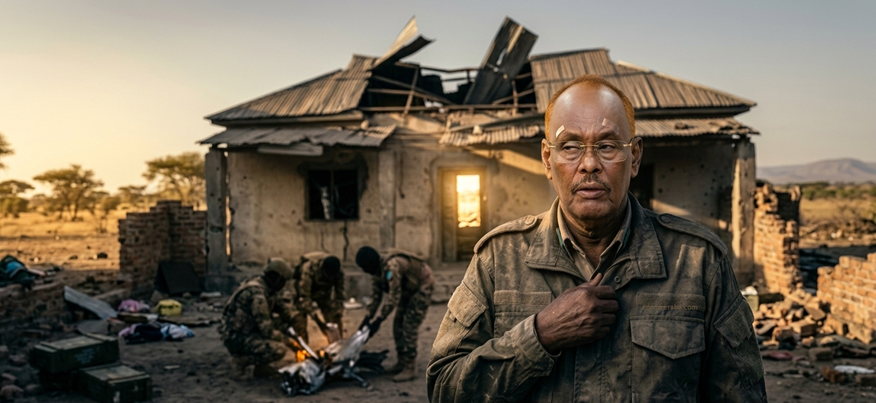
The September 4, 2026, missile strike targeting the Doolow residence of General Mahad Abdirahman Aden—widely known as “Shub,” the former commander of the Somali Custodial Corps—has escalated from a localized security incident into one of the most profound political and constitutional crises in modern Somali history. While General Shub survived the pre-dawn attack with minor injuries, the political fallout has severely fractured the relationship between the Federal Government of Somalia (FGS), regional administrations, and international partners.
More than a mere assassination attempt, the Doolow strike exposes the dangerous militarization of domestic political disputes, the compromising of national sovereignty by foreign actors, and the systematic destruction of forensic truth.
The Battle of Narratives: Air Strike vs. Internal Explosion
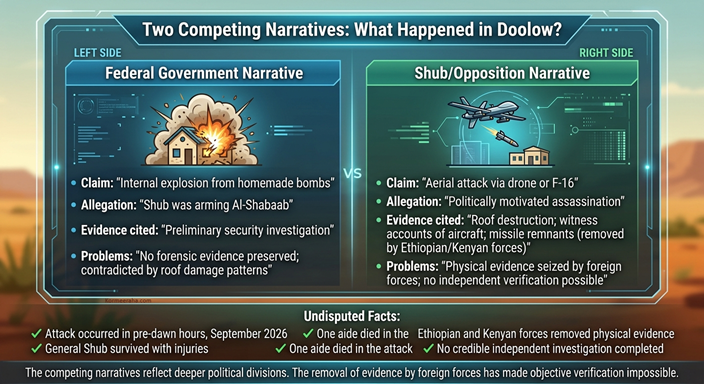
In the immediate aftermath of the attack, two diametrically opposed narratives emerged, reflecting the deep mistrust between Mogadishu and the regional states.
General Shub, speaking from Nairobi after receiving medical treatment in Ethiopia, categorically denied the federal government’s version of events. He claimed the attack was an aerial assault, stating he heard a large aircraft “hovering” before two missiles struck his bedroom. While the broader opposition and Jubaland officials attributed the strike to a Turkish-supplied Bayraktar drone, Shub insisted it was an F-16 fighter jet, alleging that President Hassan Sheikh had hired Turkish mercenaries to execute the hit.
Conversely, the Federal Government’s Ministry of Information dismissed the airstrike allegations. Citing preliminary security investigations, the government claimed the blast was caused by explosive materials Shub was manufacturing inside the house, accusing the former general of arming Al-Shabaab and the forces of ousted South West State President Abdiaziz Laftagareen.
However, visual evidence of severe roof destruction strongly corroborates the aerial munition theory. Furthermore, Shub detailed that one of his aides—who died in the blast—was a suspected spy for the National Intelligence and Security Agency (NISA) led by Mahad Salad, suggesting the location and layout of the house were compromised from within.
“The preemptive seizure of missile fragments effectively stripped Somali authorities of the ability to independently verify the weapon’s origin. The truth of who ordered the strike remains shrouded in mystery, deliberately obscured by tampering.”
Crime Scene Tampering and the Erasure of Truth
The most analytically significant aspect of the Doolow incident is not just the attack itself, but the immediate, unauthorized intervention by foreign forces in the aftermath.
Local reports confirm that Ethiopian and Kenyan security and intelligence forces—who maintain a heavy presence in the border zone—immediately secured the site and removed critical evidence, including missile remnants and debris. While Addis Ababa portrayed this as a necessary measure to identify the weapon used near its border, the action was highly irregular and deeply suspicious for several reasons:
- Lack of Legal Mandate: Neither Ethiopian nor Kenyan forces possess the jurisdiction to investigate a criminal act on sovereign Somali soil.
- Destruction of the Chain of Custody: By removing physical evidence before Somali federal or Jubaland investigators could process it, foreign forces permanently compromised the crime scene.
- Obfuscation of Origin: The preemptive seizure of missile fragments effectively stripped Somali authorities of the ability to independently verify the weapon’s origin.
Analytically, this foreign intervention achieves two things: it practically disproves the FGS’s “internal explosion” narrative by confirming an air-launched munition was used, while simultaneously ensuring that no legally viable, independent investigation can ever hold the perpetrators accountable.
“By removing physical evidence before Somali investigators could process it, foreign forces permanently compromised the crime scene—ensuring that no legally viable, independent investigation can ever hold the perpetrators accountable.”
The Political Catalyst: The South West State Proxy War
To understand the motive behind the attack, one must examine the escalating proxy war in the Southwest State. General Shub was a central figure in this conflict. Following his dismissal as Custodial Corps head by President Hassan Sheikh, Shub was placed under house arrest due to his ties to Abdiaziz Laftagareen.
Shub was released only after Mogadishu-backed allies, led by former parliament speaker Adan Madoobe and his militia, seized control of the South West State administration. Exiled from Mogadishu and given the choice to relocate to Istanbul or Nairobi, Shub chose Nairobi before eventually moving to his home in Doolow.
In Doolow, Shub became a vocal supporter of Laftagareen’s faction, which is currently clashing with Adan Madoobe’s forces on the outskirts of Baidoa. Shub did not mince words regarding his political views, asserting that the Hawiye clan had no place in the South West State and accusing President Hassan Sheikh of targeting Laftagareen since the 2022 elections. By harboring a high-ranking, politically active military figure opposed to Mogadishu, Doolow—and by extension Jubaland—had become a safe haven for anti-FGS elements, making Shub a prime target for elimination.
Geopolitical Fallout: Sovereignty, Turkey, and Ethiopia
The Doolow strike has severely complicated Somalia’s international partnerships, turning counter-terrorism assets into alleged tools of domestic repression. Nowhere is this more evident than in the diplomatic fallout with Turkey. The opposition coalition, including the Somali Future Council, alleges that Turkish-supplied drones—originally donated to the Somali National Army to fight Al-Shabaab—were repurposed to carry out extrajudicial killings against political opponents.
This perception has triggered a severe backlash from regional leaders. Jubaland has officially rebuked Ankara, accusing the Turkish government of abandoning its neutrality and openly taking the side of Villa Somalia in internal political disputes. Furthermore, General Shub’s explosive claims that President Hassan Sheikh hired Turkish mercenaries to execute the strike have only further strained an already fragile Mogadishu-Ankara relationship.
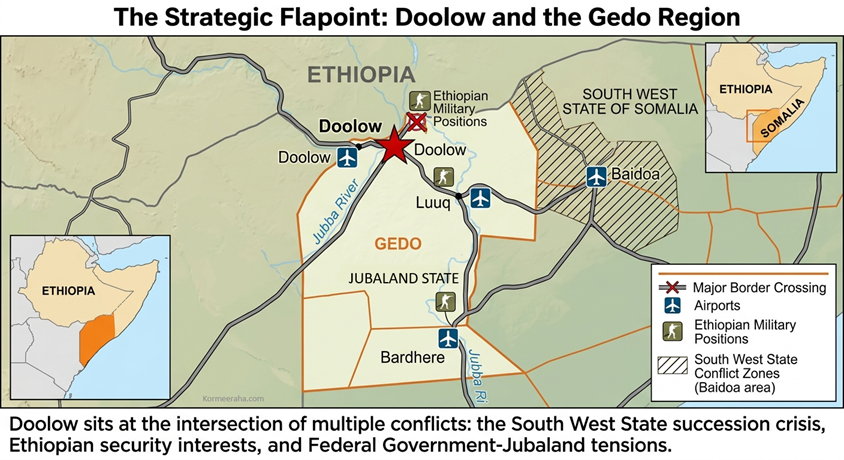
Equally consequential is the role of Ethiopia, whose heavy military footprint in the Gedo region—including key towns like Doolow, Luuq, and Bardhere—has long been a major point of friction. While the Federal Government consistently condemns Ethiopian troop movements and unilateral takeovers of local infrastructure as blatant violations of national sovereignty, Addis Ababa maintains close security coordination with Jubaland authorities on the ground.
The Doolow incident has provided Ethiopia with significant diplomatic leverage. By physically removing the missile debris from the crime scene, Ethiopian forces have positioned themselves to control the narrative. Addis Ababa can now use the incident to demonstrate to the international community that the FGS is actively creating dangerous border instability. Ultimately, this preemptive maneuver allows Ethiopia to justify its continued military presence in the region while deepening the broader geopolitical rivalry with Mogadishu.
Strategic Implications: The Slide Toward Disintegration
The September 2026 attack marks a perilous turning point. The conflict between the central government and regional administrations has officially transitioned from political and legal maneuvering into the military and security domain.
Jubaland and the Laftagareen faction of the South West State have united in their condemnation of Villa Somalia, issuing stark warnings against military interference. Regional security ministries have halted what little security cooperation remained with the FGS.
More ominously, the opposition has warned that the use of aerial drones against domestic political figures sets a catastrophic precedent. If the federal government can utilize airpower to assassinate regional allies, regional administrations may feel compelled to acquire their own aircraft, anti-aircraft capabilities, or international weaponry to target government centers in Mogadishu.
Conclusion
The botched assassination of General Mahad “Shub” is a symptom of a state teetering on the edge of fragmentation. The Federal Government’s weak executive and judicial control over Doolow highlights its inability to project power uniformly across the country. Meanwhile, the unauthorized seizure of forensic evidence by Ethiopian and Kenyan forces underscores the compromised nature of Somali sovereignty. With the crime scene permanently contaminated and no independent investigation yielding credible results, the Doolow strike will not bring closure. Instead, it will serve as a lasting grievance, accelerating the militarization of regional politics and pushing Somalia closer to the disintegration its federal system was designed to prevent.
“The Doolow strike exposes the dangerous militarization of domestic political disputes, the compromising of national sovereignty by foreign actors, and the systematic destruction of forensic truth.”