

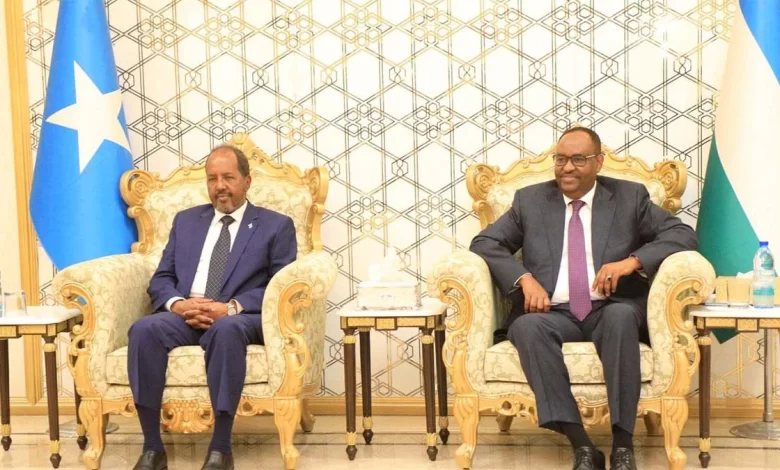
President Hassan Sheikh Mohamud has been in the Somali regional state of Puntland for three days, where he is trying to resolve a bitter dispute between himself and the President of Puntland, Said Abdullahi Deni.
Right from his arrival at the airport in Garowe, the capital of Puntland, Deni greeted him coldly and treated him unceremoniously, isolating him from everyone, including the team that accompanied him.
The President’s visit comes days after Deni blocked a visit by Prime Minister Hamza Abdi Barre. Mohamud reportedly sent the Prime Minister after hearing about Deni’s grievances.
Deni is angry with Hassan Sheikh Mohamud, not only for breaking the secret power-sharing agreements reached before Mohamud’s election as President of Somalia, but also for the uncivil manner in which Mohamud has treated him since.
Now, he has lured the diminished president into his lair. Mohamud is seeking support from regional states, particularly Puntland, as he prepares to attend the UN heads of state meeting in New York.
After three days of private conversations and tough negotiations between the two leaders on the future of their relations, no press release was issued, resulting in President Mohamud returning empty-handed to Mogadishu.
Ganging Up to Usurp Power
Both Deni and Mohamud were running for President of Somalia before May 15 and made deals to pool their money, backers, and schemes to defeat former President Mohamed Abdullahi Farmajo.
Farmajo was widely popular among the Somali people for his patriotism and the substantial development he initiated in a country plagued by mismanagement, corruption, and instability.
The turn Somalia took under Farmajo displeased not only the foreign diplomats who ruled the country by proxy but also the old guard who had taken advantage of the country’s chaos to enrich themselves.
As president of a large regional state, Deni posed obstacles to all attempts to hold Somalia’s first direct election since 1969—an election that would give the people a choice in electing their leaders—for the simple reason that Farmajo would be re-elected.
Western diplomats in Mogadishu and the current president, Farmajo’s bitter opponent, backed Deni in his refusal of a free election and forced Farmajo to negotiate a form of indirect, clan-based electoral college—a scheme that would give regional states the advantage of designating carefully vetted electors.
The deadlock created by Deni and his Jubaland counterpart, whose endorsement was needed to hold a “transparent election acceptable to all parties” as proposed by the international community, dragged out the elections for a year and a half.
This international community is represented by the ambassadors of the USA, the United Kingdom, the European Union, and above all by the omnipresent Special Representative of the UN Secretary-General, whose interference has complicated the dialogue between Somali actors.
Under the threat of US sanctions and other undue diplomatic pressure, Farmajo eventually handed over the management of the elections to Prime Minister Mohamed Hussein Roble. The latter would endorse the many demands of the opposition, whose main actors were precisely Mohamud and Deni.
Showing No Honor Among Thieves
During the presidential election, illegally moved to the “Green Zone” of Mogadishu where the “international community” resides, Hassan Sheikh Mohamud was “elected” under opaque conditions in which Deni played a major role.
Indeed, Deni not only instructed the parliamentarians of his clan, whom he had carefully selected beforehand, to vote for Mohamud, but he also paid millions in bribes so that Farmajo would be eliminated.
The agreement between Deni and Mohamud was that whoever succeeded in being elected president would appoint the other as prime minister. However, once president, Mohamud made it clear to Deni that he could not work with him as prime minister.
Deni’s subsequent proposal to Mohamud to appoint at least one of his friends from the same clan to this position was also rejected. The very idea that Deni would have a say in the appointment of ministers from Puntland was bluntly brushed aside.
After taking part in the festivities commemorating the independence of Somalia alongside the new president, Deni, disappointed and empty-handed, returned to his region of Puntland, from which he had emptied the coffers to be elected president of Somalia.
It was in Garowe that Deni learned Mohamud had appointed Hamza Abdi Barre as Prime Minister. Barre, Mohamud’s long-time friend, also belongs to the same political-religious movement.
Later, President Mohamud and the Prime Minister were careful to select individuals from Puntland who were hostile to Said Deni as ministers. Chief among them was Foreign Minister Abshir Omar Huruse.
In reality, Mohamud distrusts Deni, whose wickedness, he knows. Wasn’t Deni the one who stabbed him in the back a year earlier after the Union of Presidential Candidates succeeded in forcing Farmajo out of his seat on the National Consultative Council, which was responsible for the elections?
Waiting to Pounce on the President
Deni knew Mohamud could not afford to upset Puntland, especially now that he has less support in all parts of Somalia. The president, whose leitmotif is “Somalia at peace with itself and at peace with the world,” has clumsily made enemies in his country and at its borders.
In addition, Deni has multiplied actions that undermine the authority of the federal government. He has resumed dealing directly with Ethiopia on the economic and security fronts. He has reduced cooperation with the federal government on service delivery to drought-affected people in particular. Finally, Mogadishu officials are prohibited from landing in Puntland without Deni’s prior permission.
He wants Hassan Sheikh Mohamud to repay him the staggering $129 million he allegedly spent on the federal election campaign. He also wants shares in several juicy trade deals like khat and licenses provided to foreign vessels that exploit Somalia’s marine resources.
At the political level, Deni wants President Mohamud to disassociate himself from the American attempt to reinforce the Puntland Security Forces (PSF) and the Diyano brothers who command them. Above all, he insists on having his friends in key positions in the federal government and in Somali embassies.
This time around, it is Hassan Sheikh Mohamud’s turn to go home with his tail between his legs. The question that many are asking, however, is whether this time he will keep his promises and follow through on the demands of a vengeful and resolute Deni.
Sacrificing the Nation for Personal Gain
Either way, the two accomplices’ illicit negotiations over the sharing of Somalia’s wealth expose the sheer depth of their corruption. It is a glaring throwback to a dark era when the country’s vital interests were routinely relegated to the background to serve the greed of a few.
Even a meeting scheduled for the next few days in Garowe to mend the rifts between the regional states and the federal government will be hard-pressed to shake this grim perception. Ultimately, these backroom dealings prove that Mohamud’s tenure is not about healing the nation, but will only exacerbate Somalia’s uncertain and tragic future.