

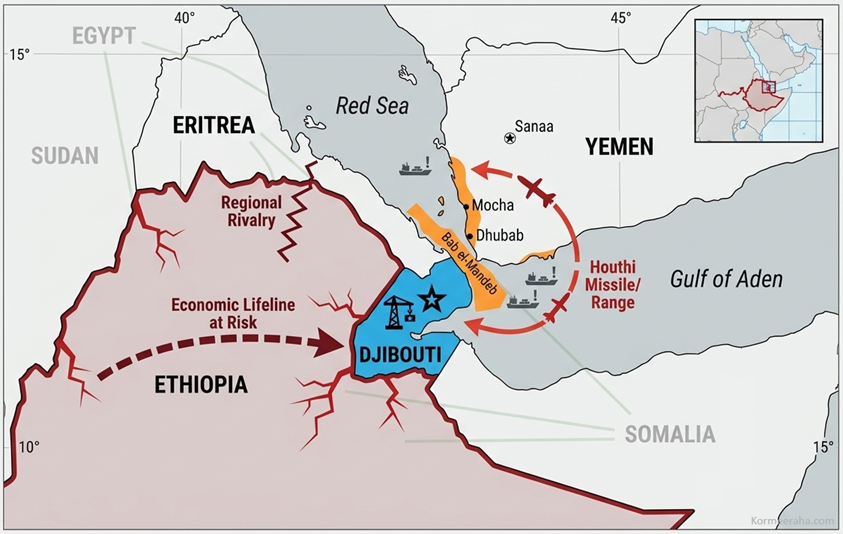
For decades, the Republic of Djibouti has leveraged its prime location at the nexus of the Red Sea and the Gulf of Aden to transform a barren, arid landscape into a vital hub for global trade and foreign military presence. However, as the Horn of Africa enters a perilous new phase of instability, Djibouti’s greatest geographic asset is rapidly mutating into its most profound strategic vulnerability.
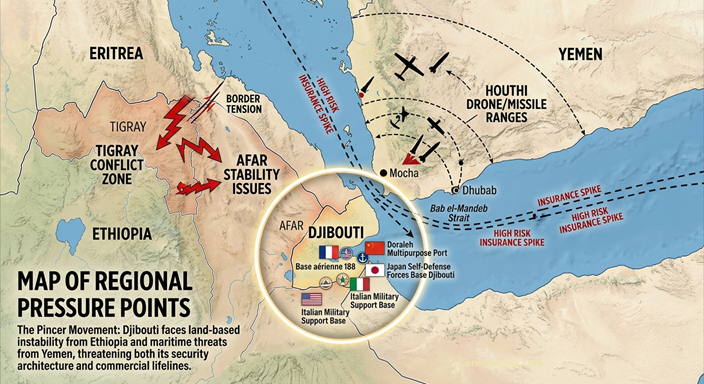
Caught in a geopolitical pincer movement, Djibouti faces compounding crises that threaten its very existence. To the west, the resurgence of internal conflict in Ethiopia threatens to spiral into a broader regional war. To the east, the militarization of the Bab el-Mandeb Strait by Houthi forces jeopardizes the maritime lifelines that sustain Djibouti’s economy. For a nation whose macroeconomic stability relies entirely on peace and transit, this dual-front crisis represents an existential challenge.
The Western Front: The Fragmentation of the Horn
The resumption of hostilities in northern Ethiopia has shattered the fragile peace established by the November 2022 Pretoria agreement. Federal forces are once again engaged in intense combat with Tigrayan armed groups and other insurgent factions across Tigray, Amhara, and Afar regions. While Addis Ababa claims territorial gains, the underlying drivers of the conflict remain unresolved, ensuring prolonged instability.
More alarming for Djibouti is the rapid deterioration of relations between Ethiopia and Eritrea. On October 9, Ethiopia formally accused Asmara before the UN Security Council of violating its sovereignty and backing armed insurgents. While Eritrea denies these claims, the breakdown in Addis-Asmara relations removes a critical buffer against wider conflict.
Furthermore, Ethiopia’s internal crisis is now inextricably linked to broader regional rivalries. Addis Ababa’s aggressive pursuit of guaranteed access to the Red Sea—highlighted by its controversial deal with Somaliland, which grants Ethiopia sea access in exchange for potential recognition—has triggered a defensive realignment among its neighbors. Egypt, driven by its existential dispute with Ethiopia over the Grand Ethiopian Renaissance Dam (GERD), has deepened ties with Eritrea and Somalia. Sudan, despite being consumed by its own civil war, shares Ethiopia’s border disputes, notably over the fertile Al-Fashaga triangle.
“This emerging axis of Egypt, Somalia, Eritrea, and Sudan threatens to transform Ethiopia’s internal fractures into a zero-sum regional confrontation. For Djibouti, whose economy is entirely tethered to Ethiopia, the prospect of a fractured, hostile, or sanctioned Ethiopia is an economic death sentence.”
This emerging axis of Egypt, Somalia, Eritrea, and Sudan threatens to transform Ethiopia’s internal fractures into a zero-sum regional confrontation. For Djibouti, whose economy is entirely tethered to Ethiopia, the prospect of a fractured, hostile, or sanctioned Ethiopia is an economic death sentence.
The Eastern Front: The Militarization of Bab el-Mandeb
Simultaneously, the narrow maritime chokepoint separating Djibouti from Yemen is becoming a highly contested theater of asymmetric warfare. Backed by Iran, Houthi forces have significantly upgraded their military capabilities, deploying advanced missiles, armed drones, and maritime warfare tactics that threaten commercial shipping and military assets far beyond the Yemeni coast.
Recent escalations have seen fierce fighting for strategic coastal positions, including Mocha, Dhubab, and Mayyun (Perim) Island. While independent verification of territorial control remains difficult, the tactical reality is clear: the Houthis are actively contesting the western littoral of the strait against Saudi-backed Yemeni government forces.
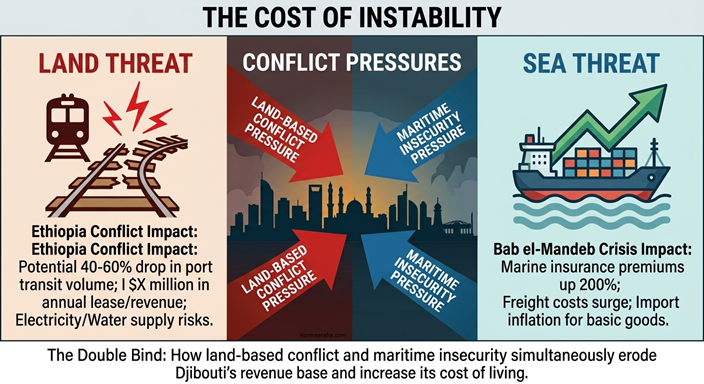
For Djibouti, the Houthi threat is not merely about the risk of a direct kinetic strike. The primary danger is the disruption of global supply chains. Persistent insecurity in the Bab el-Mandeb Strait drives up marine insurance premiums, forces shipping reroutes, and inflates freight costs. Because Djibouti’s economic model is built on being a low-cost, high-efficiency logistics gateway, any sustained disruption to maritime traffic directly undermines its competitive advantage.
The Geopolitical Paradox of Foreign Military Bases
Djibouti’s unique security architecture—hosting American, French, Chinese, Japanese, and Italian military installations—was designed to deter aggression and secure lucrative leasing fees. Camp Lemonnier serves as the cornerstone of U.S. counter-terrorism operations in Africa, while France maintains its largest overseas military base, and China operates its first foreign naval support facility.
However, in the current climate, this exceptional concentration of foreign firepower is a double-edged sword. While it provides Djibouti with diplomatic leverage and security guarantees, it also risks turning the country into a proxy battleground. An escalation in the Red Sea could expose these bases to indirect threats, drone incursions, or accidental military incidents. Djibouti faces the delicate diplomatic challenge of maximizing the economic and security benefits of these partnerships without allowing its sovereign territory to be drawn into a great-power or regional conflict.
Cascading Economic and Humanitarian Threats
The convergence of these security crises threatens to trigger a cascading failure in Djibouti’s domestic stability. The Djiboutian economy is overwhelmingly dependent on port activities and the transport of Ethiopian goods.
This creates a severe macroeconomic vulnerability. A disruption of the Addis Ababa-Djibouti rail and road corridor due to conflict in the Afar region would instantly crater Djibouti’s trade revenues and public finances. Concurrently, the maritime insecurity in the Red Sea will drive up the cost of imports. Djibouti is thus facing a dangerous “pincer effect”: a simultaneous drop in logistics revenues and a spike in the cost of basic necessities, exacerbated by its reliance on Ethiopia for electricity, water, and agricultural imports.
Beyond the balance sheet, Djibouti is bracing for a severe humanitarian emergency. The country already hosts a significant refugee population. The humanitarian fallout from the renewed Yemen conflict is already materializing; according to the UNHCR, nearly 3,000 people arrived in Djibouti from Yemen in just eight days leading up to September 17, with women and children comprising 60% of the arrivals.
If hostilities expand along Yemen’s western coast, or if the Ethiopian conflict spills over into the neighboring Afar region, Djibouti could face a massive, simultaneous influx of displaced persons. This would place unbearable strain on a country already grappling with severe water scarcity, fragile health infrastructure, and tight budgetary constraints.
“Djibouti is thus facing a dangerous ‘pincer effect’: a simultaneous drop in logistics revenues and a spike in the cost of basic necessities, exacerbated by its reliance on Ethiopia for electricity, water, and agricultural imports.”
Strategic Imperatives: The Way Forward
The international community has rightly called for restraint, but Djibouti cannot outsource its survival to external diplomacy. To navigate this perilous crossroads, the nation must adopt a proactive, multi-pronged strategy centered on prevention, protection, and resilience.
First, Djibouti must leverage its unique status as a neutral host to engage in aggressive preventive diplomacy. By positioning itself as an indispensable broker, it can actively support AU and IGAD mediation efforts in Ethiopia and Yemen. This diplomatic offensive is crucial for de-escalating tensions before they spill across borders, transforming Djibouti from a passive observer into a central architect of regional stability.
Second, the state must prioritize the hardening of its strategic infrastructure. Physical and cyber defenses around ports, rail corridors, and military bases require immediate reinforcement to withstand potential spillover violence. Simultaneously, border security with Ethiopia must be tightened to prevent insurgent infiltration, while maritime approaches from Yemen need enhanced surveillance to counter asymmetric threats. Protecting these critical arteries is essential to maintaining commercial continuity and safeguarding national sovereignty amidst regional chaos.
Third, humanitarian preparedness must be scaled up urgently. In coordination with the UNHCR, the EU, and key bilateral partners like the US and Japan, Djibouti must secure emergency funding and pre-position resources. Expanding reception facilities and strengthening health infrastructure now is vital to managing a potential simultaneous influx of refugees from both Yemen and Ethiopia, preventing a secondary humanitarian disaster.
Finally, long-term economic resilience depends on reducing absolute dependence on Ethiopian transit and energy. Accelerating investments in domestic renewable energy, such as solar and wind, will mitigate risks from cross-border power disruptions. Concurrently, diversifying the economic portfolio beyond pure logistics will build macroeconomic buffers, ensuring the nation can withstand shocks even if traditional revenue streams are compromised by regional instability.
Conclusion
Implementing these measures will be difficult, but the alternative is unacceptable. Djibouti’s rise was built on geographic arbitrage. But geography is indifferent to the nations that occupy it. Today, Djibouti is trapped between the Ethiopian hammer and the Bab el-Mandeb anvil.
The nation’s ultimate security does not rely solely on the concrete of its foreign military bases or the cranes of its modernized ports. It relies entirely on the preservation of regional peace, the stability of its landlocked neighbor, and the freedom of navigation in the Red Sea. If the Horn of Africa descends into a generalized regional war, Djibouti risks becoming the collateral victim of conflicts it neither caused nor has the military means to control. Preventing that outcome requires immediate, pragmatic, and unified strategic action.
Related
- Djibouti: Between Strategic Reality and Official Narrative (June 19, 2026)
- The Strategic Mirage: Why Djibouti’s “Stability” Is the Horn’s Most Dangerous Illusion (April 9, 2026)
- Djibouti: A Gateway to Three Continents – Africa, Asia, and Europe (September 7, 2023)
- Djibouti at 46: How Far Has the “Confetti of the Empire” Come? (June 27, 2023)