

The article “Djibouti: A Gateway to Three Continents – Africa, Asia, and Europe” by Yacoub O. Mohamed, published earlier in Kormeeraha Magazine, offers a glowing portrayal of Djibouti’s role in global trade. While it accurately highlights the country’s strategic location at the entrance of the Red Sea, it mirrors official government rhetoric without examining the practical limitations of Djibouti’s logistics model.
Not Yet a Major Global Transshipment Hub
The claim that Djibouti is a major transshipment center connecting Africa, Asia, and Europe warrants scrutiny. In maritime logistics, a true transshipment hub serves as a central node where cargo from massive ocean-going vessels is redistributed onto smaller feeder ships for multiple regional destinations. In the Red Sea and Gulf regions, this role is overwhelmingly dominated by world-class ports like Jebel Ali in Dubai and Salalah in Oman.
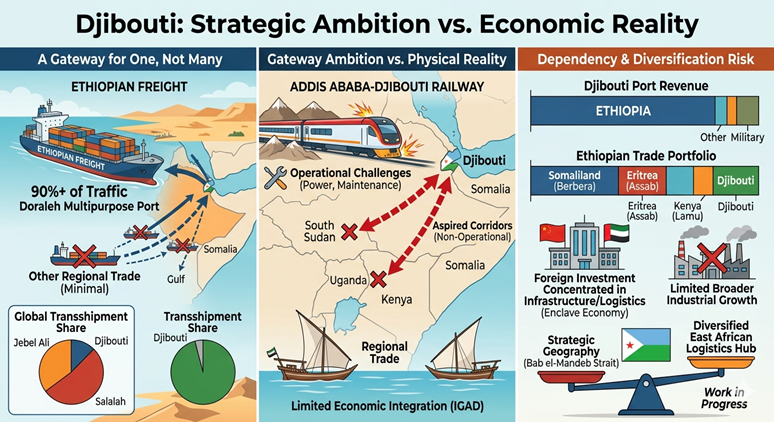
By contrast, Djibouti’s ports function almost exclusively as a gateway for a single landlocked nation: Ethiopia. The vast majority of container traffic passing through Djibouti is directly tied to Ethiopian imports and exports, leaving its broader transshipment activity minor by regional standards.
The “Gateway to East Africa” Narrative is Baseless
The assertion that Djibouti serves as a major gateway for South Sudan and Uganda is a strategic ambition, not a commercial reality. In practice, Djibouti’s economic hinterland begins and ends with Ethiopia.
Uganda continues to rely on the Northern Corridor through Mombasa, Kenya, and increasingly on routes via Dar es Salaam, Tanzania. Similarly, South Sudan’s trade flows depend on corridors passing through Kenya and Uganda. With no operational rail or highway connecting Djibouti directly to Kampala or Juba, geography and infrastructure confine the country to a bilateral pipeline rather than a regional gateway.
A Logistics Model Highly Dependent on Ethiopia
By omitting Djibouti’s absolute dependence on Ethiopia, official narratives ignore a profound structural vulnerability. For decades, Ethiopian cargo has been the primary driver of Djibouti’s port revenues, free zones, and logistics services.
This hyper-concentration means that any shift in Ethiopian foreign policy directly threatens Djibouti’s economy. As Ethiopia actively seeks to diversify its maritime access—eyeing alternative ports like Berbera in Somaliland, Assab in Eritrea, and Lamu in Kenya—Djibouti faces the constant prospect of sudden revenue drops. Rather than a diversified regional platform, Djibouti remains a captive observer of its neighbor’s economic fortunes and strategic choices.
The Addis Ababa–Djibouti Railway: Persistent Challenges
While the Chinese-built Addis Ababa–Djibouti standard-gauge railway is a major engineering milestone, its operational reality is highly complex. Since its launch, the line has struggled with recurring power supply disruptions, technical failures, maintenance backlogs, and safety interruptions. Consequently, many freight operators still rely heavily on slower, heavily taxed road transport due to concerns over the railway’s reliability. Furthermore, operational bottlenecks and customs delays around Dire Dawa continue to stall freight flows, keeping the corridor from meeting international efficiency standards.
Political Stability: A Complex Narrative
The article rightly notes Djibouti’s relative stability in a volatile region. However, stability should not be conflated with a centralized political system reinforced by extensive security controls. While Djibouti has avoided major civil conflicts, its political system remains highly authoritarian, with limited political competition and restricted space for opposition voices and a free press. A non-partisan assessment would recognize both the benefits of stability and the governance challenges that continue to shape the country’s political environment.
The Role of IGAD: Weak Economic Integration
The narrative that Djibouti’s membership in the Intergovernmental Authority on Development (IGAD) drives its economic success misinterprets regional dynamics. While IGAD serves as a useful diplomatic forum, it has failed to create a fully integrated regional market, harmonized customs systems, or major cross-border infrastructure networks.
Frustrated by IGAD’s lack of economic teeth, member states have looked elsewhere. Kenya, Uganda, and Somalia have prioritized the East African Community (EAC) for genuine market integration. Meanwhile, Ethiopia bypassed the regional framework entirely, joining the BRICS bloc to align its economic destiny with global powerhouses. Intra-IGAD trade remains low, stymied by border disputes and weak connectivity. Djibouti’s success stems from its literal geography and bilateral ties with Addis Ababa, not from IGAD’s stalled architecture.
FDI: Infrastructure Wealth vs. Broad-Based Investment
Djibouti’s ability to attract billions in Foreign Direct Investment (FDI) into ports, free zones, and foreign military bases is impressive, but these investments are largely confined to capital-intensive enclaves. Mostly funded by state-owned enterprises from China and the Gulf, this infrastructure has failed to spark a diversified domestic economy.
Private investment in manufacturing, technology, and agriculture remains negligible. This creates a stark paradox: world-class logistical infrastructure exists alongside persistent structural unemployment and poverty. Unlike diversified regional peers like Kenya or Rwanda, Djibouti’s FDI has fortified its role as a strategic landlord without fundamentally transforming the socio-economic well-being of its citizens.
Conclusion
Djibouti’s strategic location at the Bab El-Mandeb Strait is undeniable, and the country has invested heavily in modern ports, free zones, and transport infrastructure. These achievements deserve recognition. However, portraying Djibouti as a major transshipment hub linking Africa, Asia, and Europe overstates its current role.
Today, Djibouti functions primarily as Ethiopia’s maritime outlet rather than as a diversified regional logistics gateway. Its economic model remains heavily dependent on Ethiopian trade, while regional corridors to Uganda and South Sudan remain non-existent. Similarly, the Addis Ababa–Djibouti railway, though promising, continues to face operational challenges often overlooked in official narratives.
Djibouti’s strategic location is a fact; its emergence as a diversified East African logistics and investment hub remains a work in progress. The distinction between narrative and reality is essential for any serious analysis of the country’s economic and geopolitical position.