

By the dusty roads of Laag, thirty kilometers from the strategic port city of Bosaso, the abstract concept of federalism has met the harsh reality of gunfire. What began as a political disagreement over electoral mechanics and security command structures has metastasized into the most dangerous standoff between Mogadishu and Garowe in years—and the people caught in the middle are running out of room to breathe.
The Proxy War Nobody Wanted
The roots of the current crisis stretch back to 2021, when Puntland President Said Abdullahi Deni attempted to remove Mahmud Osman Diyano from his post as director of the Puntland Security Force (PSF). The move backfired spectacularly. Rather than accepting their new orders, the PSF leadership dug in, rejecting Deni’s authority and setting in motion a slow-burning fracture that would eventually draw in the full weight of the Federal Government of Somalia.
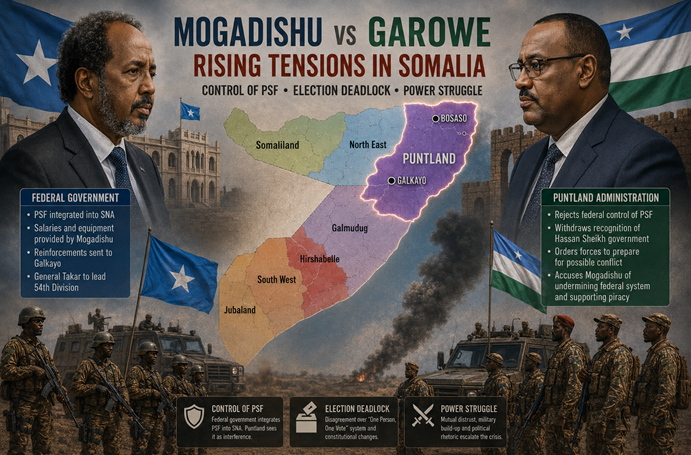
For years, the PSF existed in a kind of limbo—nominally part of Puntland’s security architecture but increasingly operating as an independent power center. Then came the escalation that changed everything. In October 2024, the administration of President Hassan Sheikh Mohamud made a decisive move: it announced that the PSF was being fully integrated into the Somali National Army (SNA), with salaries, equipment, and command flowing directly from Mogadishu.
To the federal government, this was a legitimate exercise of national authority—bringing rogue forces under central command. To Puntland, it was nothing less than a constitutional invasion, a direct assault on the autonomy that underpins Somalia’s federal structure.
The inevitable collision came in July 20, Puntland’s Darawish forces—loyal to Deni’s regional administration—clashed with PSF units in the Laag area. The fighting was fierce and unambiguous. Puntland claimed victory, seizing PSF bases and issuing ultimatums to remaining PSF elements in Bosaso: surrender to Garowe or face the consequences. For the first time in this long-running dispute, political rhetoric had been replaced by the sound of automatic weapons and the dust of military convoys.
The Ballot Box Becomes a Battlefield
The violence in Laag did not emerge from a vacuum. It is the explosive endpoint of a political deadlock that has paralyzed relations between Mogadishu and Garowe for months.
At the heart of the dispute is Hassan Sheikh Mohamud’s push for a “One Person, One Vote” electoral system—a reform that the federal government presents as a historic step toward genuine democratic representation. But President Deni and his allies see something far more sinister in the proposal. They argue that the plan is engineered to benefit specific political actors in Mogadishu, and that conditions on the ground make free and fair elections impossible under the current framework.
The disagreement is not merely technical. It is existential.
When delegations from Puntland and Jubbaland arrived in Mogadishu for negotiations, they came expecting compromise. They left in protest. The federal government, they claimed, refused to budge on either the electoral system or controversial constitutional amendments. The talks collapsed not with a handshake, but with slammed doors and accusations of bad faith.
Then came the diplomatic bombshell. Puntland officially withdrew its recognition of Hassan Sheikh Mohamud’s government, declaring that his legal term had expired and that Somalia could not be governed “by force and coercion.” In federal systems, such statements are rarely symbolic. They are warnings—declarations that the center no longer holds.
Mobilizing for the Worst
Both sides are now preparing for scenarios that, until recently, seemed unthinkable.
The Federal Government has not been subtle in its response. On July 23, a cargo plane touched down in southern Galkayo carrying weapons and supplies—hardware intended to strengthen federal positions in the region. More significantly, Mogadishu appointed General Jimale Jama Takar, a former Puntland military commander, to lead the 54th Division of the Somali National Army. The message was unmistakable: the federal government intends to project military power into Puntland, and it is prepared to use figures with local credibility to do so.
In Garowe, President Deni has responded in kind. He has ordered regional forces to full combat readiness, warning his administration against a repeat of what happened to Abdi-aziz Laftagareen, the former leader of Southwest State, whose removal by federal-aligned forces remains a raw wound in Somali politics. Deni’s rhetoric has grown sharper, more personal. He has accused Hassan Sheikh Mohamud of actively supporting the resurgence of piracy off Puntland’s coast—a charge designed to undermine the president’s international credibility—and of systematically dismantling the federal system through unilateral constitutional changes.
The result is a landscape where two armies, answering to two different command structures, now occupy overlapping territory. The only thing preventing a wider war may be the reluctance of individual commanders to be the first to pull the trigger.
When Personalities Become Policy
For the residents of Bosaso, Galkayo, and Garowe, the political theories debated in Mogadishu’s villas and Garowe’s presidential compound have lost their abstraction. They are stocking supplies. They are keeping their children close. They are watching the road for military convoys. The fighting in Laag proved that this crisis has crossed the threshold from diplomatic confrontation to armed conflict—and in Somalia, that threshold, once crossed, is rarely crossed back.
There is a tragic human dimension to this crisis that transcends the institutional disputes over federalism, electoral models, and security force command chains. At its core, this standoff is being driven by a long-held and deeply personal personality clash between two men who have never managed to find common ground.
President Hassan Sheikh Mohamud and President Said Abdullahi Deni have viewed each other with mutual suspicion from the outset—two ambitious leaders with competing visions for Somalia’s future, neither willing to grant the other the political space to govern. What should have been managed through institutional channels—constitutional courts, parliamentary mediation, genuine federal dialogue—has instead become a vendetta, with each man interpreting the other’s moves as existential threats requiring existential responses.
This personalization of politics is Puntland’s greatest danger. When leaders conflate their own political survival with the survival of the regions they govern, compromise becomes weakness and escalation becomes strength. The people of Puntland—fishermen in Eyl, merchants in Bosaso, students in Garowe, pastoralists in the hinterlands—are not pawns in a chess match between two presidents. Yet they are the ones who will pay the price if this personality-driven conflict spills into open, sustained warfare.
The international community, which has invested heavily in Somalia’s stabilization, now faces an uncomfortable truth: the federal model it championed is being torn apart not by Al-Shabaab, not by clan warfare, but by the inability of two elected leaders to share power without making it personal.
Somalia has seen this movie before. It does not end well. The road from political deadlock to military confrontation is short, and the road back is long and paved with civilian graves. If Hassan Sheikh and Deni cannot find a way to separate their personal animosity from their public duties, Puntland will not merely face a constitutional crisis. It will face the kind of open conflict that destroys cities, displaces families, and sets back decades of fragile progress.
The guns have already spoken in Laag. The question now is whether anyone in Mogadishu or Garowe is still listening to the voices of the people who stand to lose everything.