

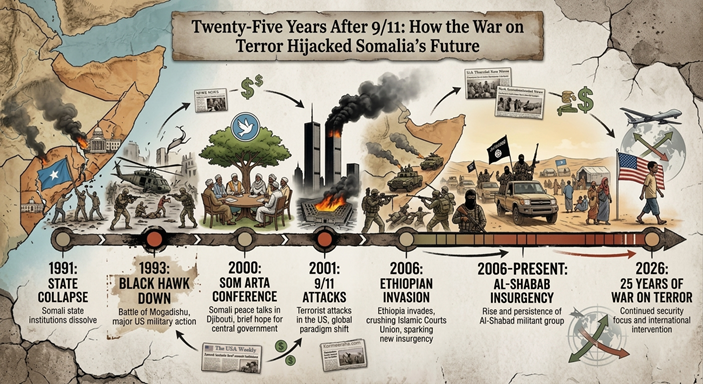
Twenty-five years after the September 11 attacks on American soil, Somalia is still living with the consequences of the open-ended ‘War on Terror’ launched by the Bush administration. In the aftermath, Washington began seeing terrorists “all over the Muslim world.” Few countries were more profoundly affected by this posture than Somalia. What followed was not a campaign for security, but a blueprint for prolonged failure. A quarter-century later, independent Somali analysis offers a sobering verdict: the War on Terror did not defeat Somali militancy—it engineered its expansion.
A Somali-Led Opening: The Arta Conference
In 2000, the Arta Conference in Djibouti offered a rare window of opportunity. A Somali-led reconciliation initiative, it brought together clan elders, civil society, and political actors to produce the Transitional National Government. Though imperfect, it was entirely Somali-owned. This was the culmination of years of grassroots effort following the 1991 state collapse. Over 90 local peace meetings had already utilized traditional mediation to address the chaos. By the late 1990s, Djibouti’s President Ismail Omar Guelleh recognized this emerging civil society as the foundation for a new state. Instead of nurturing this organic peace, the post-9/11 hunt for al-Qaeda placed Somalia in Washington’s crosshairs. The country was no longer viewed as a state to be rebuilt, but as a terrorist haven to be policed.
“Over 90 local peace meetings took place in south-central Somalia alone after 1991, utilizing traditional mediation. Then 9/11 happened, and diplomacy was replaced by drones.”
The Black Hawk Down Connection and the Weaponization of Intelligence
The Bush administration quickly identified fractured Somalia as a potential al-Qaeda staging ground. This connection was framed as an urgent security imperative, but American intelligence findings and prisoner confessions must be viewed with profound caution. History demonstrates that the U.S. has repeatedly weaponized flawed, exaggerated, or retroactively convenient “intelligence” to justify military interventions and assert global hegemony.
Following the 1993 “Black Hawk Down” battle, retrospective reports claimed al-Qaeda’s military chief, Mohammed Atef, was sent to Mogadishu to coach militia fighters, and that operatives like Mohammad Sadiq Odeh confessed to funding and training local clans. Whether these accounts were entirely factual or heavily embellished to serve a geopolitical agenda, the utility of the claim was what mattered.
Having helped create the conditions for al-Qaeda’s rise during the Soviet-Afghan war, the U.S. now needed a clear enemy to justify a heavily militarized approach. Retroactive U.N. and U.S. findings—emphasizing that Somalia was used as a “springboard” for the 1998 Kenya embassy bombings—provided the perfect alibi. This allowed Washington to bypass fragile peace processes and reframe a collapsed state as a frontline in the War on Terror. Once again, Somalia was left on the receiving end, paying the ultimate price in blood and sovereignty for a conflict driven by a superpower’s imperial imperatives.
“The U.S. has a documented history of leveraging dubious confessions and cherry-picked intelligence to manufacture consent for endless wars.”
From Reconciliation to Proxy War
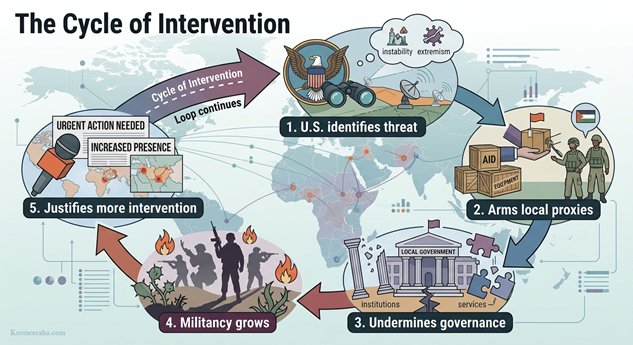
That manufactured pretext became the cornerstone for a new war. Rather than allowing the Arta process to mature, Washington armed and funded local warlords to hunt suspected al-Qaeda elements, later backing factions like Ahlu Sunna Wal Jama’a and ultimately relying on Ethiopian military power. The result was a system that continuously negotiated with the very militancy it claimed to fight, creating a cycle of militant-politicians whose power derived directly from violence. Whenever an independent Somali governance structure emerged, it was treated as a threat. Somali leaders were made entirely subject to the whims of the U.S. security apparatus; their legitimacy undermined by a system that rewarded dependency and punished independent decision-making.
The Union of Islamic Courts and the Ethiopian Invasion
The most consequential example of this dynamic was the Union of Islamic Courts (UIC). In 2006, the UIC restored order to Mogadishu after fifteen years of warlord chaos. For many Somalis, life tangibly improved. But viewed by Washington as an unacceptable independent authority, the Courts were targeted. The U.S. backed a CIA-funded warlords alliance against them, then supported Ethiopia’s devastating invasion in December 2006. What might have been a Somali political process was violently replaced by foreign occupation, igniting a fierce nationalist insurgency.
“In 2006, the Islamic Courts restored order to Mogadishu. Life improved. Then Washington destroyed them, and al-Shabab was born from the ashes.”
The Birth of al-Shabab
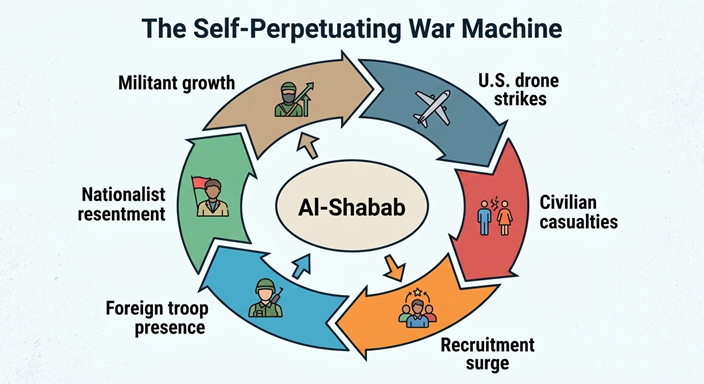
Al-Shabab was born directly from the ashes of that intervention. Growing from the shattered remnants of the Islamic Courts and the anger produced by foreign occupation, it quickly evolved into al-Qaeda’s most potent regional affiliate. Far from extinguishing the insurgency, the intervention acted as its primary incubator. The logic became entirely circular: foreign troops and drone strikes fuel recruitment; al-Shabab’s persistence is then used to justify more troops and more strikes.
A Dependency Trap, Not a Sovereign State
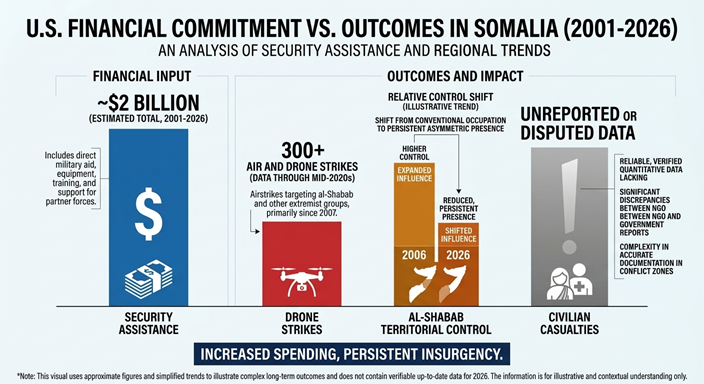
Military solutions unmoored from political settlements do not degrade insurgencies; they displace them. Despite decades of drone campaigns and nearly $2 billion in U.S. support, al-Shabab persists, and the human cost has been severe. Airstrikes have killed civilians, alienating the very population the government needs to win over. Instead of building sovereignty, Somalia became a laboratory for managing insecurity. Political elites learned to survive by accommodating external patrons, resulting in a profound dependency trap. Elite military units like Danab and Gorgor cannot be sustained without foreign paymasters. As one Somali analyst noted: “We have permission to buy guns, but the countries that pay the bills still choose the rifles.”
“We have permission to buy guns, but the countries that pay the bills still choose the rifles.”
— Somali security analyst
A Parallel Security Architecture
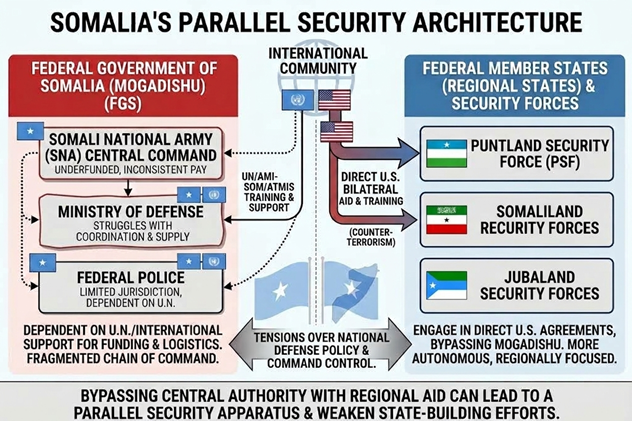
Recently, the U.S. has built a parallel security architecture that bypasses Mogadishu entirely. While diplomats criticize the federal government’s lack of a transition plan, U.S. Special Operations commanders sign bilateral security agreements with regional leaders in Somaliland, Puntland, and Jubaland. Washington treats Somalia not as a state-building project, but as a fragmented security theater. Coupled with U.S. funding cuts to the U.N. support mission, the message is unequivocal: Somalia’s security is not Somali-owned, nor is it designed to become so.
A Permanent Battlefield
Twenty-five years after 9/11, the balance sheet of the War on Terror in Somalia is grim. The promise of Somali-led reconciliation was abandoned. Independent governance was destroyed. Al-Shabab was born from the ashes. And Somalia remains fragmented, dependent, and trapped in a cycle of violence. The War on Terror did not make Somalia safer. It made it a permanent battlefield.
This article draws on reporting and analysis published by kormeeraha.com.