

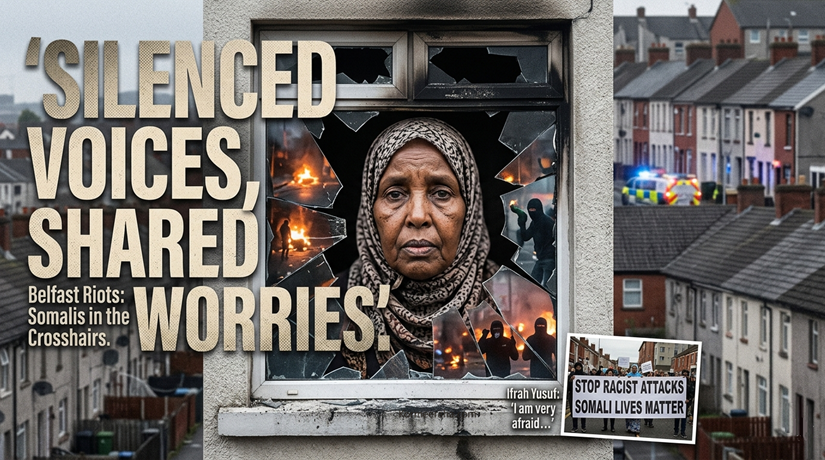
Fleeing war and instability, they sought peace in Northern Ireland. Instead, they found themselves hunted in the streets, their homes set ablaze by a mob fueled by social media algorithms and xenophobic rage.
For the Somali diaspora, the journey to a new life is rarely a straight line. It is a path paved with the trauma of displacement, the perilous crossings of borders, and the desperate hope for a sanctuary where they can rebuild. But for the Somali community in Belfast, that hope was recently incinerated.
Over the past few weeks, the streets of Northern Ireland’s capital have been transformed into a battleground of racist violence. Masked mobs, armed with petrol bombs and fueled by a toxic cocktail of anti-immigrant sentiment and Islamophobia, have turned their fury on refugee families. At the receiving end of this hate are Somalis, who have found themselves the primary targets of a terrifying campaign of discrimination and physical assault—all sparked by a digital lie.
The Flames of Hate
The physical toll of the Belfast riots is written in the charred remains of homes and the shattered windows of minority-owned businesses. But the psychological scars run much deeper.
In a horrifying display of targeted violence, hostile groups have directly attacked residences occupied by Somali, Sudanese, and other refugee families. The mobs did not just protest; they hunted. Properties and vehicles were set on fire, transforming quiet residential streets into war zones.
The violence forced a frantic, terrifying displacement. Many Somali families were evacuated in the dead of night, their lives uprooted once again, this time by the very society they hoped would embrace them. They were shepherded to safety under the heavy protection of police and fire services, watching their makeshift sanctuaries go up in smoke.
The economic devastation has been equally ruthless. Somali business owners, many of whom have poured their life savings into local shops to serve the community, have watched their livelihoods targeted and destroyed by the rampaging mobs.
Weaponized Algorithms: The Anatomy of a Riot
How does a community become the target of such visceral, organized hate in a matter of days? The answer lies in the dark corners of the internet.
The violence erupted following a tragic knife attack in the city. In the chaotic immediate aftermath, police initially misidentified the suspect’s nationality, suggesting he was Somali. Though authorities quickly corrected the record—confirming the attacker was actually Hadi Alodid, a 30-year-old from Sudan—the correction was too late. The digital spark had already caught fire.
While mainstream media and official channels swiftly aligned with the facts, a shadow ecosystem of far-right instigators seized upon the initial mistake. Prominent anti-immigrant figures, most notably Tommy Robinson, alongside a network of far-right accounts, weaponized the error. Across X (formerly Twitter), TikTok, and Telegram, manipulated videos and fabricated narratives were pushed to millions of feeds, deliberately stoking anti-immigrant sentiment and Islamophobia.
Private Facebook pages, YouTube live streams, and dedicated local Telegram channels became the command centers for the riots. Organizers used these platforms to doxx Somali families, sharing their home addresses online and effectively painting targets on their doors. Even after the police definitively cleared the Somali community of any connection to the initial attack, these digital echo chambers ignored the truth, continuing to pump out venom and incite violence.
The UK’s media regulator, Ofcom, alongside government officials, has strongly condemned the attacks and is now monitoring the digital footprints of those spreading the inciting misinformation. Yet, for the families hiding behind locked doors, the regulatory response offers little immediate comfort.
Voices from the Ashes
Behind the statistics of burned homes and deployed police forces are the human beings living through a nightmare. The Somali and wider immigrant communities in Belfast are speaking out, their testimonies painting a grim picture of life at the receiving end of racist violence.
Ifrah Yusuf, a Somali woman who arrived in the country just last year seeking a fresh start, found her new life paralyzed by fear. After her home address was maliciously shared online by rioters, she was trapped inside.
“I have a fear inside me that I might be attacked because of the way I dress (hijab) or because of my appearance,” she told BBC News, her voice trembling with the trauma of the ordeal. The riots forced her to miss two days of work, a stark reminder of how quickly the right to safely exist and work in public can be stripped away by a mob.
The terror was not confined to the streets; it breached the walls of their homes. Twasul Mohammed, a Sudanese-born community activist in Belfast, recounted the harrowing moments when the violence peaked. She confirmed that numerous Somali, Sudanese, Syrian, and Eritrean families were forced to flee.
“Families locked themselves in bathrooms while petrol bombs were thrown at the houses,” Twasul revealed, describing the sheer panic of parents trying to shield their children from the sound of shattering glass and roaring flames. Those who managed to escape the inferno were evacuated to a local church, which opened its doors to offer desperate shelter.
Yet, amidst the overwhelming tide of discrimination and hate, there are glimmers of profound humanity. Zeinab, a mother whose family was directly victimized by the violence, spoke to Al Jazeera about their narrow escape. A women’s rights organization helped orchestrate their flight from the city, and they were ultimately taken in by an Irish family living outside Belfast.
Reflecting on the kindness of strangers during her darkest hour, Zeinab offered a poignant message of gratitude: “We feel that not all people hate foreigners; there are good people who share our concerns.”
A Community on High Alert
Today, the Somali community in Belfast remains in a state of hyper-vigilance. The trauma of being targeted for their race, religion, and immigrant status has cast a long, dark shadow over their daily lives. Parents, terrified for the safety of their children, are keeping them home from school. The vibrant, bustling minority-owned shops stand boarded up, silent monuments to the economic and social toll of the riots.
The events in Belfast serve as a chilling case study of modern racist violence. It demonstrates how a simple factual error, when amplified by far-right algorithms and xenophobic influencers, can be transformed into a lethal weapon against marginalized diaspora communities.
The Somali families of Belfast did not cross oceans and endure unimaginable hardships only to be burned out of their homes by the very people they sought to live among. As the ashes settle and the police maintain their heavy presence on the streets, the question remains: How can a community rebuild when the threat of hate is just one viral post away?
For now, they hold on to the kindness of allies like the Irish family who sheltered Zeinab, and they wait for the fires to die down, hoping that one day, the sanctuary they sought will finally feel like home.
