
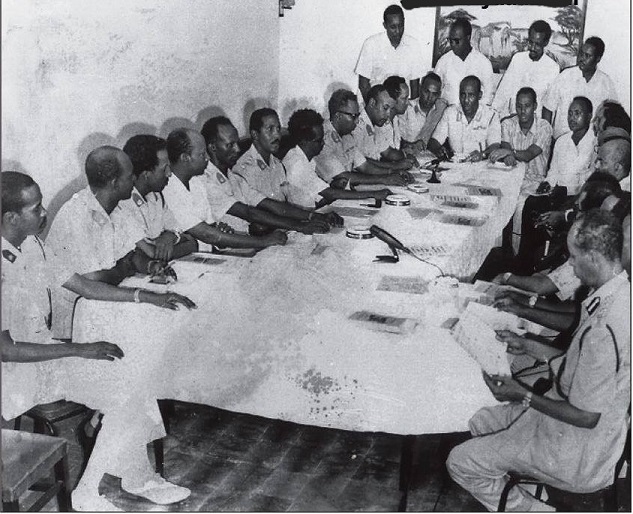
Today marks the anniversary of the October 21, 1969 revolution that brought the Somali military to power. It began as a bloodless coup, triggered by the assassination of Somalia’s first democratically elected president, Abdirashid Ali Sharmarke, on October 15, 1969.

President Sharmarke was elected in 1967 amid controversy, following a vote marred by fraud, corruption, and clan feuds. He survived one grenade attack on his life, but the second attempt proved fatal: he was shot at close range by a policeman from his own clan in Las Anod.
In the months after the coup, the new regime adopted a socialist system and allied itself with the Soviet Union. During its first seven years, the government focused on modernizing a country still trapped in a minimalist colonial economic system.
The state took control of the economy. Banks were nationalized, state-owned industries were established, and large cooperative farms were created. Programs to boost agricultural and fishing output were developed. With unprecedented political stability, the government launched ambitious projects.
The centerpiece was investment in human capital to transform Somali society. Through a Rural Development Campaign, young volunteer teachers, instructors, and nurses were sent en masse to remote areas to teach literacy, train herders and farmers, and support nomadic communities.
With the creation of a welfare state, education from primary school through university was made free. A dress code that discouraged displays of wealth was enforced in schools. Healthcare was also free, and health facilities staffed by Soviet-trained Somali practitioners were built in every major town.
The social revolution promoted gender equality. Women were encouraged to dream big and contribute beyond their traditional roles. This era saw the first high-ranking female officers in the army and police, as well as women doctors, pilots, scientists, and more.

Previously marginalized clans were rehabilitated and gained access to the same opportunities as the major clans that had dominated Somali political and economic life since independence.
The revolutionary regime also pursued secularization and Somalization of daily life, minimizing the influence of clerics and the clan system. It attempted to forge a unified national identity around a single dialect while promoting the cultural diversity of Somalia’s sub-regions.
However, the revolutionary system faced a severe test between 1974 and 1975, during the Dabadheer (“long-tail”) drought, which devastated a vast region from Togdheer to Galgadud. President Mohamed Siad Barre declared a state of emergency and redirected the entire social programs budget to drought relief.
By 1976, Somalia was at its peak. The Somali model of development attracted many admirers across Africa. Somalia was called upon to help African liberation movements from Eritrea to South Africa, and responded. Somali military instructors trained security forces in Mozambique, Burundi, and other nascent states.

Today, most Somali leaders of a certain generation were educated at state expense during those two decades. Easy access to government benefits continued until President Siad Barre was ousted on January 26, 1991, by disgruntled politicians backed by unruly clan militias.
President Hassan Sheikh Mohamud, who has often called Siad Barre a dictator, has nonetheless admitted that he himself—as a poor orphan child—benefited from the social programs of the revolution. Yet this admission has not prevented him and his increasingly unpopular entourage from pursuing a diametrically opposite path.
After decades of civil war that destroyed and divided the country, most young Somali adults either grew up in exile or have known only a chaotic Somalia, punctuated by the current foreign-influenced and unstable administration.
Given today’s challenges—fragile governance, clan divisions, and a lack of basic services—more Somalis than ever long for a government that puts people’s needs first. It is no surprise that many talk about what has been lost and dream of a new revolution to reset society. That is precisely why the 1969 revolution remains relevant: not as a model to be copied blindly, but as a reminder that rapid social transformation, investment in human capital, and national unity are achievable when political will exists.