
Once again, the dusty, sun-bleached streets of Mogadishu find themselves at the mercy of a familiar, exhausting political theater. As May 15, 2026—the date marking the official end of President Hassan Sheikh Mohamud’s four-year mandate—crossed the calendar, Somalia did not celebrate a democratic transition. Instead, the nation slipped quietly back into a zero-sum game of political brinkmanship, a grim reminder that in the upper echelons of Somali politics, compromise remains the rarest currency.
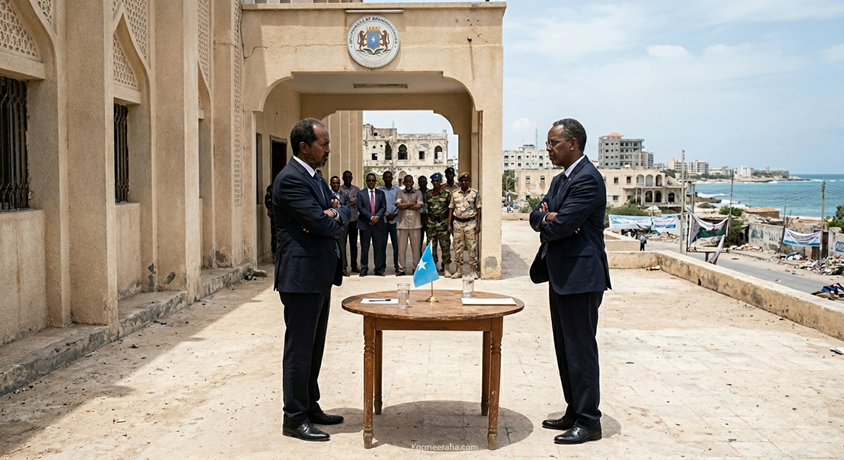
The collapse of the mid-May consultative summit in the capital was not a surprise; it was a symptom. On one side stands Villa Somalia, dug into a rigid vision of a centralized, direct “one person, one vote” electoral system. On the other sits a deeply entrenched coalition of opposition leaders—the Somali Future Council, flanked by powerful regional states like Puntland and Jubaland—who view the president’s democratic push as a thinly veiled power grab aimed at enforcing unilateral rule.
Neither side is willing to blink. And as usual, the international community has been left to clean up the shattered glass.
“The official four-year mandate has concluded. The country has officially entered a transitional phase, preventing any single faction from making unilateral decisions.”
— Joint consensus summary from Western diplomats at the Halane compound.
The Audacity of No Tanaasul (Concession)
To understand why Mogadishu’s elite cannot find common ground, one must examine how they weaponize their ideals. President Hassan Sheikh presents his “one person, one vote” model as the ultimate antidote to the country’s antiquated, clan-based 4.5 power-sharing formula. It sounds noble on paper. Yet, in practice, forcing a massive constitutional overhaul without the buy-in of major regional federal states is less about democracy and more about control.
The opposition, led by familiar heavyweights like Sharif Sheikh Ahmed, Hassan Ali Khaire, and Abdirahman Abdishakur, is no more accommodating. While they rightly point out the “constitutional vacuum” left after May 15, their demand for a purely “consensus-based” system often translates into a return to the backroom deals that favor entrenched elites.
When Alper Aktaş, the head of the Turkish Embassy, rushed to Villa Somalia on May 16 to plead for concessions, the opposition spent less time focusing on the substance of the meeting and more time publicly seething that the diplomat still referred to Hassan Sheikh as “President.” In Mogadishu, optics and titles frequently trump progress.
Global Enforcers and Distracted Benefactors
The tragedy of this inability to compromise is that it forces foreign allies to act as political babysitters. This May, it took a dual-front diplomatic intervention to keep the capital from sliding into outright civil conflict.
At the secure Halane compound, Western ambassadors from the US, UK, and the European Union had to draw a literal “red line” for Villa Somalia, warning that a unilateral election would not be recognized. Simultaneously, they had to coddle the opposition, recognizing a “transitional phase” just enough to convince them to call off potentially bloody street protests.
Meanwhile, Turkey has been forced to play the role of regional mediator, less out of altruism and more out of sheer economic panic. With multi-billion-dollar offshore oil drilling projects ready to launch near Galmudug, Ankara cannot afford a civil war. President Recep Tayyip Erdoğan has resorted to flying the entire Somali political class out of the country—summoning them to Ankara for face-to-face talks because they cannot be trusted to behave responsibly in their own capital.
The Cost of the Standoff
While politicians bicker over clauses and mandates in air-conditioned rooms, the consequences of their stubbornness bleed onto the streets.
On May 10, the Hiil Shacab (People’s Solidarity) protest saw ordinary citizens marching not just against the electoral delay, but against the local government’s aggressive campaign of forced evictions and land clearances in the Wadajir and Zoobe areas. Real bullets were met with stone-walled political indifference. At least one citizen died in the Daynile district, and several others were wounded.
The June Battleground
Following the collapse of the Halane talks, the opposition coalition has altered its strategy. Rather than risk immediate blockades, they have drawn up a structured blueprint for civic unrest starting in June 2026 to systematically force Villa Somalia into concessions before the Turkey summit.
| Date | Planned Type | Target & Strategy |
|---|---|---|
| June 4, 2026 | Mass Relaunch | Initial multi-site push led by Abdirahman Abdishakur Warsame to challenge term extensions. |
| Weekly (Post-June 4) | Recurring Demonstrations | Rolling protests targeting all districts of the Benadir region to exhaust state security responses. |
The ultimate flashpoint remains where these gatherings will physically occur. While the Banadir Regional Administration has restricted authorized rallies strictly to Engineer Yarisow Stadium to ensure public safety, the Somali Future Council has rejected this constraint. They have mapped out 22 distinct protest sites across the capital—including Daynile, Wadajir, and paths leading to the Daljirka Dahson (Unknown Soldier) Monument—explicitly to decentralize the government’s security response.
With Banadir Police Chief Mahdi Omar Mumin warning that unauthorized gatherings will be firmly shut down, the stage is set for a volatile summer. Somalia stands at a historic crossroads, with billions in potential oil wealth on its horizon and an ongoing war against Al-Shabaab that requires unified leadership. Yet its leaders remain trapped in an old loop: prioritizing personal survival over national stability, choosing the barricade over the roundtable, and proving, once again, that in Mogadishu, the hardest thing to build is a bridge.