
For decades, the blue of the Somali sky carried a deeper meaning than a mere horizon—it was the colour of a dream deferred. From the scorched plains of the north to the ancient coastal cities of the south, a people bound by language, faith, and an unyielding love of freedom waged a relentless war against the map-makers of Europe. Their weapons were not just rifles, but poetry, political savvy, and an almost spiritual belief in unity. This is the story of how a fractured land became a nation—and how July 1st came to be etched not just on calendars, but into the very heartbeat of Somali identity.
The Colonial Noose Tightens
In 1884, European colonialism unfurled a new and insidious chapter across Africa, with the Horn of Africa becoming a prime target for foreign powers hungry for territory and influence. The Somali people, historically a proud and independent pastoralist and trading society, soon found their ancestral lands carved up by Britain, Italy, and France. These colonisers did not come as friends; they came to extract, to divide, and to rule. But the Somali spirit was not so easily caged. As foreign warships appeared off the coast and treaties were signed in languages the locals did not speak, a fierce awareness spread among the clans: this was an invasion of sovereignty, and it would not go unanswered.
The First Thunder: Dervish Resistance and Southern Uprisings
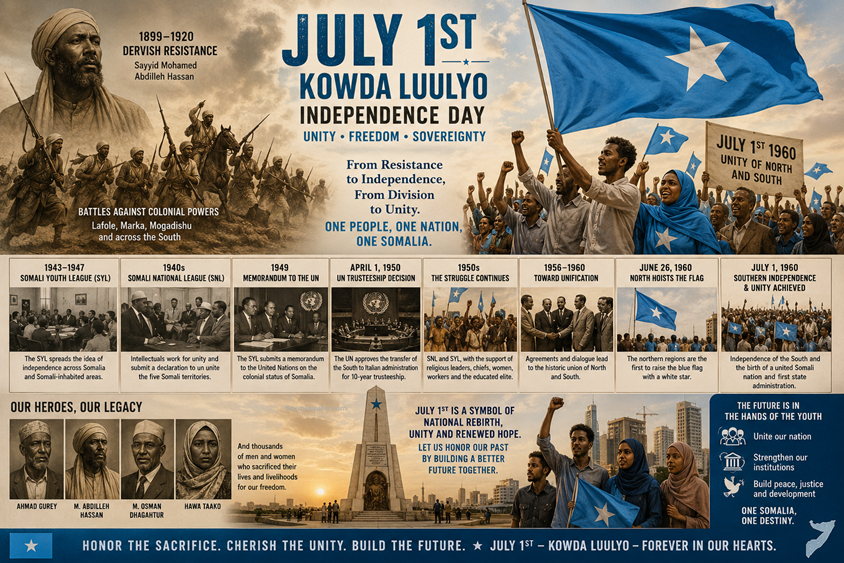
By 1899, the northern regions under British control became the stage for one of Africa’s most extraordinary anti-colonial revolts. Led by the magnetic Sayyid Mohamed Abdille Hassan—a Sufi mystic, poet, and warrior—the Dervish forces ignited a twenty-year war that would become the stuff of legend. The Sayyid’s poetic taunts and battlefield courage united clans that had long been divided, rallying them under a single banner of resistance.
Meanwhile, in the south, the Italian occupiers faced their own nightmares. In towns like Lafole, Marka, and Mogadishu, local fighters rose up, meeting the colonial armies with grit and gunfire. These early clashes were not mere skirmishes; they were the opening salvos of a liberation struggle that would span generations, planting the seeds of national consciousness in every corner of Somali soil.
The Political Awakening: 1941–1949
The end of World War II reshaped the global order—and with it, Somalia’s fate. Italy’s defeat handed control of both the northern and southern regions to the British, creating a temporary but crucial window for political organisation. It was in this fertile ground that modern Somali nationalism truly took root.
In 1943, a group of young visionaries formed the Somali Youth Club, which by 1947 had evolved into the formidable Somali Youth League (SYL). This was no mere social gathering; it was a political engine that would drive the independence movement forward. The SYL’s genius lay in its ability to transcend clan loyalties, spreading the message of unity and self-determination to Somalis everywhere—from the bustling streets of Mogadishu to the distant Somali communities in Kenya, Ethiopia, and Djibouti. At the same time, in the north, the Somali National League (SNL) was fighting the same fight, with its intellectuals railing against clan divisions and tirelessly advocating for the unification of all five Somali territories under a single national identity.
Taking the Case to the World
The Somali liberation movement was not fought only on the ground; it was also waged in the halls of international power. In 1949, following a formal memorandum submitted by Somali representatives to the United Nations laying bare the injustices of colonialism, the world took notice.
On April 1, 1950, the UN approved a compromise: rather than granting immediate independence, Italy would administer the southern regions under a UN trusteeship for ten years, after which they would gain full sovereignty. It was a bittersweet reality, as the north remained under British control. Worse still, Britain proved itself an unreliable custodian of Somali lands. They callously ceded the Hawd region to Ethiopia—a betrayal that burned deep in the Somali psyche—and later handed the Northern Frontier District (NFD) to Kenya, while the fate of French-occupied Djibouti was sealed with a pen stroke.
The Decade of Unity: 1950–1960
The 1950s became a decade of relentless political dialogue and grassroots mobilisation. The SNL and SYL, joined by an alliance of religious leaders, traditional chiefs, women’s groups, workers, and the newly educated elite, forged an unbreakable coalition. They understood that freedom could not be won by one clan or one region alone; it required a united front. Between 1956 and 1960, crucial agreements were hammered out, bridging the administrative gap between the south, which enjoyed its own local governance under the trusteeship, and the north, which operated under a supervised British administration. The pieces of the Somali puzzle were finally beginning to fit together.
Sacrifice and the Price of Freedom
None of this came without cost. The path to independence is paved with the bones of the brave. The legacy of the 16th-century conqueror Ahmed Gurey inspired later generations, standing in spiritual solidarity with modern heroes: the indomitable Sayyid Mohamed Abdille Hassan, the fiery Mohamed Osman Dhagahtur, and the fearless Hawa Taako. These men and women, and countless unnamed others, gave their lives and their livelihoods so that their children might breathe the air of a free Somalia. They fought not for personal glory, but to expel foreign powers that had come only to plunder the nation’s natural wealth and subjugate its people.
Two Dates, One Destiny: June 26 and July 1
On June 26, 1960, the northern regions became the first to hoist the blue flag with the white star—a moment of pure, unbridled joy as the State of Somaliland gained its independence. But the dream was only half complete. Just five days later, on July 1, the southern regions (the Trust Territory of Somaliland) finally gained their independence, and the two territories were united into a single Somali Republic. It was the birth of a nation, the formalisation of a centuries-old ideal, and the dawn of the first modern Somali state administration, and the promise of a Somali peninsula united under a single flag.
A Legacy Renewed, A Future Beckoning
For over three decades, the federal commemoration of July 1st faded into the shadows, neglected amid the chaos of revolution, state collapse, and civil war. But today, that flame has been rekindled. Historic monuments honouring the independence activists have been restored, and the annual celebrations have regained their former glory. Yet, the true significance of July 1st lies not in parades or flags, but in what it represents: the collective political will of every segment of Somali society, with the youth at the forefront, proving once again that they are the nation’s most powerful catalyst for change.
The Unfinished Business
As Somalia navigates the turbulent waters of the present, with slow development and the lingering scars of conflict, the lessons of July 1st are more urgent than ever. The ambitious goal of these commemorations is to reconnect a new generation with the heroes who came before them—to ensure that young Somalis and intellectuals not only remember the past but actively mobilise to unify the country, restore faith in institutions, and rebuild the trust that has been shattered. July 1st is not just a date on a calendar; it is a mirror reflecting what Somalis have achieved, and a compass pointing toward what they must still become.