
On June 17, the announcement of a peace agreement between Tehran and Washington sent Brent crude prices falling within a single day. Four weeks later, the memorandum had collapsed, bombardments resumed across West Asia, and the Strait of Hormuz was once again a flashpoint. By early July, African economies were absorbing oil price spikes and fertilizer shortages they had no role in creating.
This was not an isolated event. Over the past two decades, the continent has absorbed the economic aftershocks of major global disruptions: the 2008 food crisis, the Covid-19 pandemic, the war in Ukraine, and now the American-Israeli offensive against Iran. Earlier tremors—the 2009 financial contagion, the European debt crisis, the 2014 oil collapse, and the China slowdown—sent ripples through the same structural openings. What distinguishes recent crises is their rapid succession, leaving economies little time to recover between blows.
The speed of transmission is notable, but the deeper issue is structural. Africa’s vulnerability does not originate in distant conflicts; it is rooted in long-standing dependencies that these events merely activate. Each crisis has illuminated a different facet of the same underlying condition.
This analysis is offered as a contribution to the ongoing discussion among African policymakers. Reactive approaches have limits; a posture that anticipates disruptions rather than responding to them would serve the continent’s long-term stability.
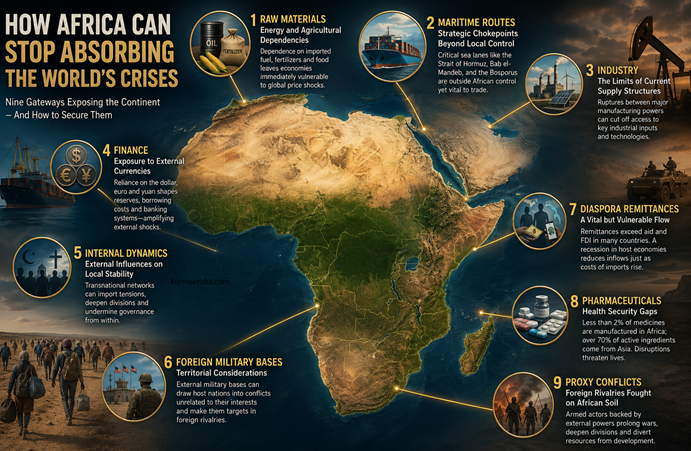
The next crisis is impossible to predict. It may stem from a geopolitical flashpoint, a currency fluctuation, a climate event, or an unforeseen conflict. Its origin matters less than the gateways through which it would reach African economies. Nine such gateways remain open today. Addressing them would not prevent global crises, but it would reduce the continent’s exposure to their consequences.
The Nine Gateways
1. Raw Materials – Energy and Agricultural Dependencies
Crises typically transmit first through energy markets, fertilizers, and food commodities. For net-importing nations, the impact is immediate. Even oil-producing countries without local refining capacity face constraints. Current fuel reserves across much of Africa cover approximately three weeks of consumption, compared to the international recommendation of three months.
2. Maritime Routes – Strategic Chokepoints Beyond Local Control
The Strait of Hormuz, Bab el-Mandeb, and the Bosphorus are contentious and critical passages for African trade, yet none are under African control. Around Bab el-Mandeb, the presence of foreign naval forces has effectively sidelined littoral states such as Djibouti and Somalia from decisions affecting their own waters, even as those waters absorb the security risks and military traffic generated by external powers. Shipping line suspensions or rising insurance premiums can quickly destabilize supply chains and logistics networks.
3. Industry – The Limits of Current Supply Structures
A major geopolitical rupture between major manufacturing powers could disrupt access to telecommunications equipment, solar technology, and construction materials. Diversifying strategic supply sources requires years of planning and investment—time that is better spent before a crisis occurs.
4. Finance – Exposure to External Currencies
The dollar, euro, and yuan shape African foreign exchange reserves, sovereign borrowing costs, and banking operations. This monetary dependence acts as an amplifying mechanism, deepening the impact of shocks arriving through other gateways.
5. Internal Dynamics – External Influences on Local Stability
Transnational political and religious networks can carry external tensions into domestic contexts, amplifying social divisions and weakening governance from within. Regional instability in the Sahel, the Horn of Africa, and around Lake Chad often has roots that extend beyond national borders. Understanding these influence networks is essential for effective conflict prevention.
6. Foreign Military Bases – Territorial Considerations
Military installations operated by external powers—French, American, Chinese, Turkish, and others—are present across the continent under security cooperation frameworks. However, such bases can draw host nations into conflicts unrelated to their own interests, as seen when regional states hosting foreign installations faced retaliatory threats during recent Middle East tensions.
7. Diaspora Remittances – A Vital but Vulnerable Flow
In several African countries, remittances from diaspora communities exceed both official development assistance and foreign direct investment. A recession in host economies would reduce these inflows precisely when imported food and energy costs are rising—a double pressure on household budgets.
8. Pharmaceuticals – Health Security Gaps
Less than 2% of medicines consumed in Africa are manufactured on the continent, while over 70% of active pharmaceutical ingredients are sourced from Asia. Unlike energy, essential medicines such as insulin, antiretrovirals, and antimalarials cannot be rationed without severe human consequences. The use of medical supply disruptions as political tools, as observed in Côte d’Ivoire in 2011–2012, illustrates the stakes involved.
9. Proxy Conflicts – Foreign Rivalries Fought on African Soil
State and non-state actors backed by external powers have prolonged armed conflicts across the continent, deepening ethnic divisions, weakening central governments, and diverting resources from essential services. When foreign rivalries are pursued through local armed proxies, African populations bear the human and economic costs of wars they did not initiate.
Securing the Gateways – The Time to Act Is Now
Markets can shift rapidly. The June announcement of a potential peace agreement caused Brent crude prices to fall within a day; a month later, the reversal was equally swift. Such volatility suggests that relying on external stabilization is inherently uncertain.
Among the visible consequences of these open gateways is the steady flow of emigration. Food price spikes, collapsed remittances, foreign-backed conflicts, and climate-driven pressures send millions toward dangerous routes across the Sahara and the Mediterranean. These same structural exposures drain the continent of skilled professionals, doctors, engineers, and entrepreneurs. When such individuals leave, Africa loses not only present capacity but future innovators. Emigration on this scale is often a rational response to conditions that remain beyond local control.
What makes these nine gateways particularly challenging is their interconnectedness. A supply shock drives food prices higher, fueling social unrest, which external actors may exploit through influence networks or proxy forces, diverting budgets from healthcare and education, accelerating emigration. One crisis feeds another. The gateways do not operate in isolation; they amplify one another in a cycle that deepens with each external shock.
The relevant question is not the specific conflict in Iran, but how many of these nine gateways remain open in African economies today. Will the continent respond as fifty-four separate nations, each managing disruptions independently? Or will it develop collective mechanisms to reduce these exposures while relative calm still holds?
In a global system undergoing significant structural change, external shocks are not hypothetical—they are probable. The variable within Africa’s control is the degree of preparedness. Acting during periods of stability, rather than amid crisis, offers the most practical path toward reducing vulnerability. The opportunity to do so is available now.