
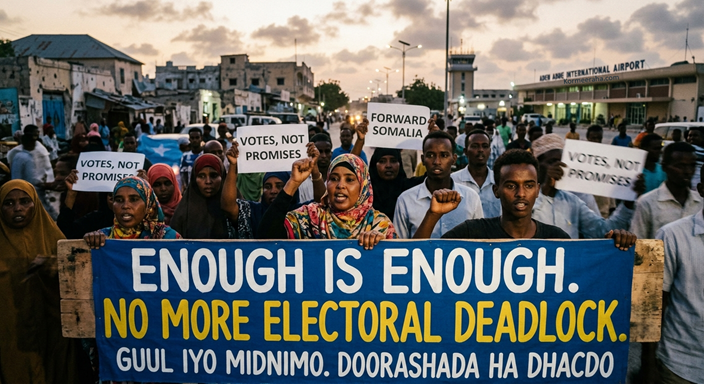
The longer Somalia’s federal election is held hostage by a minority of unruly politicians, the more precarious the nation’s future becomes. The Somali people have spoken clearly: enough with the election deadlock.
Citizens are exhausted by watching a handful of political actors drag the nation’s reputation through the mud. President Mohamed Abdullahi Mohamed “Farmajo” has repeatedly demonstrated to the international community that certain regional leaders are deliberately obstructing the electoral process. Said Deni and Ahmed Madobe are the most notable offenders.
These two regional leaders consistently sabotage attempts to convene with the president and other regional heads. If these disruptive actions do not expose their true intentions, it is difficult to see how proponents of endless consensus-building can still be persuaded.
Somalis are fed up with being held hostage by self-serving politicians. The country must proceed to elections as soon as possible. We can achieve this by utilizing the functional 4.5 power-sharing model and engage the regional states that are ready for the polls. We should also include elders to represent the Somaliland, Puntland, and Jubaland regions.
Furthermore, we cannot freeze time to accommodate the international community. Specifically, certain Western representatives seem less interested in assisting the country than in adding fuel to the fire. Somalis can no longer tolerate thinly veiled threats of sanctions against the federal government. These threats arise if the government proceeds with polls without Puntland and Jubaland, or if it requests a necessary extension of its mandate.
Certain diplomatic representatives from the United States, the European Union, Norway, Sweden, and the UK are, both directly and indirectly, fueling an illegitimate opposition. By entertaining their unrealistic demands, these actors inadvertently grant them a veneer of legitimacy, thereby stalling the democratic process.
Enough is enough.
The Somali government must focus its energy on what truly matters. That is the need to unite the country. It must improve security on the streets and in the regions and combat drought and poverty. It should not court an opposition whose only demands reverse the gains past governments made.
Moving forward, President Farmajo should prioritize engagement with principled international partners. This includes the African Union, the Arab League, Turkey, and China. These entities are interested in mutual respect and fair cooperation with Somalia. This is the only viable path forward, rather than stagnating in anticipation of a breakthrough that is simply not coming.
If these obstructive figures truly want elections, the country should commit to a “one person, one vote” system. This would place the ordinary Somali citizen in control of their own future, rather than surrendering their right to choose to corrupt political elites.
To achieve this, Parliament must step up to its responsibilities. It must grant the government a two-year extension so that necessary legislation can be passed, a national population census can be conducted, and the country can finally move forward.
The time for delays is over. Enough is enough.