

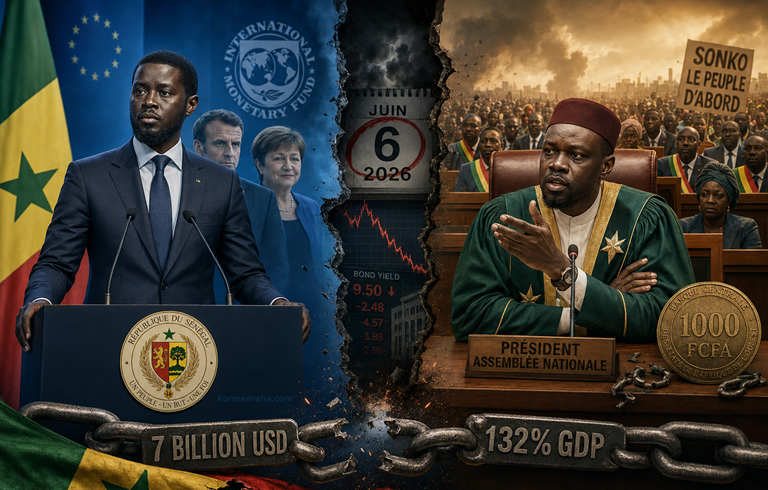
Less than two years after their revolutionary alliance brought down the old regime, Senegal’s two most powerful men—President Bassirou Diomaye Faye and Ousmane Sonko—are locked in a full-blown institutional crisis. What began as a friendship forged in prison and a shared vision for national sovereignty has collapsed into a bitter struggle for control, with the country now at a decisive crossroads.
How Sonko Propelled Faye to Power
In 2024, Ousmane Sonko was the undisputed leader of Senegal’s opposition and the charismatic head of the Pastef party. But legal convictions—widely seen as a political manoeuvre by the former regime—barred him from running for president. Sonko made a strategic choice: he anointed his “brother” and fellow former tax inspector, Bassirou Diomaye Faye, as his replacement. The campaign slogan said it all: “Diomaye is Sonko, Sonko is Diomaye.” In March 2024, Faye won the presidency with over 54% of the vote, carried by Sonko’s popularity.
From Duo to Duel
Once in power, Faye appointed Sonko as Prime Minister, formalizing a power‑sharing arrangement. But ideological cracks soon emerged. Sonko pushed for a rapid withdrawal of French troops, rejection of IMF intervention, and an end to the CFA franc. Faye took a more pragmatic approach: he kept diplomatic channels open with Paris, opened the door to IMF talks, and resisted a rushed rupture with France. These divergences escalated into a personal power struggle.
The breaking point came on May 22, 2026, when Faye dismissed Sonko as Prime Minister.
The Institutional Counter‑Strike
Sonko struck back immediately. Benefiting from Pastef’s super-majority (130 of 165 parliamentary seats), he was elected President of the National Assembly on May 26, 2026, with 132 out of 133 votes. He was sworn in on May 28. As the second‑highest official in the state, Sonko now controls the parliamentary agenda, oversees committees, and can launch inquiries—or even a motion of censure against the president.
A New Prime Minister and a Deadlocked Government
On May 25, 2026, Faye appointed Ahmadou Al Aminou Lô, a 60‑year‑old technocrat and former BCEAO official, as Prime Minister. Lô is an economist, not a Pastef loyalist. Sonko publicly congratulated him but pointedly refused to grant him “legitimacy” from the party.
The government formation has since stalled. Pastef has laid out preconditions for joining any new executive: adherence to the party’s 2024 program, debt transparency, and stronger anti‑corruption measures. Without these guarantees, Sonko’s parliamentary majority will not cooperate—raising the spectre of political paralysis.
The $7 Billion Debt and IMF Influence
A central point of contention is Senegal’s mounting public debt. An official audit revealed approximately $7 billion (4,500 billion FCFA) in hidden debt accumulated between 2019 and 2024, pushing the country’s total debt to an estimated $132 billion. The revelations triggered widespread concern and strained relations with the International Monetary Fund (IMF), which suspended part of its financial program, citing a lack of transparency.
As Prime Minister, Ousmane Sonko strongly opposed any IMF-led restructuring, arguing that Senegal could manage its economic challenges independently. President Bassirou Diomaye Faye, however, has signalled a greater willingness to negotiate with international lenders. Following Sonko’s dismissal, the government announced that talks with the IMF would resume during the week of June 8, 2026 — a move widely seen as a major policy reversal.
Macron’s Shadow
The rift has also reshaped Senegal–France relations. Faye has closed French military bases (July 2025) but refused Sonko’s demand for a total, immediate rupture. He met Emmanuel Macron in Paris in August 2025, and in April 2026 reportedly gave further “guarantees” to maintain strong ties. Sonko, by contrast, has been a fierce critic of French influence, once rebuking Macron for claiming that France brought freedom to Africa. Many analysts now ask: did Macron play a role in Sonko’s downfall?
Market Jitters and a Constitutional Deadline
The turmoil has spooked investors. Senegal’s foreign‑currency bonds dropped by up to 5.7 cents on the euro and nearly 4 cents on the dollar following the government’s dismissal.
An even more urgent threat looms: June 6, 2026, marks the end of the National Assembly’s constitutional immunity period. At that point, the president can legally dissolve parliament. Faye could use this power to break the deadlock—triggering early elections and sidelining Sonko’s legislative fortress.
Conclusion: A Decisive Week Ahead
The Senegal situation has evolved from a political rift into a full‑fledged institutional crisis. The country is now at a crossroads, with the possibility of either tense cohabitation or outright political paralysis. The confluence of the government formation deadlock, the approaching June 6 constitutional deadline, and the resumption of IMF negotiations under a new economic team suggests that the coming week is likely to be decisive for Senegal’s political and economic trajectory. The actions of both President Faye and Speaker Sonko in the next few days will determine whether the nation can navigate this storm or slide deeper into crisis.
