
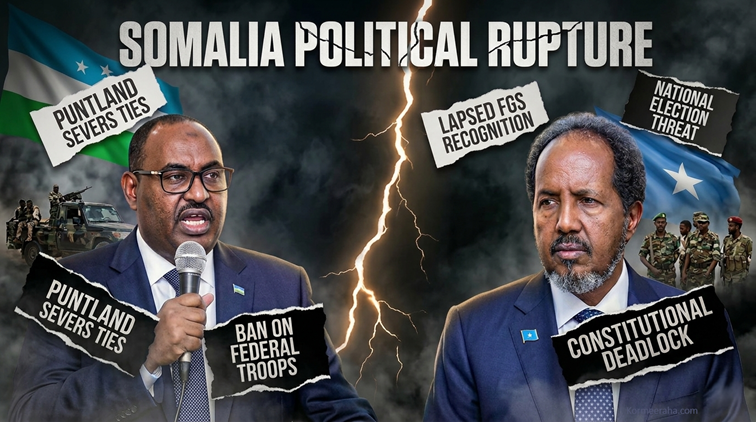
The relationship between the Puntland Administration and the Federal Government of Somalia (FGS) has reached its most perilous inflection point in the country’s post-civil war history. What was once a fragile political partnership has curdled into a deep-seated, multidimensional conflict that now threatens every sector of the Somali state—and, more alarmingly, could unravel into open military confrontation.
At its core, the dispute stems from a bitter “old buddies” disagreement between President Hassan Sheikh Mohamud and Puntland leader Said Abdullahi Deni. Yet, this personal vendetta has metastasized into existential battles over constitutional legitimacy, electoral integrity, and the equitable distribution of national resources. With Puntland formally isolating itself from the central government, the federal project—already beleaguered by insecurity—now faces its most severe internal rupture since its inception.
The Point of No Return: A Relationship Collapses
The partnership between Garowe and Mogadishu has effectively entered a state of clinical death. The current dynamic is not merely tense; it is functionally non-existent, with both administrations treating each other as hostile entities rather than partners in a unified federation. The depth of this schism is underscored by several dramatic official escalations witnessed in June 2026.
Puntland has formally rescinded its recognition of the FGS, arguing that President Hassan Sheikh’s mandate expired the moment a consensual electoral agreement was abandoned; in Garowe’s view, Mogadishu is now operating as a “term-expired” administration devoid of democratic legitimacy. In tandem with this political repudiation, President Deni has declared that Puntland will henceforth manage its own revenue streams, natural resources, and international cooperation agreements unilaterally—treating Mogadishu as irrelevant to its domestic affairs until a mutually agreeable administration is established.
Perhaps the most definitive act of defiance has been Puntland’s effective closure of its territorial borders to federal forces, prohibiting any troops taking orders from Mogadishu from operating, garrisoning, or even transiting through its jurisdiction. Meanwhile, Puntland is no longer isolated; it has successfully forged a powerful opposition bloc by aligning with Jubaland and key Mogadishu-based politicians under the “Somali Future Council” banner, creating a formidable counterweight to federal authority.
While this marks at least the fifth time Puntland has officially announced it is cutting ties with Mogadishu, the current rupture is qualitatively different. This is no longer a tactical standoff or a political bargaining chip. The relationship has transcended ordinary disagreement to reach a complete and legally consequential separation, with each side viewing the other’s institutions as fundamentally illegitimate.
The Personal Vendetta: When Politics Becomes Grudge
To understand the institutional collapse, one must examine the toxic personal chemistry between the two principals. The rift between President Said Abdullahi Deni and President Hassan Sheikh Mohamud has evolved from political rivalry into visceral enmity, poisoning every avenue of dialogue. The specific factors that have soured their relationship reveal a deep well of betrayal that goes far beyond policy differences.
Political insiders report that Deni feels profoundly double-crossed. During the 2022 presidential election in Mogadishu, Deni threw his considerable weight behind Hassan Sheikh to defeat the incumbent, Mohamed Abdullahi Farmaajo, expecting in return a seat at the table and meaningful influence over national policy. Instead, he claims he was summarily sidelined the moment the victory was secured.
This sense of betrayal has since curdled into scorched-earth rhetoric; Deni has abandoned diplomatic niceties, publicly branding Hassan Sheikh as “the man destroying the country,” and leveling explosive accusations that the FGS is actively facilitating pirate networks and reverting to the authoritarian playbook of Somalia’s former military regime to consolidate power.
Beyond the personal insults, there is a profound philosophical divergence: Deni openly accuses his former ally of harboring hegemonic ambitions, asserting that Hassan Sheikh’s ultimate goal is to “rule the country alone” and render the federal constitution a mere scrap of paper.
This perception of centralized tyranny is the ideological fuel driving Puntland’s defiance. Desperate last-ditch mediation efforts by elder statesmen, including former Presidents Sharif Sheikh Ahmed and Mohamed Abdullahi Farmaajo, have collapsed entirely, with reports indicating that Hassan Sheikh’s reluctance to even acknowledge or reciprocate these peace overtures has convinced Deni that dialogue is a dead end.
This personal animus has effectively dismantled the last vestiges of formal cooperation, reducing state-to-state relations to a bitter zero-sum game where each leader’s primary objective appears to be undermining the other.
The Military Red Line: Blockading Federal Forces
On June 18, 2026, Puntland crossed a significant military Rubicon. The administration issued a sweeping decree banning all federal military forces and vehicles from its territory—a direct challenge to Mogadishu’s sovereignty and a clear signal that Garowe is prepared to defend its autonomy by force if necessary. The decision, ratified by the Puntland Council of Ministers, carries three critical and interlocking components.
First, Puntland has officially disavowed its membership in the Somali National Army, stating it will not recognize a unified military command until a comprehensive, federally agreed-upon security architecture is negotiated—effectively splitting the national defense apparatus.
Second, all Puntland security and judicial agencies have been placed on high alert, ordered to physically block, intercept, and legally prosecute any federal military convoys or personnel attempting to enter or traverse Puntland’s domain, transforming the decree from a political statement into an actionable enforcement regime.
Third, the move was precipitated by intelligence reports indicating that Mogadishu was planning to reactivate military units in the region and redeploy former Puntland soldiers who had defected to the central government. Garowe views this as a calculated act of military encroachment and a provocation designed to destabilize its internal security, justifying the blockade as a defensive necessity.
The Architect of Opposition: Deni’s Grand Coalition
President Deni has not merely retreated to his regional bastion; he has emerged as the de facto leader of a national opposition movement, extending his strategy far beyond Puntland’s borders to re-engineer Somalia’s political landscape from the ground up.
Deni was the primary architect behind the “Somali Future Council,” a new umbrella coalition that successfully united Puntland, Jubaland, and prominent anti-Hassan Sheikh politicians in Mogadishu, and the Council has already released an alternative electoral roadmap directly challenging Mogadishu’s legitimacy.
In a decisive move, Deni spearheaded the opposition’s May 15 ultimatum, declaring that it would no longer recognize federal legislation passed after the FGS’s mandated term expired, effectively labeling the current administration a caretaker government with no authority to enact new laws.
Beyond this procedural challenge, he has become the loudest voice against the FGS’s controversial constitutional amendments, framing them not as reforms but as a unilateral power-grab designed to dilute regional autonomy and concentrate authority in the presidency.
Deni’s crowning political achievement, however, has been to peel Jubaland’s Ahmed Madoobe away from the federal alliance, creating a cohesive southern-northern axis of resistance. Together, Puntland and Jubaland now represent a formidable territorial and political bloc that Mogadishu cannot easily ignore or coerce.
“This is no longer a tactical standoff or a political bargaining chip. The relationship has reached a complete and legally consequential separation, with each side viewing the other’s institutions as fundamentally illegitimate.”
Electoral Apocalypse: The Paralysis of Democracy
Perhaps the most immediate and damaging consequence of this feud is the complete paralysis of Somalia’s national electoral timeline. The promise of a historic “one person, one vote” transition has been replaced by a constitutional and logistical nightmare, threatening to fragment the country into parallel political universes.
The FGS insists on proceeding with direct universal suffrage, but without Puntland and Jubaland’s participation—which constitutes nearly half the country’s territory and population—such a vote is geographically incomplete and politically invalid. International observers have already noted the impossibility of a nationally accepted outcome under these conditions.
In direct opposition, on June 20, 2026, the opposition’s Somali Future Council unveiled its own electoral model—a hybrid system combining direct popular participation with the traditional 4.5 clan power-sharing formula, explicitly excluding the political parties backed by Mogadishu.
The opposition is also demanding the dissolution of the FGS-appointed electoral commission and the creation of a joint, neutral body overseen by both the federal government and member states, a precondition Mogadishu has so far rejected.
Meanwhile, Puntland has already ratified its own legislation for regional parliamentary elections; if the deadlock persists, Somalia could witness two simultaneous, mutually exclusive electoral processes—one in Mogadishu and allied states, and another in the defiant southern and northern territories—a scenario that would de facto partition the country’s political system.
The electoral deadlock has already sparked localized armed violence, with Mogadishu witnessing clashes as recently as this month. In March, federal forces and allied clan militias deposed the Southwest State leadership following its public break with President Hassan Sheikh over the election timeline. Exploiting the ensuing power vacuum, Al-Shabaab and ISIS have expanded their operational reach and launched increasingly brazen attacks, capitalizing on a political class too fractured and distracted to mount a coherent response.
The Geopolitical Powder Keg
All of this internal disintegration is occurring against a volatile regional backdrop. From the civil wars in Sudan to the simmering tensions in the Red Sea and the Gulf of Aden, the Horn of Africa is a theater of intensifying great-power competition and proxy influence.
The Somali autonomous regions—stretching from the self-declared Republic of Somaliland in the north to Jubaland in the south—are increasingly becoming playgrounds for foreign meddling. External actors are selectively backing various factions, exacerbating existing fault lines and providing financial and military resources that make a unified Somali state increasingly elusive.
This external interference not only emboldens regional leaders like Deni to defy Mogadishu but also raises the stakes of the current standoff, turning a domestic crisis into a potential flashpoint for broader regional instability.
Conclusion: A Crossroads Without a Compass
The dispute between Puntland and the Federal Government has metamorphosed into one of the most perilous crises facing the Somali nation since its arduous reconstruction began. It infiltrates every critical sector—security, fiscal stability, constitutional order, and national cohesion.
With both sides deeply entrenched and personal animosities poisoning the well of reason, a consensual solution appears increasingly distant. The mediation efforts of elders and international partners have yielded no traction, as both leaders appear to calculate that compromise is a political liability.
If this trajectory continues unabated, Somalia faces one of two grim futures: either the nation will split further into competing, rival systems of governance, rendering the federal project obsolete; or the simmering tensions will escalate into severe political—and potentially military—confrontation that sets the country back decades.
The path forward requires an urgent, internationally-backed mediated dialogue that prioritizes the nation’s broader strategic interests and the desperate welfare of the Somali people over the egos of its leaders. However, given the depth of the personal betrayal and the complexity of the geopolitical entanglements, finding a mediator trusted by both sides remains the most formidable challenge of all.