
In Mogadishu’s fortified Green Zone, an illusion prevails: that dialogue can halt Somalia’s slide toward collapse.
It is mid-July 2026. President Hassan Sheikh Mohamud’s mandate expired in May, yet he remains in Villa Somalia. The Turkish-mediated talks, now in their second round, project an aura of progress. But the clock is frozen only behind the blast walls.
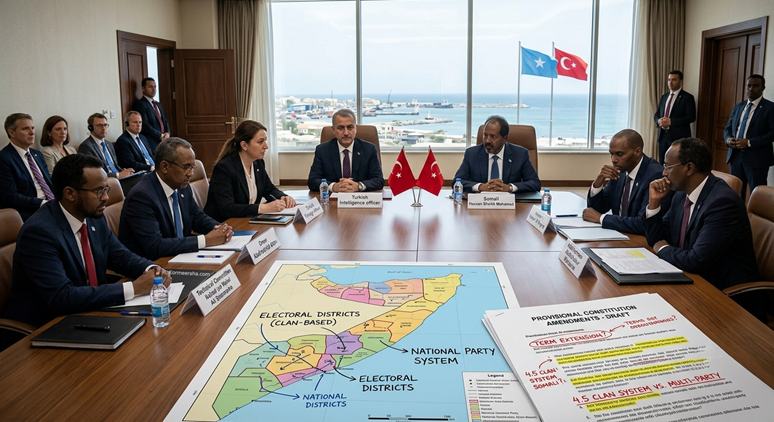
The backstory matters. In May 2026, US- and UK-facilitated negotiations at the Halane base collapsed. Ankara moved swiftly to fill the void. By July 7–8, a new round opened in Mogadishu—this time led by Turkey’s National Intelligence Organization (MİT), with Western diplomats, the EU, and the UN as observers.
But this is the mirage: that Ankara’s intervention can forge a stable, democratic Somalia. The mediation is not a neutral peace process. It is a geopolitical gambit, designed to freeze the clock while Villa Somalia consolidates power under the cover of “inclusive dialogue.”
Beneath the diplomatic chatter lies a zero-sum battle over the very architecture of the Somali state. And that is precisely why Turkish mediation is unlikely to deliver the breakthrough its architects promise.
Ankara’s Pragmatic Patronage: The Irony of History
To understand Ankara’s role in Mogadishu, one must first discard the notion of Turkey as a disinterested referee. Historically, Turkey’s foreign policy in Somalia has been fiercely pragmatic: it backs whoever sits in the presidential palace of Villa Somalia. This unwritten rule has made Ankara a perennial target for the opposition, a reality that has come full circle in the most ironic of ways.
Just six years ago, in 2021, it was Hassan Sheikh Mohamud—now the incumbent whose term quietly expired two months ago—standing in the opposition. Back then, he fiercely accused Turkey of arming the National Army to prop up the sitting president, Mohamed Abdullahi Farmajo.
Today, the script has completely flipped. Hassan Sheikh is the incumbent relying on Turkish security umbrellas, while Farmajo is the opposition leader. The suspicion from the current opposition isn’t born of anti-Turkish sentiment, but of a cold political reality: Ankara’s primary interest is the survival and stability of the federal government it has spent a decade building.
Carrots Over Sticks: Turkey’s Unique Diplomatic Leverage
Yet, despite this inherent structural bias toward the state apparatus, Turkey remains uniquely positioned in the Somali political psyche. Unlike the United Arab Emirates, which is widely perceived by Somalis as meddling and funding specific regional factions, Ankara is trusted by the wider population and most political stakeholders.
Turks are seen as generous builders, funding visible, life-changing infrastructure projects, and are even credited with making genuine, albeit unsuccessful, attempts to broker a historic settlement between the breakaway region of Somaliland and Mogadishu.
Furthermore, for the Federal Government of Somalia (FGS), Turkey is the ultimate diplomatic safe haven. Unlike the UN, EU, UK, and US—who during a similar political standoff in 2022 threatened Mogadishu with crippling sanctions to force a specific political roadmap—Ankara has never imposed a political line under the threat of punitive measures.
Turkey offers carrots, not sticks. But this deep, transactional trust is exactly what makes the current MİT-led mediation track so controversial to the opposition, who see the incumbent’s most powerful patron operating in the shadows.
The Traditionalists: Mustaqbal’s Defensive Crouch
To understand the deadlock, one must discard the illusion of a unified “opposition.” The anti-government camp is a fractured landscape of competing fiefdoms, which the FGS has masterfully exploited.
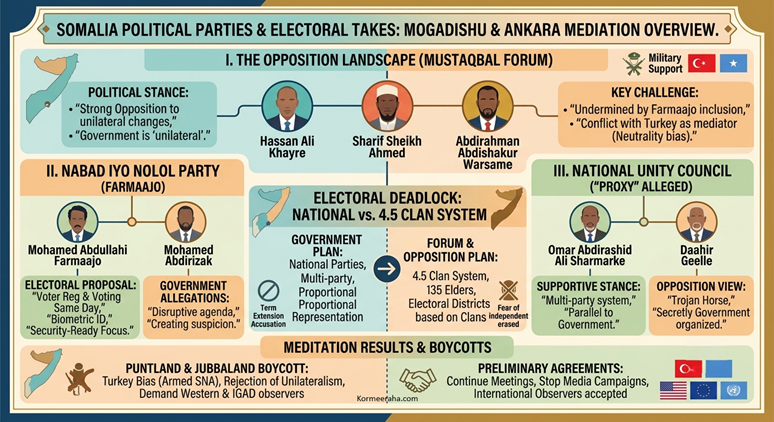
At the table sits the Golaha Mustaqbal (Somali Future Council), the traditionalist powerhouse led by former Prime Minister Hassan Ali Khayre and former President Sharif Sheikh Ahmed. They are the old guard—the ultimate gatekeepers of a moribund representation system.
While they pay lip service to the holy grail of “one-person, one-vote” (1p1v) democracy, their true objective is defensive. They want to lock the electoral system into the 4.5 clan-power-sharing formula, ensuring that the 135 traditional elders remain the ultimate kingmakers.
For Mustaqbal, decentralization isn’t about modern democracy; it’s about preserving their elite veto power against a rising, issue-based political class that could marginalize them in a purely popular vote.
The Disruptors: Farmajo’s Tactical Delay
Then there is the disruptive force of Nabad iyo Nolol, the party of former President Mohamed Abdullahi Farmajo. Operating from the shadows, Farmajo’s technical lead, former Foreign Minister Mohamed Abdirizak, has introduced a brilliant but practically impossible proposal: same-day biometric voter registration and voting.
Framed as an anti-corruption safeguard against state capture, it is analytically a tactical delay mechanism. In a country where the state cannot even guarantee security for a single polling station, demanding a flawless, nationwide biometric rollout in one day ensures the electoral timeline stalls indefinitely.
It is a masterclass in political obstructionism, allowing Farmajo’s camp to appear pro-democracy while practically guaranteeing that the current transitional government remains in a state of suspended animation.
The Trojan Horse: The Somali Unity Council
Finally, lurking at the edges of the negotiations, is the Golaha Midnimada (Somali Unity Council) led by former Prime Minister Omar Abdirashid Ali Sharmarke. Widely viewed by the rest of the opposition as a “manufactured” faction, the Unity Council endorses the FGS’s multi-party model.
They act as the regime’s useful opposition—a Trojan horse that provides Villa Somalia with a veneer of bipartisan consensus. By splintering the opposition’s narrative, this council effectively shatters the anti-government bargaining power, allowing the FGS to point to them and claim that national stakeholders support the shift toward a multi-party system, leaving the hardline traditionalists isolated.
The Electoral Trap: State Capture vs. Clan Entrenchment
Beneath the polite diplomatic chatter lies a vicious debate over the electoral model, which will dictate the distribution of state power for the next decade. The FGS is pushing for a proportional representation model based on national political parties. On paper, it is a modern vision. In reality, it is a mechanism for state capture, heavily favoring the incumbent by leveraging the state’s financial machinery to consolidate executive authority.
The opposition’s counter-demand—a 1p1v system strictly bound to clan quotas—is equally cynical, designed to institutionalize identity politics. Hovering over this is the specter of a “stealth term extension.” Because Hassan Sheikh’s term expired in May 2026, the opposition views the government’s unilateral constitutional amendments as a legalistic smokescreen to engineer a de facto extension into 2027. The opposition’s intransigence is driven by an existential fear: if they concede on the electoral model, they concede the presidency.
The Rebel Governors: Deni, Madoobe, and the UAE Axis
If the opposition in Mogadishu is fractured, the real veto power lies outside the capital, in the hands of Puntland’s President Said Deni and Jubbaland’s President Ahmed Madoobe. Both have categorically boycotted the Turkish mediation, turning a domestic dispute into a regional proxy war.
Deni and Madoobe are not just staying home; they are playing the geopolitical card. Leveraging their deep financial and security ties with the United Arab Emirates (UAE), the two presidents have aligned with the anti-Turkey regional axis.
Their strategic calculation is simple: delegitimize the mediator to weaken the incumbent. By highlighting Turkey’s security integration with the FGS, the rebel governors have successfully framed Ankara as a partisan actor, weaponizing their absence to stall any unilateral moves by Villa Somalia.
The Internationalization of the Crisis
The boycott by the rebel governors has forced the hand of Western powers. Washington and Brussels, wary of Ankara monopolizing Somalia’s political architecture, threw their weight behind the Puntland and Jubaland demand for a multilateral track.
The result is a significant diplomatic pivot for Turkey’s initial exclusive model. The MİT was forced to open the doors, allowing Western diplomats to sit at the table as observers. The mediation is no longer a purely Turkish fiefdom; it is an internationalized pressure cooker.
To the casual observer, the talks are a success: the parties have agreed to keep talking and de-escalate media rhetoric. But this quiet is an illusion of progress. The core issues remain entirely unresolved.
Conclusion: The Illusion of the Foreign Savior
The Ankara gambit may have successfully paused the clock and prevented an immediate explosion in Mogadishu. But in Somalia, a paused clock is not a fixed one.
The uncomfortable truth is that Turkish mediation—and indeed, any foreign endeavor, however well-intentioned or strategically brilliant—will not save Somalia. Outsiders can broker temporary truces, draft procedural roadmaps, and fund vital infrastructure, but they cannot manufacture the political will required to build a functional, unified state.
The ultimate failure lies squarely at the feet of Somalia’s own political elite. By continually inviting foreign patrons to arbitrate their domestic disputes, these leaders are sacrificing the nation’s sovereignty and the basic security and well-being of its citizens on the altar of personal power. They have effectively outsourced the future of their country to external actors, turning the Somali state into a geopolitical chessboard rather than a social contract.
Until these leaders look past their existential fears, abandon the politics of obstruction, and take genuine ownership of their country’s destiny, the soul of the Somali state will remain trapped in a labyrinth of its own making. No foreign patron can solve a crisis that the architects of the crisis refuse to resolve.